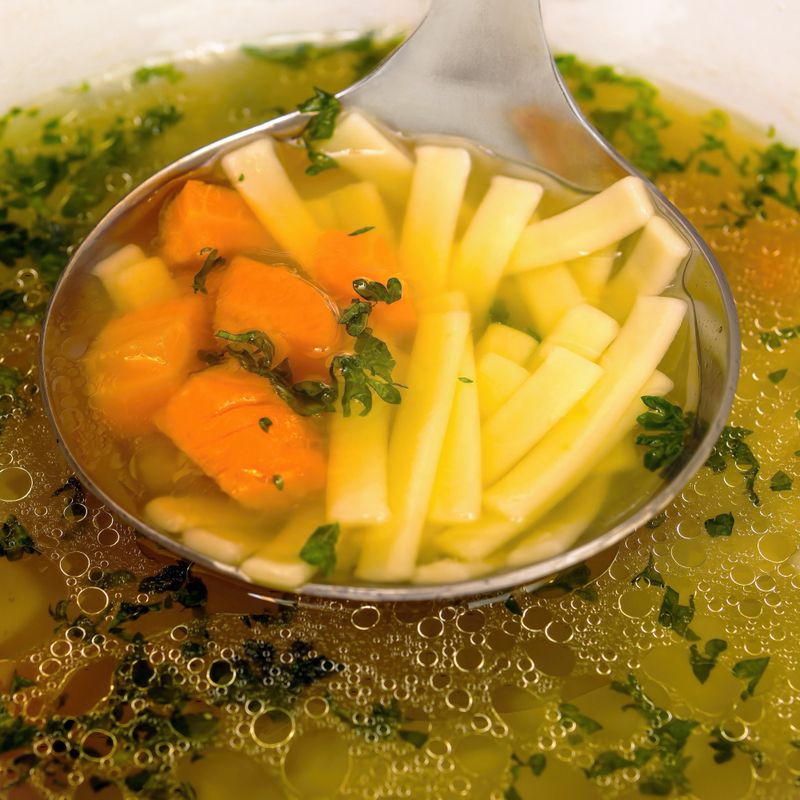
Slow Cooker Chicken Bone Broth
A rich, golden, gelatin-set chicken bone broth made hands-off in a 6-quart slow cooker. Roasting the bones first and adding a splash of apple cider vinegar gives deep flavor and a silky body.
- Prep
- 40 min
- Cook
- 1 days
- Wait
- 5 hr 30 min
- Total
- 1.3 days
- Makes
- About 2½ quarts (2.4 liters), 8 cups of 10 oz each
Steps
Before you start
- Use about 3 lb (1.36 kg) of raw or leftover roasted chicken bones: backs, necks, wings, carcasses and feet all work. Feet and wings give the most gelatin.
- Plan for 24 hours of slow cooking plus chilling time. Start in the morning so you can strain the broth the next day while you're awake.
- Use a 6-quart (5.7 L) slow cooker. Leave at least 1 inch (2.5 cm) of space below the rim.
- Raw poultry must reach 165°F (74°C). Have an instant-read thermometer ready, and wash hands, board and pan after handling raw bones.
- Skip salt while cooking. Season each cup when you serve it, so the broth stays flexible for other recipes.
Heat the ovenOven 425°F / 220°C
- Position a rack in the center and heat the oven to 425°F (220°C).
- Line a rimmed baking sheet with parchment if you like for easy cleanup.
+ Show details− Hide details
Ready when: Oven reaches 425°F (220°C)
Roast the bonesOven 425°F / 220°C
- Toss the chicken bones with the oil on the baking sheet and spread in a single layer with space between pieces.
- Roast at 425°F (220°C) for 35 to 40 minutes, flipping once halfway, until deep golden brown.
- Check the thickest piece with an instant-read thermometer touching meat but not bone: it must read at least 165°F (74°C).
- Skip roasting if using already-cooked carcasses.
+ Show details− Hide details
Ready when: Bones are deep golden brown and the thickest meaty piece reads at least 165°F (74°C)
Tip: Crowded bones steam instead of browning, so use two sheets if needed.
Add bones and vinegar
- Transfer the hot bones to the slow cooker.
- Pour the apple cider vinegar over them.
- Pour a few tablespoons of hot water onto the baking sheet, scrape up the browned bits, and add them to the cooker.
+ Show details− Hide details
Ready when: Browned bits are scraped off the pan and in the cooker
Tip: The browned bits on the pan are concentrated flavor, so don't leave them behind.
Add aromatics
- Add the carrots, celery, onion, garlic, bay leaves, peppercorns and parsley stems, if using.
- Pour in about 10 cups (2.4 L) cold water so everything is just covered, keeping the level at least 1 inch (2.5 cm) below the rim.
+ Show details− Hide details
Ready when: Ingredients are just submerged
Tip: Starting with cold water helps draw out proteins slowly for a clearer broth.
Rest in vinegar
- Let the covered cooker sit off for 30 minutes before turning it on.
- The acidity helps start extracting minerals and collagen from the bones.
+ Show details− Hide details
Ready when: 30 minutes have passed
Slow cook 24 hours
- Cover and cook on LOW for 24 hours.
- Do not stir.
- If foam gathers in the first 2 hours, skim it off with a spoon.
- If the liquid level drops below the bones after 12 hours, top up with hot water.
- After the first 3 hours, check that the broth is steaming and reads at least 165°F (74°C) on a thermometer.
+ Show details− Hide details
Ready when: Broth is deep golden, smells rich, and small bones crumble easily when pressed
Tip: Keep the heat on LOW. A hard boil makes the broth cloudy and greasy.
Strain the broth
- Turn off the cooker and let it sit 20 minutes.
- Set a fine-mesh strainer over a large heatproof bowl and ladle the broth through it.
- Discard the bones and vegetables, which are spent.
+ Show details− Hide details
Ready when: Broth is clear of solids and golden
Tip: Press the solids gently with a ladle. Don't force them through, or the broth clouds.
Chill and defat
- Cool the bowl on the counter for 30 minutes, then refrigerate uncovered until cold, about 4 hours or overnight.
- Lift off the solidified fat cap with a spoon.
- Save the fat for cooking if you like.
+ Show details− Hide details
Ready when: Broth is jiggly like soft gelatin and the fat layer is solid
Tip: A well-set jelly means plenty of collagen. If it stays liquid it's still delicious, just lighter.
Season and serve
- Reheat 1 cup (240 ml) broth in a saucepan over medium heat for 3 to 4 minutes until steaming and at least 165°F (74°C).
- Season with salt to taste and sip warm, or use it in soups and sauces.
+ Show details− Hide details
Ready when: Broth is steaming hot, melted smooth and reads 165°F (74°C)
Good to know
Tips
- Add chicken feet or wings for a more gelatinous broth.
- Never add salt until serving so you can use the broth in any dish.
- Freeze in ice cube trays or 1-cup portions for quick use.
- For a shorter cook, 12 hours on LOW still makes a good broth, though lighter in body.
Make ahead
The broth can be made up to 5 days ahead and kept in the fridge, or frozen for 6 months.
Storage & reheating
Refrigerate in airtight jars up to 5 days. Freeze in containers, leaving 1 inch (2.5 cm) of headspace, for up to 6 months. Thaw overnight in the fridge. Reheat gently on the stove until steaming hot (165°F/74°C). Don't leave broth at room temperature for more than 2 hours.
Substitutions
- apple cider vinegar → white wine vinegar or lemon juice. Use the same amount. Flavor will be slightly different.
- raw chicken bones (backs, necks, wings, feet or carcasses) → 2 leftover roasted chicken carcasses plus 1 lb wings. Skip roasting for already-cooked carcasses; roast the raw wings to 165°F (74°C).
- celery stalks → fennel stalks. Gives a slightly sweeter, anise-like note.
- fresh parsley stems → fresh thyme sprigs. Use 4 to 5 sprigs.
More broths
See all →
Find more like this
- Meal
- Lunch
- Main ingredient
- Chicken
- Method
- OvenStovetopSlow Cooker
- Quick & Easy
- EasyMake AheadFreezer Friendly