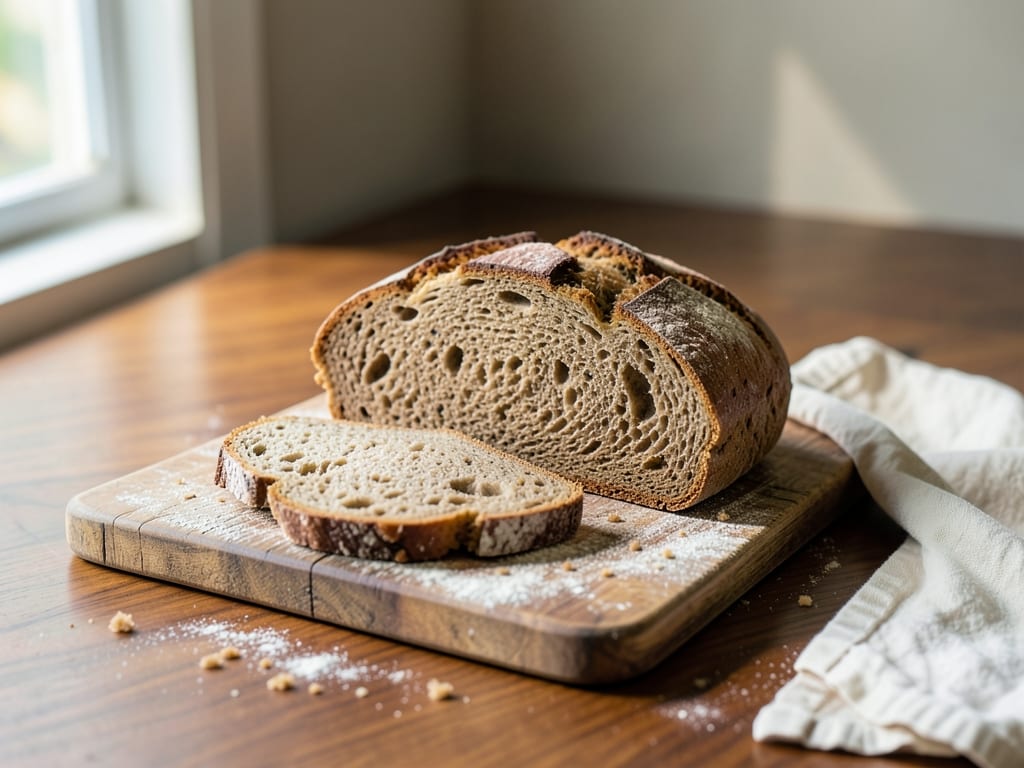
Vegan 100% Whole Wheat Sourdough Bread
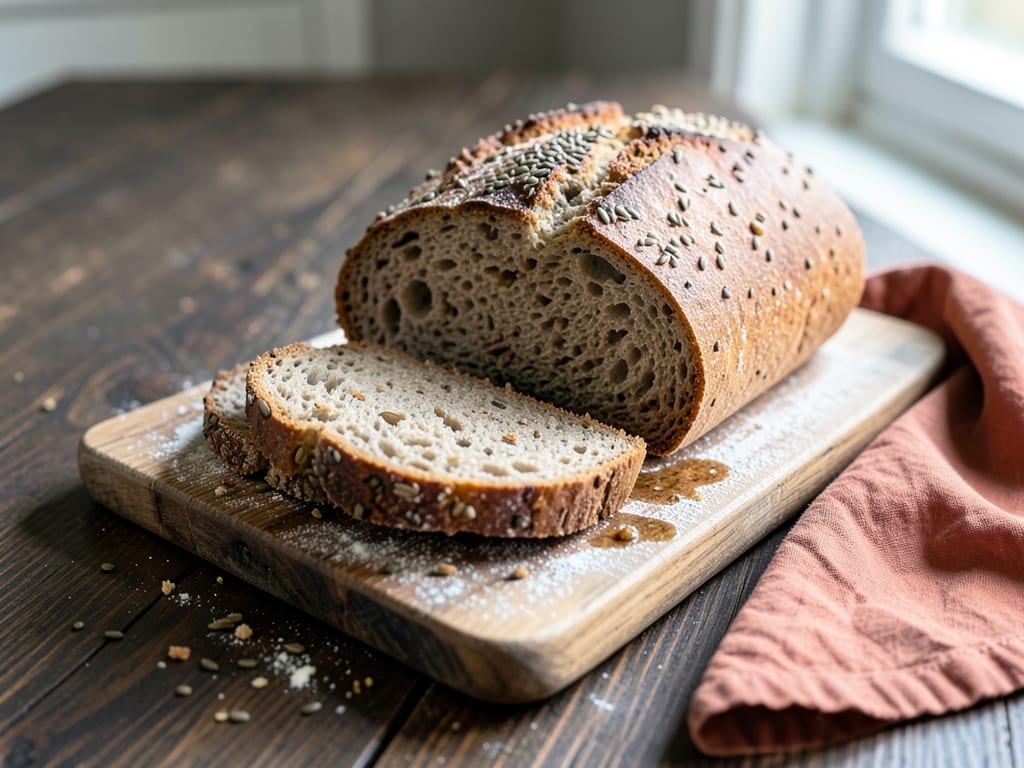
A hearty, nutty, fully whole wheat sourdough made with just four ingredients. It has a crisp crust, a tender, moist crumb and a gentle tang from a long cold proof. It's naturally vegan.
- Prep
- 43 min
- Cook
- 45 min
- Wait
- 18 hr 33 min
- Total
- 20 hr 1 min
- Makes
- 1 round loaf (about 10 slices)
Steps
Before you start
- Feed your starter 4–8 hours before mixing. Use it when it has doubled and is bubbly and domed. A spoonful should float in water.
- Plan the timeline: mix in the morning, shape in the afternoon, proof overnight in the fridge and bake the next morning. Total time is about 20 hours, with only about 45 minutes of hands-on work.
- Use a kitchen scale. Whole wheat flour varies a lot by cup, so the gram weights are the reliable measure.
- Your kitchen should be about 75–78°F (24–26°C) for the bulk rise. In a cooler kitchen, expect it to take up to 1–2 hours longer.
- Line a bowl or 9-inch (23 cm) banneton with a clean towel, ready to dust with rice flour.
Autolyse the flour
- In a large bowl, combine the 500 g whole wheat flour and 360 ml lukewarm water.
- Mix with wet hands or a spatula for about 1 minute until no dry flour remains and the dough looks shaggy.
- Cover the bowl and let it rest for 45 minutes so the bran softens.
+ Show details− Hide details
Ready when: No dry flour remains and the dough looks shaggy
Tip: Don't skip this rest. Whole wheat dough without it turns out dense and gritty.
Mix in starter and salt
- Spoon the 100 g starter on top of the dough and sprinkle with the salt.
- Wet your hand and pinch and squeeze the dough for about 3 minutes, folding it over itself, until the starter and salt are fully worked in and the dough feels cohesive.
- Cover and rest for 30 minutes.
+ Show details− Hide details
Ready when: No streaks of starter or pockets of salt remain, and the dough is tacky but holds together
Tip: Keep your hand wet. This dough is sticky and wet hands stop it clinging.
Stretch and fold
- Do 4 sets of stretch and folds, 30 minutes apart, with the dough covered in between.
- For each set, wet your hand, grab the edge of the dough, stretch it up until it resists, and fold it over the center.
- Turn the bowl a quarter turn and repeat.
- Do this 8 times per set (2 full rotations).
- Do the first set now, then the remaining 3 sets at 30-minute intervals.
+ Show details− Hide details
Ready when: By the fourth set the dough feels smoother, puffier and holds its shape more firmly
Tip: Whole wheat gluten tears easily. Stretch gently and stop when you feel resistance.
Finish bulk fermentation
- Cover the bowl and leave the dough at 75–78°F (24–26°C) for 1½ hours, or until it has grown by about 40–50%.
- Mark the starting level with a rubber band or tape on the bowl.
+ Show details− Hide details
Ready when: The dough has risen 40–50%, is domed with bubbles at the edges and jiggles when the bowl is shaken
Tip: Whole wheat over-ferments easily, so don't wait for it to double. Overproofed dough turns slack and sour.
Preshape the dough
- Lightly wet the counter (not floured) and use a bench scraper to scrape the dough out.
- Fold the edges to the center to form a loose round.
- Flip it seam-side down and drag it toward you on the counter to tighten it into a ball.
- Rest it uncovered for 20 minutes.
+ Show details− Hide details
Ready when: The dough holds a loose round and has relaxed slightly
Shape into the banneton
- Dust the banneton generously with the rice flour.
- Flip the dough over so the seam side faces up and fold the bottom third up, then the sides in, then roll it down from the top into a tight ball.
- Place it seam-side up in the banneton and pinch the seam to seal.
+ Show details− Hide details
Ready when: The surface is taut and the seam is pinched closed
Tip: If you skip the rice flour, use plenty of whole wheat flour or the dough will stick to the banneton.
Cold proof overnight
- Cover the banneton with a plastic bag or shower cap and refrigerate for 11–12 hours, or up to 14 hours total including the preheating step.
+ Show details− Hide details
Ready when: The dough is puffy and a floured finger poke springs back slowly, leaving a small dent
Tip: Cold dough is much easier to handle and score than dough at room temperature.
Preheat the Dutch ovenOven 475°F / 245°C
- Place the Dutch oven with its lid on a rack in the center of the oven and preheat to 475°F (245°C) for 45 minutes.
- The dough stays in the fridge during this time.
+ Show details− Hide details
Ready when: The oven has held 475°F (245°C) for at least 45 minutes
Tip: Use oven mitts. The pot and lid will be extremely hot.
Score and bake coveredOven 475°F / 245°C
- Cut a piece of parchment to fit the Dutch oven with handles for lifting.
- Turn the dough onto it, seam side down, then score the top with a razor blade, cutting a ½-inch (1 cm) deep slash.
- Lift the parchment into the hot pot, cover and bake at 475°F (245°C) for 20 minutes.
+ Show details− Hide details
Ready when: The loaf has risen noticeably and the score has opened
Tip: Work fast so the oven doesn't lose heat.
Uncover and finish bakingOven 450°F / 230°C
- Reduce the oven to 450°F (230°C).
- Remove the lid and bake for 23–25 more minutes until the crust is deep brown.
- Lift the loaf out with the parchment.
+ Show details− Hide details
Ready when: The crust is deep brown, the loaf sounds hollow when tapped on the bottom, and the center reads 205–210°F (96–99°C)
Tip: Whole wheat crust looks darker than white bread, so check the temperature rather than relying on color.
Cool completely
- Transfer the loaf to a wire rack and cool for at least 2 hours before slicing.
+ Show details− Hide details
Ready when: The loaf is fully cool to the touch, with no warmth at the center
Tip: Slicing too early makes the crumb gummy because it is still cooking inside.
Good to know
Tips
- Judge fermentation by the dough, not the clock. Whole wheat ferments faster than white flour and over-proofing is the most common problem.
- If the dough feels stiff, wet your hands. Resist adding flour, because whole wheat dough should be tacky.
- For a more sour loaf, extend the cold proof to 14–16 hours. For a milder one, keep it to 8–10 hours.
- If you don't have a Dutch oven, bake on a preheated baking stone with a pan of boiling water on the lower rack to make steam.
Make ahead
"Shape the loaf and refrigerate it for up to 14 hours total, then bake straight from the fridge. Baked loaves can be frozen sliced for up to 3 months."
Storage & reheating
"Room temperature: keep cut side down on a board or in a bread bag for up to 3 days. Fridge: not recommended, since it dries the bread out. Freezer: slice and freeze in an airtight bag for up to 3 months. Toast slices from frozen, or warm a whole loaf in a 350°F (175°C) oven for 10–15 minutes."
Substitutions
- whole wheat flour → Up to 100 g of the flour can be replaced with bread flour. This gives a lighter crumb and a slightly higher rise. Reduce the water by about 10 ml if the dough feels too wet.
- white rice flour → Whole wheat flour or cornmeal. Rice flour works best at preventing sticking, but any flour will do.
- fine sea salt → Kosher salt, 12 g (about 1 tablespoon of Diamond Crystal). Kosher salt crystals are larger, so use more by volume and weigh it for accuracy.
- active sourdough starter (100% hydration, fed with flour and water only) → A whole wheat starter. The starter's flour type isn't critical, but a whole wheat starter gives a nuttier flavor.
More sourdough
See all →

Find more like this
- Meal
- Breakfast
- Method
- Oven
- Quick & Easy
- 5 Ingredients or Less