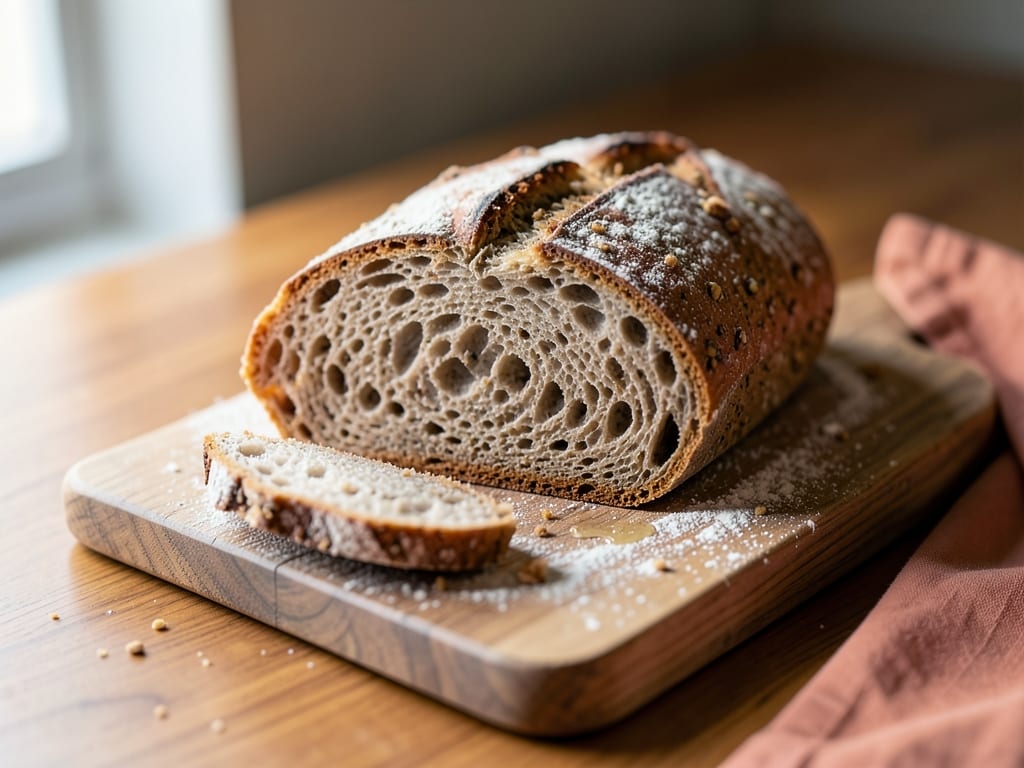
Sourdough Spelt Bread
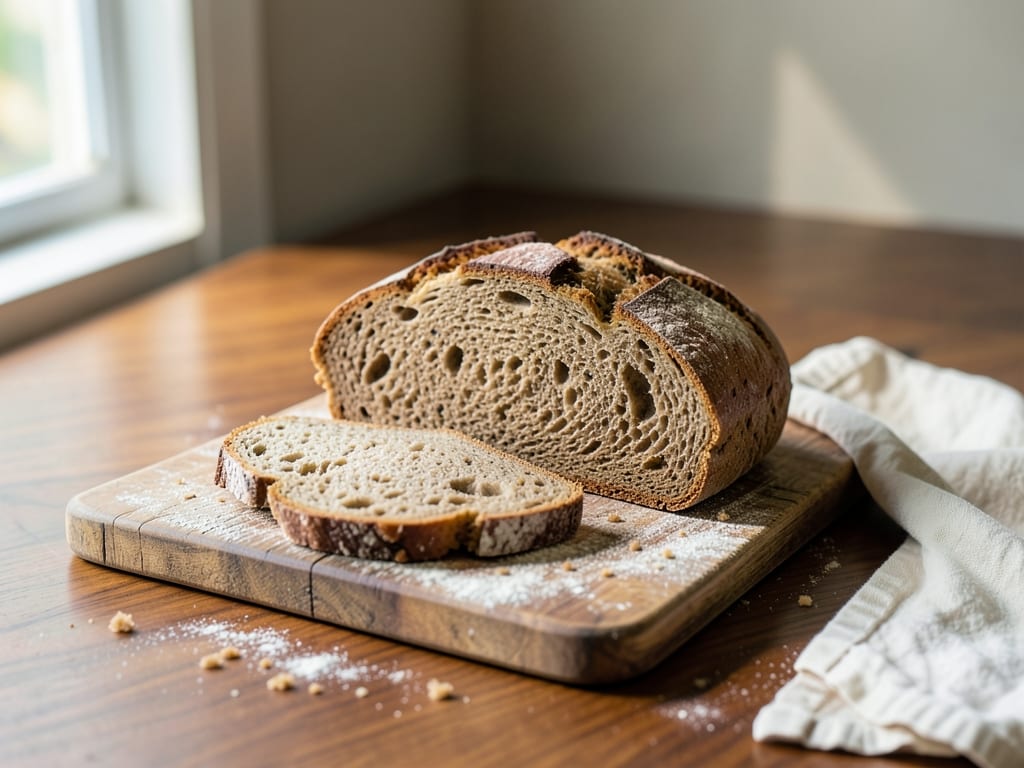
A tender, nutty, slightly sweet sourdough loaf made entirely with spelt flour. It has a crackly crust and a soft, open crumb. The dough is gently folded and proofed in the fridge overnight, because spelt's delicate gluten overferments easily.
- Prep
- 43 min
- Cook
- 42 min
- Wait
- 15 hr 20 min
- Total
- 16 hr 45 min
- Makes
- 1 round loaf (about 10 slices)
Steps
Before you start
- Feed your starter 4-6 hours before mixing so it is bubbly, domed and at least doubled. Use it at its peak; a sluggish starter gives a dense loaf.
- Plan the timeline: mix in the late afternoon, shape in the evening, proof in the fridge overnight and bake the next morning. Total time is about 17 hours, but only about 45 minutes is hands-on.
- Weigh the ingredients with a kitchen scale. Spelt flour varies by brand and by how it is scooped, so the gram amounts are the reliable ones.
- Aim for a room temperature of about 75°F (24°C). In a cooler kitchen add 30-60 minutes to the bulk rise; in a warmer one shorten it.
- Spelt dough is stickier and more fragile than wheat dough. Handle it gently with wet hands and don't over-ferment it.
Autolyse the flours
- In a large bowl, combine the white spelt flour, whole spelt flour and lukewarm water.
- Mix with a wet hand or spatula for about 1 minute until no dry flour remains and the dough looks shaggy.
- Cover the bowl and let it rest.
+ Show details− Hide details
Ready when: No dry flour remains and the dough looks shaggy
Tip: Spelt absorbs water quickly. Don't add extra water, even if the dough seems stiff at first.
Mix in starter and salt
- Dimple the starter and salt over the dough.
- Squeeze and fold the dough with wet hands for about 3 minutes, pinching it through until the starter and salt are fully worked in.
- Cover and rest.
+ Show details− Hide details
Ready when: Dough is cohesive and no streaks of starter remain
Tip: Dough should feel soft and slightly sticky. That is normal for spelt.
First set of folds
- With wet hands, grab one edge of the dough, stretch it gently upward until you feel resistance, and fold it over the center.
- Turn the bowl a quarter turn and repeat 4 times in all.
- Cover and rest.
+ Show details− Hide details
Ready when: Dough tightens into a smoother ball
Tip: Stretch gently. Spelt gluten tears more easily than wheat gluten.
Second set of folds
- Repeat the 4 stretch-and-folds exactly as before.
- The dough should feel smoother and slightly airier.
- Cover and rest.
+ Show details− Hide details
Ready when: Dough is smoother and holds its shape a little better
Finish the bulk rise
- Leave the dough covered and undisturbed at about 75°F (24°C) until it has risen by about 50%, looks puffy and jiggles when you shake the bowl, with a few bubbles on top and at the edges.
- Total bulk fermentation from mixing in the starter is about 3 hours.
+ Show details− Hide details
Ready when: Dough has risen about 50%, is domed and jiggly, with bubbles visible
Tip: Do not wait for it to double. Spelt over-ferments quickly and collapses.
Pre-shape and rest
- Lightly flour the counter with a little white spelt flour and scrape the dough out gently.
- Fold the edges to the center to form a loose round, then flip it seam-side down.
- Cover and rest.
+ Show details− Hide details
Ready when: Dough has relaxed and spread slightly
Tip: Use the bench scraper to avoid tearing the dough.
Shape into the banneton
- Dust the banneton generously with the rice flour.
- Flip the dough over so the seam side faces up.
- Fold the sides to the center, then roll it up from the top, and drag it toward you to tighten the surface.
- Place it seam-side up in the banneton and pinch the seam closed.
+ Show details− Hide details
Ready when: Surface is taut and the dough holds a round shape
Tip: Don't overwork it. A few light pulls are enough.
Cold proof overnight
- Cover the banneton with a plastic bag or shower cap and refrigerate for 8-12 hours (10 is ideal).
+ Show details− Hide details
Ready when: Dough is puffy, and a floured finger poke springs back slowly and partway
Tip: If the poke leaves a dent that does not spring back at all, bake immediately.
Preheat the Dutch ovenOven 475°F / 245°C
- About 45 minutes before baking, place the empty lidded Dutch oven on the middle rack and preheat to 475°F (245°C).
+ Show details− Hide details
Ready when: Oven has reached 475°F (245°C) and the pot has heated for 45 minutes
Tip: Do this while the dough finishes its last stretch in the fridge. Don't skip the full 45 minutes.
Score and bake coveredOven 475°F / 245°C
- Place a sheet of parchment over the banneton and invert the dough onto it.
- Score one confident 1/2-inch (1 cm) deep slash across the top with a razor.
- Use the parchment to lower the dough into the hot pot, cover, and bake at 475°F (245°C) for 20 minutes.
+ Show details− Hide details
Ready when: Loaf has risen and expanded, and the slash has opened
Tip: The pot is extremely hot. Use thick oven mitts.
Uncover and finish bakingOven 450°F / 230°C
- Remove the lid, reduce the oven to 450°F (230°C), and bake 20-24 more minutes until the crust is deep golden brown and the loaf sounds hollow when tapped on the bottom.
+ Show details− Hide details
Ready when: Deep golden-brown crust, hollow sound when tapped, and an internal temperature of 205-210°F (96-99°C)
Tip: If the bottom browns too fast, set the pot on a baking sheet for the final 10 minutes.
Cool completely
- Lift the loaf out with the parchment and cool it on a wire rack for at least 90 minutes before slicing.
+ Show details− Hide details
Ready when: Loaf feels completely cool to the touch
Tip: Cutting early makes spelt crumb gummy.
Good to know
Tips
- Watch the dough, not the clock. Spelt over-ferments quickly, so stop the bulk rise at about a 50% increase.
- Keep the hydration modest. Spelt absorbs less water than wheat, and wetter dough tends to spread.
- A very hot Dutch oven and a confident score give the best oven spring.
- Let the loaf cool fully before slicing for the best crumb.
Make ahead
The shaped dough can stay in the fridge for up to 14 hours before baking; beyond that it may overproof. Baked loaves can be frozen for later.
Storage & reheating
Room temperature: keep cut-side down on a board or in a bread bag for up to 3 days. Fridge: not recommended, as it dries the bread out. Freezer: slice and freeze in an airtight bag for up to 3 months. Toast slices from frozen, or reheat a whole loaf at 350°F (175°C) for 10-15 minutes to refresh the crust.
Substitutions
- light (white) spelt flour → All-purpose or bread flour. Replace up to 200 g of the white spelt with it for a sturdier, chewier loaf. Add 10-20 g more water.
- whole spelt flour → White spelt flour. Use all white spelt for a lighter loaf, or swap more whole spelt in for a denser, nuttier one.
- rice flour → All-purpose flour or semolina. Rice flour prevents sticking best, but these work if you flour generously.
- active sourdough starter (100% hydration) → Active whole wheat or rye starter. Any 100% hydration starter at its peak works.
More sourdough
See all →
Find more like this
- Meal
- Dinner
- Method
- Oven
- Quick & Easy
- 5 Ingredients or LessMake Ahead