German-Style Sourdough Rye Bread with Caraway
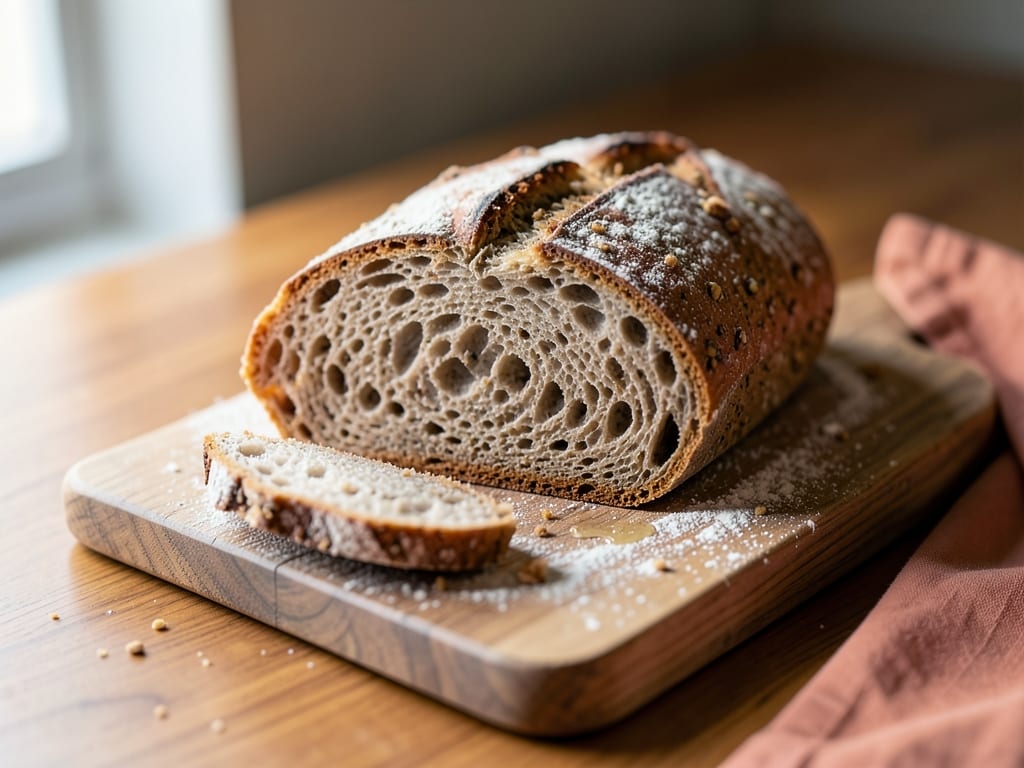
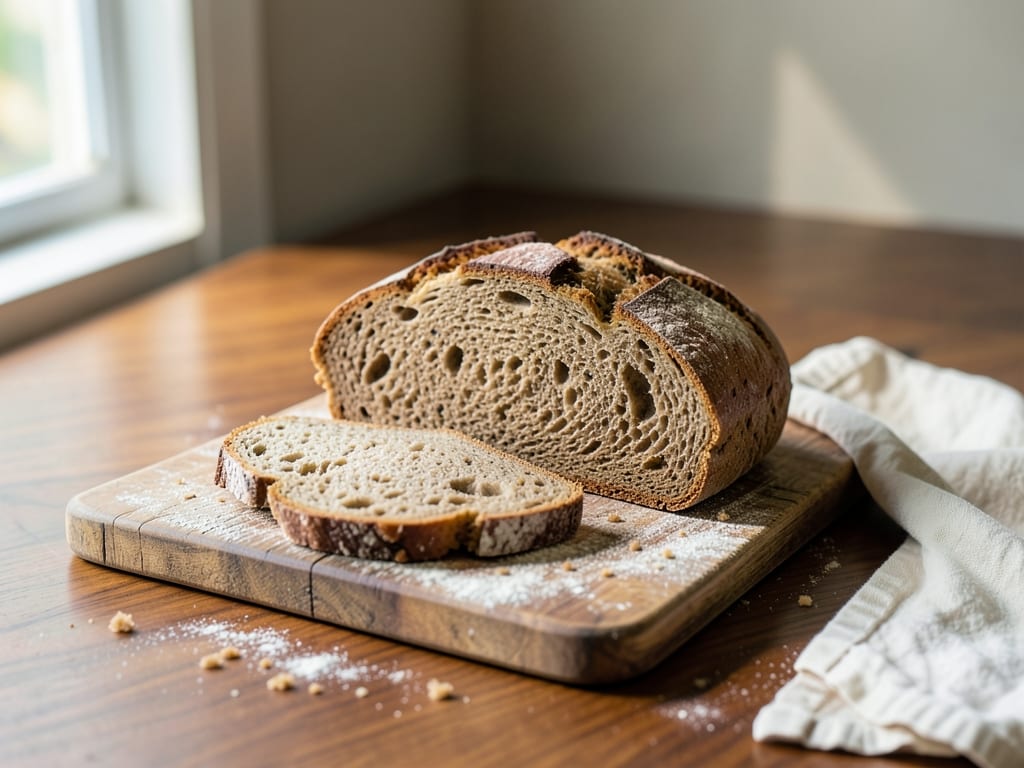
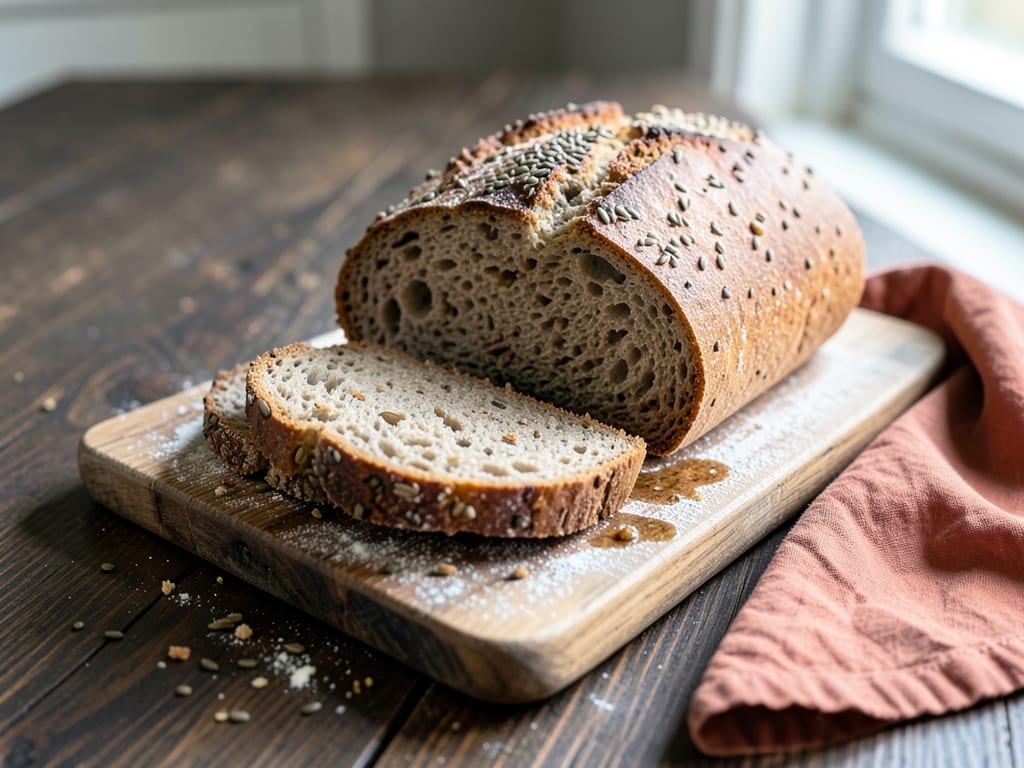
A tangy, moist, chewy-crumbed loaf with 40% whole rye flour, toasted caraway and a touch of molasses. A long cold proof builds deep flavor, and a Dutch oven gives a crackling, deeply browned crust.
- Prep
- 42 min
- Cook
- 45 min
- Wait
- 20 hr 15 min
- Total
- 21 hr 42 min
- Makes
- 1 round loaf (about 10 slices)
Steps
Before you start
- Feed your starter 4–8 hours before mixing so it is bubbly, domed and at or near its peak. It should pass the float test (a spoonful floats in water). Use 100% hydration starter (equal weights flour and water).
- Plan the timeline: mix in the morning, bulk ferment about 4 hours, shape, then chill 12 hours (overnight) and bake the next day. The loaf then needs at least 3 hours to cool.
- Rye dough is much stickier than wheat dough. Keep a bowl of water nearby for wetting your hands and use a bowl scraper rather than adding extra flour.
- Weigh ingredients with a digital scale. Rye flour is hard to measure accurately by cups, and hydration matters here.
Toast the caraway
- Place the 1 tbsp (7 g) caraway for the dough in a small dry skillet over medium-low heat.
- Toast, shaking the pan often, for about 2 minutes.
- Tip onto a plate and let cool completely.
+ Show details− Hide details
Ready when: Seeds smell fragrant and nutty and are a shade darker; they should not smoke or turn dark brown.
Tip: Caraway burns quickly. Pull the pan off the heat as soon as it smells strongly aromatic.
Mix and rest dough
- In a large bowl, whisk the warm water, starter and molasses until mostly dissolved and milky.
- Add the bread flour, rye flour and cooled toasted caraway.
- Mix with a wet hand or spatula for 2–3 minutes until no dry flour remains.
- The dough will be sticky and heavy, more like a thick paste than wheat dough.
- Scrape down the sides, cover the bowl, and let it rest at room temperature (about 75°F / 24°C).
+ Show details− Hide details
Ready when: No dry streaks of flour; dough looks shaggy and thick.
Tip: Do not add extra flour to fix the stickiness. Rye absorbs water slowly and the dough will firm up as it rests.
Add salt, first fold
- Sprinkle the salt over the dough and add 1 tablespoon of water if desired to help it dissolve.
- With wet hands, dimple the salt into the dough, then squeeze and fold the dough over itself for about 1 minute until the salt is no longer gritty.
- Then do the first set of stretch and folds: wet your hand, grab the edge of the dough, stretch it up and fold it over to the center.
- Rotate the bowl a quarter turn and repeat 8 times in total.
- Cover.
+ Show details− Hide details
Ready when: Dough feels slightly smoother and tighter, though still sticky.
Tip: Rye tears more easily than wheat dough. Stretch gently and stop when you feel resistance.
Finish stretch and folds
- After the 30-minute rest, do a second set of 8 wet-hand stretch and folds, cover, and rest 30 minutes.
- Then do a third set, cover, and leave the dough alone.
+ Show details− Hide details
Ready when: Dough looks smoother, holds together as a cohesive mass and starts showing small bubbles.
Tip: If your kitchen is cold (below 70°F / 21°C), place the bowl in the oven with just the light on.
Bulk ferment
- Leave the covered dough at 74–78°F (23–26°C) for about 2½ more hours.
- Rye dough does not double like wheat dough.
- Look for it to increase in volume by about 40–50%, with a slightly domed top and bubbles at the edges and surface.
+ Show details− Hide details
Ready when: Dough has grown 40–50%, is domed, jiggles when the bowl is shaken, and has visible bubbles at the edge. It smells pleasantly sour.
Tip: A clear bowl with a rubber band or tape marking the starting level makes it easy to judge the rise.
Shape the loaf
- Dust the inside of the banneton generously with the rice flour, then sprinkle the 1 tsp topping caraway over the bottom.
- With wet hands, scrape the dough onto a lightly wet (not floured) counter.
- Fold the edges to the center to form a rough round, flip it seam-side down, and gently drag it toward you on the counter to tighten the surface into a smooth ball, about 6 inches (15 cm) across.
- Using a scraper, lift it into the banneton seam-side up, so the smooth top lands on the caraway.
+ Show details− Hide details
Ready when: Loaf is a taut, rounded ball that holds its shape on the counter.
Tip: Wet hands and a wet counter stop rye dough from sticking much better than flour does.
Cold proof overnight
- Cover the banneton with a shower cap or plastic bag and refrigerate for 12 hours (anywhere from 10 to 14 hours works).
+ Show details− Hide details
Ready when: Dough is puffy and a floured finger pressed in leaves a dent that fills back in slowly.
Tip: Rye over-proofs faster than wheat. If the surface starts to crack and the dough collapses when poked, bake right away.
Preheat Dutch ovenOven 475°F / 245°C
- When ready to bake, place the Dutch oven with its lid on in the center of the oven.
- Preheat to 475°F (245°C) and let the pot heat for a full 45 minutes.
- Keep the dough in the fridge during this time.
+ Show details− Hide details
Ready when: Oven has reached 475°F (245°C) and the pot has been in it for a full 45 minutes.
Tip: Use oven mitts when removing the pot. The lid and pot are dangerously hot.
Score and loadOven 475°F / 245°C
- Cut a sheet of parchment larger than the loaf.
- Turn the cold dough out onto it so the caraway side faces up.
- With a razor blade or sharp knife, make one ½-inch (1 cm) deep slash across the top, or a cross.
- Carefully remove the hot pot, lift the loaf by the parchment, lower it in, and replace the lid.
+ Show details− Hide details
Ready when: Score is clean and open, and the loaf sits centered in the pot.
Tip: Work quickly so the pot doesn't lose heat. Trim excess parchment so it doesn't touch the oven walls.
Bake coveredOven 475°F / 245°C
- Return the covered pot to the oven at 475°F (245°C) and bake for 20 minutes.
- The trapped steam keeps the crust soft so the loaf can expand fully.
+ Show details− Hide details
Ready when: Loaf has risen and the score has opened, though the crust is still pale.
Tip: Do not lift the lid during this stage; steam escapes.
Bake uncoveredOven 450°F / 230°C
- Reduce the oven to 450°F (230°C).
- Remove the lid and bake 25 minutes more, until the crust is deep brown.
- Lift the loaf out of the pot and check the internal temperature with an instant-read thermometer.
+ Show details− Hide details
Ready when: Crust is deep brown and sounds hollow when tapped on the bottom; internal temperature reads 205–210°F (96–99°C).
Tip: If the bottom browns too fast, set the pot on a baking sheet for the final 10 minutes.
Cool completely
- Transfer the loaf to a wire rack and let it cool for at least 3 hours before slicing.
- For the best texture, wrap it loosely in a clean towel and wait until the next day.
+ Show details− Hide details
Ready when: Loaf feels completely cool to the touch on the bottom, and a slice cuts cleanly without compressing.
Tip: Cutting rye bread warm gives a sticky, gummy crumb. Be patient.
Good to know
Tips
- Rye dough is supposed to be sticky. Wet hands and tools are the key; avoid adding more flour.
- Watch the dough, not the clock. Rye ferments faster than wheat, especially in warm kitchens, and over-proofed dough bakes up flat and dense.
- For a stronger rye flavor, replace 50 g of the bread flour with more rye and increase the water by 15 ml.
- Slice with a long serrated knife and wipe the blade if it gets gummy.
Make ahead
Mix and shape the dough the day before and refrigerate it for up to 14 hours until ready to bake. The baked loaf also improves in flavor after resting wrapped for 12–24 hours.
Storage & reheating
Room temperature: wrap in a clean cotton towel or store in a bread bag, cut side down, for up to 4 days. Fridge: not recommended, as it dries the bread out. Freezer: slice, wrap tightly and freeze up to 3 months. Toast slices straight from frozen, or refresh a whole thawed loaf in a 350°F (175°C) oven for 10 minutes.
Substitutions
- whole rye flour (dark rye) → medium or light rye flour. Gives a lighter color and milder flavor; the dough may need 10–20 ml less water.
- unsulphured molasses → honey or dark brown sugar (1 tbsp / 20 g). Gives a lighter, less bitter flavor and a slightly paler crust.
- bread flour → all-purpose flour. Loaf will be slightly less chewy and a bit flatter; reduce the water by 15 ml.
- white rice flour → rye flour or wheat bran. Dusting with rye flour works but sticks more easily; use generously.