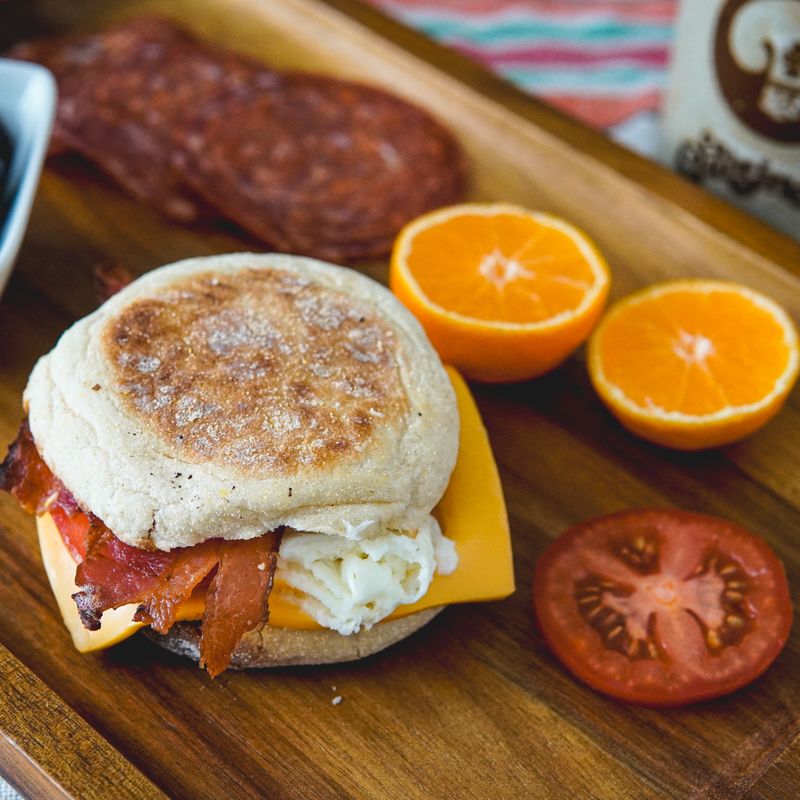
Sourdough English Muffins
Chewy, tangy griddle-cooked English muffins with deep nooks and crannies, made with active sourdough starter and a gentle pinch of baking soda for lift. Split with a fork, toast, and slather with butter.
- Prep
- 35 min
- Cook
- 30 min
- Wait
- 6 hr 15 min
- Total
- 7 hr 20 min
- Makes
- 10 muffins (3-inch / 7.5 cm)
Steps
Before you start
- Feed your starter 4 to 8 hours ahead so it is bubbly, doubled, and floats in water when you start. A sluggish starter gives dense muffins.
- Plan for about 7 hours total, most of it hands-off. Mix in the morning to griddle in the late afternoon, or see Make Ahead for an overnight option.
- Dough is sticky. Use wet hands or a bowl scraper rather than adding extra flour.
- Griddle on low heat and be patient: muffins must cook through slowly without burning the cornmeal. A heavy cast-iron skillet or electric griddle works best.
Mix the dough
- In a large bowl, whisk the milk and starter until the starter mostly dissolves.
- Add the melted butter, sugar, and salt and stir.
- Add the bread flour and mix with a spatula or wet hands until no dry flour remains and you have a shaggy, sticky dough.
- Cover the bowl.
+ Show details− Hide details
Ready when: No dry flour remains; dough is shaggy and sticky
Tip: Do not add the baking soda yet. It is added just before shaping so it keeps its lift.
Stretch and fold
- With wet hands, grab one edge of the dough, stretch it up gently, and fold it over the center.
- Turn the bowl a quarter turn and repeat 8 to 10 times total, until the dough tightens and resists stretching.
- Re-cover.
+ Show details− Hide details
Ready when: Dough feels smoother and springs back slightly when stretched
Bulk ferment
- Leave the covered bowl at a comfortable room temperature (72–76°F / 22–24°C) for 4 hours, until the dough is puffy, domed, about 50% larger, and shows bubbles at the edges and surface.
- In a cooler kitchen it may need up to 5 hours.
+ Show details− Hide details
Ready when: About 50% larger, jiggly, with visible bubbles
Tip: Mark the dough level with a rubber band on the bowl to judge the rise.
Add soda and roll
- Dust a work surface with a little of the cornmeal.
- Scrape the dough out, spread it into a rough rectangle, and brush or drizzle on the baking soda mixture.
- Knead gently 1 minute to work it in; the dough may feel slippery at first.
- Pat or roll to an even ¾-inch (2 cm) thickness.
+ Show details− Hide details
Ready when: Dough is evenly ¾ inch (2 cm) thick with no streaks of soda
Tip: Roll gently so you keep the bubbles; thinner dough makes flat muffins.
Cut and proof
- Sprinkle about half of the cornmeal over a parchment-lined baking sheet.
- Cut rounds with the 3-inch cutter, pressing straight down without twisting.
- Place them 1 inch (2.5 cm) apart on the cornmeal.
- Gather scraps, pat out again, and cut more to total 10.
- Dust tops with the remaining cornmeal, cover loosely, and let rest 45 minutes.
+ Show details− Hide details
Ready when: Muffins look puffy and a gentle poke springs back slowly
Tip: Twisting the cutter seals the edges and stops them rising.
Heat the griddle
- Set a heavy skillet or griddle over low heat (about 325°F / 165°C on an electric griddle) for 5 minutes.
- Rub with a thin film of butter.
- Test with one scrap of dough or a pinch of cornmeal: it should sizzle gently and brown slowly.
+ Show details− Hide details
Ready when: Pan is evenly warm and a pinch of cornmeal toasts slowly
Tip: If the pan is too hot the outsides will burn before the centers cook.
Cook first side
- Using a wide spatula, lift 4 to 5 muffins onto the pan, leaving 1 inch (2.5 cm) between them.
- Cook, uncovered, 7 minutes without moving, until the bottoms are deep golden brown and the sides look slightly set.
+ Show details− Hide details
Ready when: Bottoms deep golden brown; sides begin to look dry
Tip: Lower the heat if the bottoms darken before 5 minutes.
Flip and finish
- Flip carefully and cook another 6 to 7 minutes, until the second side is golden and the muffin has risen.
- Check that the center reaches 205°F (96°C) on an instant-read thermometer; if not, cover and cook 2 more minutes.
- Repeat with the remaining muffins, wiping out stray cornmeal between batches.
+ Show details− Hide details
Ready when: Both sides golden brown; sides feel firm; center reaches 205°F (96°C)
Tip: Wipe the pan if the cornmeal begins to scorch.
Cool completely
- Move the muffins to a wire rack and let them cool for 30 minutes.
- The crumb needs this time to finish setting; cutting warm muffins makes them gummy.
+ Show details− Hide details
Ready when: Muffins are fully cool and firm to the touch
Split and toast
- Pierce around the edge of each muffin with a fork and pull apart to expose the craggy interior.
- Toast the halves until golden and crisp at the edges, then serve with butter and jam.
+ Show details− Hide details
Ready when: Toasted halves are golden with crisp nooks
Tip: A fork gives more nooks and crannies than a knife.
Good to know
Tips
- Use a starter that is at its peak; an under-active starter gives dense, flat muffins.
- Cook low and slow. A lightly browned crust with a fully cooked, tender center is the goal.
- Weigh the flour and liquid with a scale for consistent dough.
- For perfectly round muffins, griddle them inside greased 3-inch metal rings.
Make ahead
"After the stretch and fold, let the dough rise 1 hour at room temperature, then refrigerate covered for 8 to 14 hours. Let it sit 30 minutes at room temperature, then continue from step 4. Cooked muffins also freeze well."
Storage & reheating
"Room temperature in an airtight bag up to 3 days. Freeze split or whole in a freezer bag up to 3 months. Toast straight from frozen until hot and crisp."
Substitutions
- bread flour → all-purpose flour. Muffins will be slightly less chewy; reduce milk by 1 tablespoon (15 ml) if the dough feels very slack.
- whole milk → unsweetened oat or soy milk. Use the same amount, warmed; the flavor will be a little less rich.
- unsalted butter → neutral oil. Use 2 tablespoons (28 ml); you lose a little butter flavor.
- fine yellow cornmeal → semolina flour. Gives the same non-stick, crunchy coating.
More sourdough
See all →


Find more like this
- Meal
- Breakfast
- Diet
- VegetarianHalal
- Method
- Stovetop