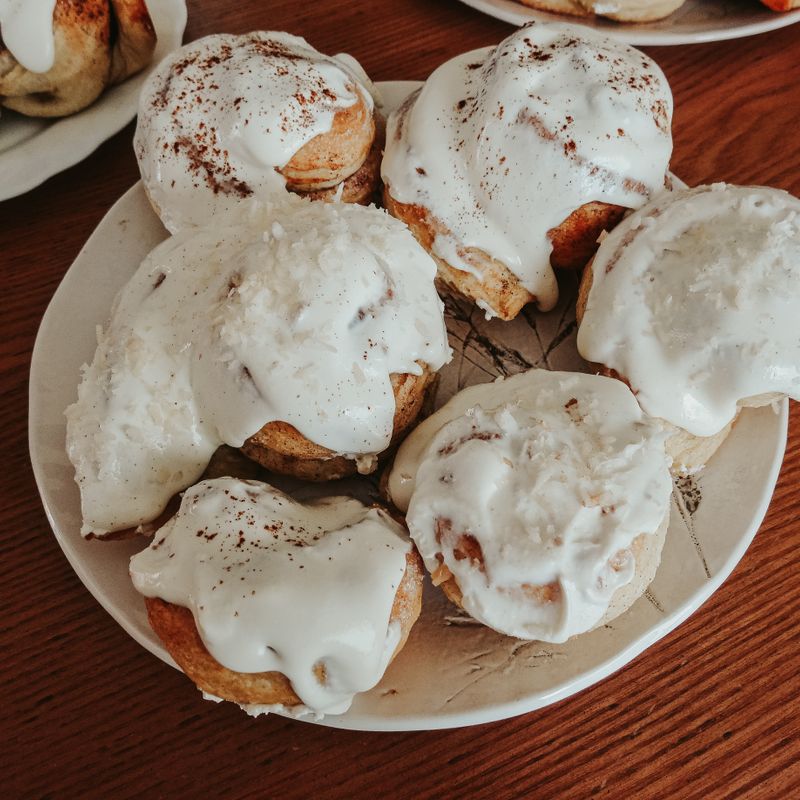
Overnight Sourdough Cinnamon Rolls with Cream Cheese Frosting
Soft, pillowy rolls made with ripe sourdough starter and swirled with a gooey brown sugar-cinnamon filling. They proof slowly in the fridge overnight, so you wake up to rolls that only need to warm up and bake. Finished with a tangy cream cheese frosting.
- Prep
- 1 hr 15 min
- Cook
- 30 min
- Wait
- 16 hr 45 min
- Total
- 18 hr 30 min
- Makes
- 12 large rolls (one 9×13-inch pan)
Steps
Before you start
- Feed your starter 4–8 hours before mixing so it is bubbly, doubled, and at or just past its peak (domed and airy, or a spoonful floats in water). A sluggish starter is the most common cause of dense rolls.
- Plan the timeline: mix in the morning, bulk ferment about 4½ hours, shape in the afternoon, refrigerate overnight (8–14 hours), then warm up 1½ hours and bake the next morning.
- Take the butter and cream cheese out of the fridge 1–2 hours before you need them. The dough and filling butter should be soft like mayonnaise, and the cream cheese soft for a smooth frosting.
- Flour is measured by weight (125 g per cup, spooned and leveled). A kitchen scale gives the most reliable dough.
Mix and rest dough
- In the bowl of a stand mixer, stir together the lukewarm milk, ripe starter, egg, and granulated sugar until the starter is mostly dissolved.
- Add the flour and mix with the dough hook on low (speed 1–2) for about 2 minutes, until no dry flour remains and the dough looks shaggy.
- Cover and let it rest 30 minutes so the flour hydrates.
+ Show details− Hide details
Ready when: No dry flour remains; dough is shaggy and sticky
Tip: If your starter is cold from the fridge, feed it first; cold or unfed starter will slow the rise by hours.
Knead in butter
- Sprinkle the salt over the dough.
- Knead on low-medium (speed 2) for 3 minutes.
- With the mixer running, add the soft dough butter one piece at a time, waiting until each piece is mostly absorbed.
- Continue kneading 6–8 more minutes, scraping the hook as needed, until the dough is smooth, soft, and tacky.
- It should clear most of the bowl sides and pass the windowpane test (a small piece stretches thin enough to see light through without tearing).
+ Show details− Hide details
Ready when: Smooth, elastic, tacky but not sticky; stretches into a thin translucent sheet
Tip: Resist adding extra flour; a slightly tacky dough gives softer rolls. By hand, knead on an unfloured counter for 12–15 minutes.
Bulk ferment
- Transfer the dough to a lightly oiled or buttered large bowl and cover.
- Let it ferment at 75–78°F (24–26°C).
- At 30 and 60 minutes, do a set of stretch and folds: wet your hand, grab the edge of the dough, stretch it up and fold it over the center, turn the bowl a quarter turn, and repeat 4 times.
- Then leave it undisturbed until the dough has grown by 50–75% and looks puffy with a few bubbles, about 4–5 hours total.
+ Show details− Hide details
Ready when: Dough is 50–75% larger, domed, jiggly, with some bubbles visible at the edges
Tip: In a cool kitchen (under 70°F/21°C) this can take 6+ hours. Put the bowl in the oven with only the light on to help.
Roll out dough
- Mix the filling first: stir together the brown sugar, cinnamon, and filling salt in a small bowl.
- Lightly flour the counter and turn out the dough.
- Gently pat into a rough rectangle, then roll to an even 18×12-inch (46×30 cm) rectangle about ¼ inch (6 mm) thick, with a long side facing you.
- Square off the corners by tugging them gently.
+ Show details− Hide details
Ready when: Even rectangle about 18×12 inches that does not spring back
Tip: If the dough keeps shrinking, cover it and rest 10 minutes, then keep rolling.
Add filling
- Spread the very soft filling butter over the dough with an offset spatula, all the way to the edges.
- Sprinkle the sugar-cinnamon mixture evenly over the butter, leaving a 1-inch (2.5 cm) bare strip along the far long edge.
- Press the sugar gently into the butter with your palm so it stays put.
+ Show details− Hide details
Ready when: Dough is evenly coated with no bare spots except the 1-inch strip
Tip: Butter that is melted rather than soft will leak out during baking and make the bottoms greasy.
Roll and cut
- Starting at the long edge nearest you, roll the dough up snugly into an 18-inch log, finishing seam-side down.
- Pinch the seam to seal.
- Slide a length of dental floss under the log, cross the ends over the top, and pull to cut.
- Cut the log in half, then each half in half, then each piece into 3 rolls to make 12 rolls about 1½ inches (4 cm) wide.
+ Show details− Hide details
Ready when: 12 evenly sized rolls with clear spiral layers
Tip: Floss gives cleaner cuts than a knife, which squashes the spiral. Re-shape any flattened roll with your hands.
Pan and chill overnight
- Grease the 9×13-inch pan with the pan butter.
- Arrange the rolls cut-side up in 3 rows of 4, leaving a little space between them.
- Cover the pan tightly with plastic wrap or a lid and refrigerate 8–14 hours.
- The rolls will puff up slowly as they chill.
+ Show details− Hide details
Ready when: Rolls look noticeably puffier and have started to touch
Tip: Don't skip the tight cover; the surface dries out and forms a crust in the fridge otherwise.
Warm up rolls
- Take the pan out of the fridge, keep it covered, and leave on the counter at about 75°F (24°C) for 1 to 1½ hours.
- The rolls are ready when they are puffy and touching each other, and a gently poked roll springs back slowly, leaving a small dent.
- Preheat the oven to 350°F (175°C) for the last 20 minutes with a rack in the center.
+ Show details− Hide details
Ready when: Puffy, jiggly, filling the pan; poked dent springs back slowly
Tip: If the rolls still look flat and dense after 1½ hours, give them up to another 45 minutes. Baking underproofed rolls makes them heavy.
Bake rollsOven 350°F / 175°C
- Uncover the pan and bake at 350°F (175°C) on the center rack for 28–32 minutes, until the tops are deep golden brown and the centers read 190°F (88°C) on an instant-read thermometer.
- If the tops brown too fast, tent loosely with foil for the last 10 minutes.
+ Show details− Hide details
Ready when: Deep golden brown tops, 190°F (88°C) in the center of the middle roll, no raw dough in the swirls
Tip: The center rolls bake last, so check one of them for temperature.
Make frosting
- While the rolls bake, beat the softened cream cheese and frosting butter in a medium bowl with a hand mixer on medium speed for 1–2 minutes until completely smooth and creamy.
- Add the powdered sugar, vanilla, and 1 tablespoon milk.
- Beat on low until combined, then on medium for 1 minute until fluffy.
- Add more milk 1 teaspoon at a time if you want a thinner, drizzly consistency.
+ Show details− Hide details
Ready when: Smooth, spreadable, with no cream cheese lumps
Tip: Cold cream cheese leaves lumps that will not beat out; make sure it is truly soft.
Cool and frost
- Let the rolls cool in the pan on a rack for 15 minutes, until warm but not piping hot.
- Spread the frosting over the warm rolls so it melts slightly into the swirls.
- Serve warm.
+ Show details− Hide details
Ready when: Pan is warm to the touch; frosting softens but stays on the rolls
Tip: Frosting piping-hot rolls makes it slide off in a greasy puddle.
Good to know
Tips
- Use a ripe starter at its peak. If it doesn't float or double after feeding, the rolls will rise very slowly and be dense.
- Always do the windowpane test after kneading; underdeveloped dough gives rolls that collapse and are crumbly.
- Cut with floss, not a knife, for neat spirals that don't squash.
- Don't overbake. Pull the rolls at 190°F (88°C) in the center; going past that dries them out.
Make ahead
Shaped rolls can be refrigerated in the pan for 8–14 hours (up to 16 hours in a very cold fridge) before baking. You can also freeze the unbaked, shaped rolls in the pan, tightly wrapped, for up to 1 month; thaw overnight in the fridge, then warm up on the counter 1½–2 hours and bake as directed.
Storage & reheating
Room temperature: covered, up to 2 days. Fridge: covered, up to 5 days. Freezer: unfrosted baked rolls, wrapped well, up to 2 months. Reheat individual rolls in the microwave for 20–30 seconds, or covered with foil in a 300°F (150°C) oven for 10–15 minutes, then add frosting.
Substitutions
- all-purpose flour → bread flour. Gives a slightly chewier, taller roll; add 1–2 tablespoons more milk if the dough feels stiff.
- whole milk → unsweetened oat milk or unsweetened almond milk. Works in the dough; the rolls will be slightly less rich. Use dairy-free butter to make them fully dairy-free.
- light or dark brown sugar → coconut sugar or muscovado sugar. Use the same weight; muscovado gives a deeper molasses flavor.
- full-fat cream cheese → mascarpone. Gives a milder, creamier frosting; add 1 teaspoon lemon juice for tang.
More rolls & buns
See all →


Find more like this
- Meal
- Breakfast
- Cuisine
- American
- Main ingredient
- Cream Cheese
- Diet
- VegetarianHalal
- Method
- Oven
- Quick & Easy
- Make Ahead