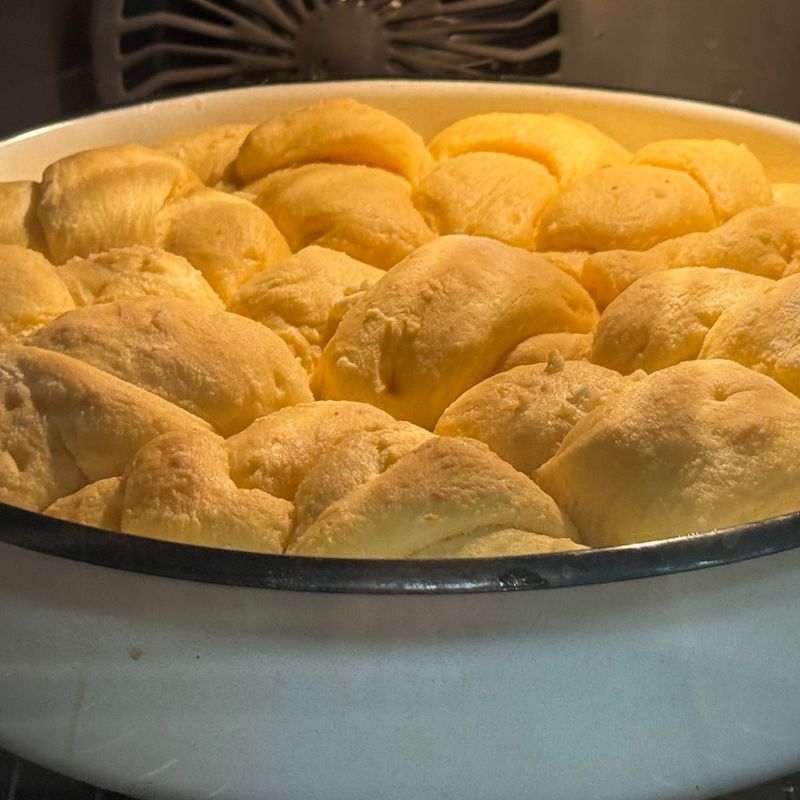
Soft Dinner Rolls
Pillowy, golden, buttery-topped dinner rolls made with a simple milk-and-egg enriched dough. They pull apart in tender, fluffy layers and bake in one pan, ready for the holiday table or a weeknight dinner.
- Prep
- 40 min
- Cook
- 20 min
- Wait
- 2 hr
- Total
- 3 hr
- Makes
- 12 rolls
Steps
Before you start
- Take the egg out of the fridge 30 minutes ahead so it isn't cold enough to slow the yeast.
- Melt 4 tablespoons of butter for the dough and let it cool until just warm to the touch, so it won't kill the yeast.
- Weigh the flour on a kitchen scale if you can. Scooping packs the cup and gives dry, dense rolls.
- Plan on about 3 hours from start to finish, most of it hands-off rising time.
- Use a thermometer for the milk. It should be 105–110°F (40–43°C), warm but not hot.
Foam the yeast
- Pour the 105–110°F (40–43°C) milk into the bowl of a stand mixer.
- Stir in the yeast and granulated sugar and let it sit for 5 minutes.
+ Show details− Hide details
Ready when: The surface looks creamy and slightly foamy, with small bubbles.
Tip: If there's no foam after 10 minutes, the yeast is dead or the milk was too hot or cold. Start over with fresh yeast.
Mix the dough
- Add the beaten egg, the cooled melted butter, and the salt to the milk mixture and whisk briefly.
- Add 4 cups (500 g) of the flour.
- Attach the dough hook and mix on low speed for 2 minutes until a shaggy, sticky dough forms and no dry flour remains.
+ Show details− Hide details
Ready when: No dry flour remains and the dough clumps around the hook.
Tip: Keep the salt from sitting directly on the yeast for long. Whisk it in before adding the flour.
Knead until smooth
- Knead on medium-low speed for 8 minutes (or by hand on a lightly floured counter for 10–12 minutes).
- If the dough sticks to the bowl like batter after 3 minutes, sprinkle in the remaining ¼ cup (30 g) flour, 1 tablespoon at a time.
+ Show details− Hide details
Ready when: The dough is smooth, soft, and slightly tacky. It clears the sides of the bowl and a small piece stretches into a thin, translucent sheet without tearing.
Tip: Don't add much more flour. A slightly tacky dough makes the softest rolls.
First rise
- Grease a large bowl with 1 teaspoon of the oil.
- Shape the dough into a ball, turn it in the bowl to coat, and cover with a towel or plastic wrap.
- Let it rise in a warm spot (75–80°F / 24–27°C) for about 60 minutes.
+ Show details− Hide details
Ready when: The dough has doubled, looks puffy, and a finger poked in leaves an indentation that springs back slowly.
Tip: In a cool kitchen, set the bowl in the oven with only the light on.
Divide the dough
- Brush the 9×13-inch pan with the remaining 1 teaspoon oil.
- Turn the dough onto a lightly floured counter and press gently to release the large bubbles.
- Cut it into 12 equal pieces, about 78 g (2¾ oz) each.
- Weigh them for even rolls.
+ Show details− Hide details
Ready when: You have 12 pieces of similar size.
Tip: Cut with a bench scraper or sharp knife instead of tearing, which stretches the gluten.
Shape the rolls
- Flatten one piece slightly, then pull the edges into the center and pinch to seal.
- Flip it seam-side down and cup your hand over it.
- Roll in small circles against the counter until the top is taut and smooth.
- Place the rolls seam-side down in the pan in 3 rows of 4, with small gaps between them.
+ Show details− Hide details
Ready when: Each ball has a smooth, taut top and a pinched-closed bottom.
Tip: Keep the unshaped pieces covered so they don't form a dry skin.
Second riseOven 375°F / 190°C
- Cover the pan loosely with a towel and let the rolls rise in a warm spot for 40 minutes.
- After 20 minutes, position a rack in the center of the oven and preheat to 375°F (190°C).
+ Show details− Hide details
Ready when: The rolls are puffy and touching each other. A gently poked roll springs back slowly and leaves a faint dent.
Tip: Under-risen rolls bake up dense. If the dent doesn't fill in at all, bake right away because they're overproofed.
Bake the rollsOven 375°F / 190°C
- Bake at 375°F (190°C) on the center rack for 18–22 minutes.
- Rotate the pan halfway through if your oven bakes unevenly.
+ Show details− Hide details
Ready when: The tops are deep golden brown, the sides are lightly browned, and an instant-read thermometer in the center of a roll reads 190°F (88°C).
Tip: If the tops brown too quickly before the center is done, tent the pan with foil.
Brush and cool
- As soon as the pan comes out of the oven, brush the tops with the 2 tablespoons melted butter and sprinkle with flaky salt if using.
- Let the rolls cool in the pan for 15 minutes, then serve warm.
+ Show details− Hide details
Ready when: The tops are glossy and the rolls are warm, not steaming hot.
Tip: Brushing while the rolls are hot lets the butter soak in and keeps the crust soft.
Good to know
Tips
- Weigh the flour. Too much flour is the most common reason for dry rolls.
- Weigh each dough piece for evenly sized rolls that finish baking at the same time.
- Rise times depend on room temperature. Judge by the dough, not the clock: doubled in volume and slow to spring back.
- For extra-shiny tops, brush with an egg wash (1 egg beaten with 1 tbsp milk) before baking, in addition to the butter after.
Make ahead
After shaping, cover the pan tightly and refrigerate for up to 16 hours. Let it stand at room temperature for 45–60 minutes until puffy, then preheat the oven and bake as directed.
Storage & reheating
Keep cooled rolls in an airtight container or zip-top bag at room temperature for up to 2 days, or refrigerate for up to 5 days. Freeze for up to 3 months, wrapped well. Reheat at 300°F (150°C) wrapped in foil for 10 minutes (15–20 minutes if frozen), or microwave a roll for 10–15 seconds.
Substitutions
- instant yeast → active dry yeast, same amount. Let it foam in the warm milk and sugar for 10 minutes before continuing. The first rise may take 10–15 minutes longer.
- whole milk → 2% milk. The rolls will be slightly less rich. Skim or nondairy milks give a drier crumb.
- all-purpose flour → bread flour, same weight. This gives a chewier, loftier roll. You may need 1–2 extra tablespoons of milk.
- unsalted butter → neutral oil, 3 tbsp (45 ml). The rolls will lose some buttery flavor but stay soft.
More rolls & buns
See all →
Find more like this
- Meal
- Dinner
- Cuisine
- American
- Diet
- VegetarianHalal
- Method
- Oven
- Quick & Easy
- Easy
- Occasion
- ThanksgivingFamily Gatherings