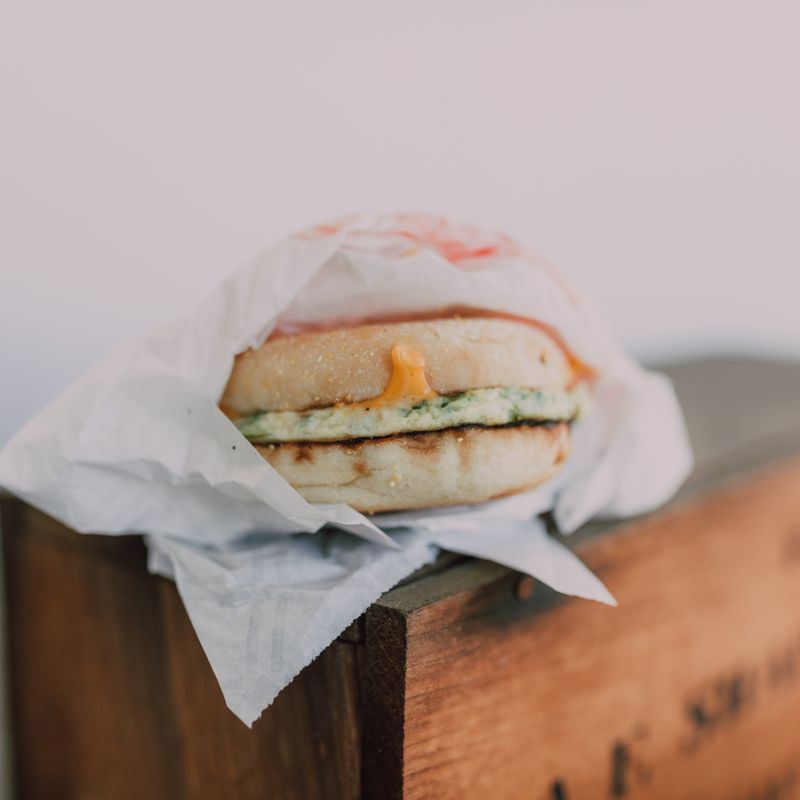
Griddle-Cooked English Muffins
Tall, chewy homemade English muffins with a cornmeal crust and plenty of nooks and crannies. They're cooked slowly on a griddle, then split with a fork and toasted until crisp.
- Prep
- 30 min
- Cook
- 30 min
- Wait
- 1 hr 40 min
- Total
- 2 hr 40 min
- Makes
- 10 muffins (about 3-inch / 7.5 cm)
Steps
Before you start
- Take the butter and egg out so they come to room temperature, about 30 minutes ahead.
- Check that your yeast is fresh. If it hasn't foamed after 5 minutes in step 1, start over with new yeast.
- Use a thermometer for the milk. Above 115°F (46°C) can slow or kill the yeast.
- You'll need a heavy skillet or griddle with a lid, and a 3-inch (7.5 cm) ring cutter or clean tuna cans with both ends removed.
Activate the yeast
- Pour the warm milk (105–110°F / 40–43°C) into the bowl of a stand mixer.
- Stir in the sugar and yeast.
- Let it sit for 5 minutes.
+ Show details− Hide details
Ready when: The surface is foamy and smells yeasty.
Tip: If there's no foam, the yeast is dead or the milk was the wrong temperature. Start over.
Mix the dough
- Add the beaten egg, 3 tablespoons softened butter, bread flour and salt.
- Mix with the dough hook on low speed for 2 minutes until a shaggy dough forms.
- Scrape down the bowl as needed.
+ Show details− Hide details
Ready when: No dry flour remains and the dough clumps around the hook.
Tip: Keep the salt away from the yeast until the flour is added, so it doesn't slow the yeast.
Knead until smooth
- Knead on medium-low speed for 6–8 minutes.
- The dough will be soft and slightly tacky.
- Or knead by hand on a lightly floured counter for 10 minutes.
+ Show details− Hide details
Ready when: The dough is smooth and elastic and pulls away from the bowl sides. A small piece stretches thin without tearing (windowpane).
Tip: Resist adding much more flour. A wetter dough gives a more open crumb.
First rise
- Shape the dough into a ball and place it in a lightly oiled or buttered bowl.
- Cover with plastic wrap or a damp towel.
- Let it rise in a warm spot for 60 minutes.
+ Show details− Hide details
Ready when: The dough has doubled in size and a floured finger leaves a dent that springs back slowly.
Roll and cut
- Line a baking sheet with parchment and dust it generously with cornmeal.
- Turn the dough onto a floured counter and roll it to ¾ inch (2 cm) thick.
- Cut out rounds with a 3-inch (7.5 cm) cutter.
- Gently gather the scraps, rest them for 5 minutes, then re-roll and cut.
- You should get about 10 muffins.
+ Show details− Hide details
Ready when: Rounds are an even ¾ inch (2 cm) thick.
Tip: Press the cutter straight down without twisting so the sides rise evenly.
Second rise
- Place the rounds on the cornmeal, spaced 2 inches (5 cm) apart.
- Dust the tops with more cornmeal.
- Cover loosely with a towel and let them rise for 35 minutes.
+ Show details− Hide details
Ready when: The muffins look puffy, about 1 inch (2.5 cm) tall, and are soft to the touch.
Tip: Don't let them over-proof. They will deflate when moved to the griddle.
Heat the griddle
- Heat a heavy skillet or griddle over medium-low heat for 3 minutes.
- Rub it lightly with a little of the extra butter.
- Test the temperature with a scrap of dough, which should sizzle gently and brown slowly.
+ Show details− Hide details
Ready when: A dough scrap browns in about 2 minutes without scorching.
Tip: If the pan is too hot, the outsides will burn before the centers cook.
Cook the first side
- Using a spatula, lift the muffins onto the griddle in batches of 3–4, leaving 1 inch (2.5 cm) between them.
- Cover and cook for 7 minutes without moving them.
+ Show details− Hide details
Ready when: The bottoms are deep golden brown and the sides look set.
Tip: Wipe out burnt cornmeal between batches and re-butter lightly.
Flip and finish
- Flip the muffins and cook, covered, for another 6–7 minutes.
- Check that the second side is golden brown.
- Transfer to a wire rack.
- Repeat with remaining muffins.
+ Show details− Hide details
Ready when: Both sides are golden brown, the sides feel firm, and the center reads 200°F (93°C) on an instant-read thermometer.
Tip: If a muffin feels doughy, bake it on a sheet at 350°F (175°C) for 5 minutes.
Cool and split
- Cool the muffins on the rack for at least 30 minutes.
- Split each one around the edge with a fork, then pull apart.
- Toast the halves until golden and crisp.
+ Show details− Hide details
Ready when: The halves pull apart with a craggy, open crumb and the toasted surface is golden.
Tip: Splitting with a fork, not a knife, creates the crags that catch butter.
Good to know
Tips
- Cook low and slow. Patience on the griddle gives you cooked centers and an even golden color.
- Always split with a fork so the interior has the signature nooks and crannies.
- Keep the dough slightly sticky. Too much flour makes dense muffins.
- Use a lid to trap heat so the muffins rise and cook evenly.
Make ahead
"After cutting, cover the muffins on the cornmeal-dusted tray and refrigerate for up to 12 hours. Let them stand at room temperature for 30 minutes before cooking."
Storage & reheating
"Room temperature in an airtight bag for 3 days. Freeze split or whole for up to 3 months, with parchment between halves. Toast straight from frozen until hot and crisp."
Substitutions
- bread flour → all-purpose flour. The muffins will be a little less chewy. Add 2 tablespoons (30 ml) less milk if the dough feels too wet.
- whole milk → unsweetened plant milk. Use warmed oat or soy milk. The flavor and browning will be slightly different.
- fine yellow cornmeal → semolina flour or extra bread flour. Semolina gives a similar crunch. Flour works but doesn't give the classic crust.
- unsalted butter → neutral oil. Use the same amount in the dough and for greasing the griddle.
More rolls & buns
See all →

Find more like this
- Meal
- Breakfast
- Cuisine
- American
- Diet
- VegetarianHalal
- Method
- Stovetop