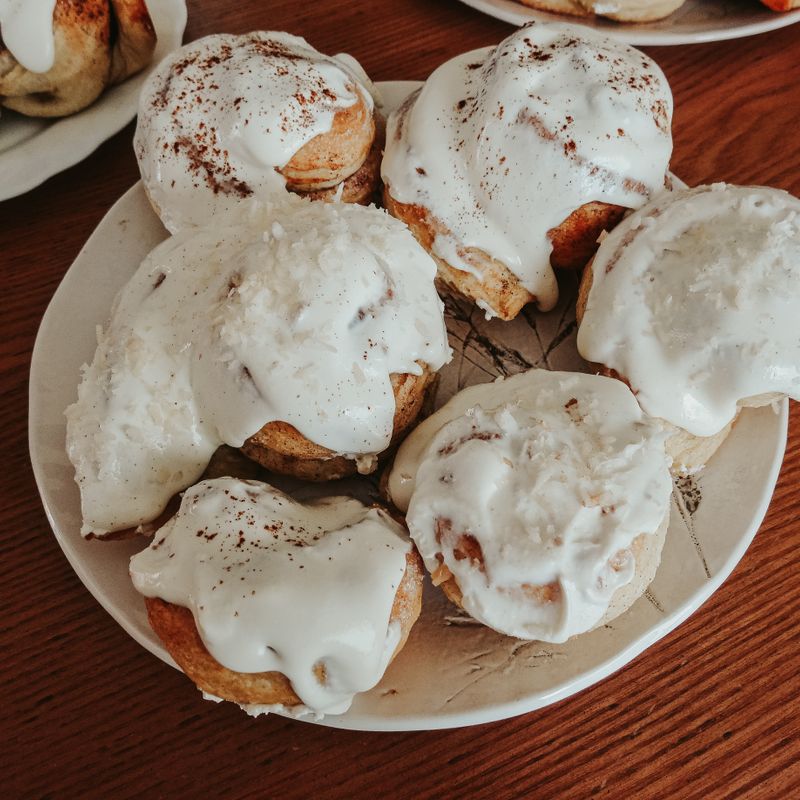
Soft Cinnamon Rolls with Cream Cheese Frosting
Pillowy, buttery rolls swirled with brown sugar and plenty of cinnamon, baked until golden and topped with a tangy cream cheese frosting that melts into every layer. Made with a simple enriched dough and one easy rise before shaping.
- Prep
- 56 min
- Cook
- 25 min
- Wait
- 1 hr 55 min
- Total
- 3 hr 16 min
- Makes
- 12 large rolls (one 9×13-inch pan)
Steps
Before you start
- Set out the eggs, cream cheese, filling butter and frosting butter 1 hour ahead so they are at room temperature. The filling butter should be spreadable like mayonnaise.
- Measure flour by spooning it into the cup and leveling it off, or weigh it. Scooping packs in extra flour and makes dry, dense rolls.
- Plan on about 3¼ hours from start to finish. Most of that is rising time.
- Heat the milk to 110°F (43°C), which feels comfortably warm, not hot. Milk over 130°F (54°C) can kill the yeast.
Wake up the yeast
- Pour the 110°F (43°C) milk into the bowl of a stand mixer.
- Stir in the instant yeast and granulated sugar.
- Let it sit for 5 minutes.
+ Show details− Hide details
Ready when: The surface looks creamy and slightly foamy with small bubbles.
Tip: If nothing foams after 10 minutes, the yeast is likely old or the milk was too hot or cold. Start over with fresh yeast.
Mix the dough
- Add the cooled melted butter, beaten eggs and salt to the milk mixture and whisk briefly.
- Fit the mixer with the dough hook.
- Add the 4 cups (480 g) flour and mix on low speed for about 1 minute, until a shaggy dough forms and no dry flour remains.
+ Show details− Hide details
Ready when: The dough is shaggy and no dry flour remains at the bottom of the bowl.
Tip: Make sure the melted butter is only warm. Hot butter will scramble the eggs and harm the yeast.
Knead until smooth
- Knead on medium-low speed for 8 minutes (or by hand on a lightly floured counter for 10 minutes).
- The dough should clear the sides of the bowl but stay slightly tacky.
+ Show details− Hide details
Ready when: The dough is smooth and elastic, and it springs back slowly when you poke it. It sticks a little to a clean finger but does not leave much residue.
Tip: Resist adding more than 1–2 tablespoons of extra flour. A slightly sticky dough gives the softest rolls.
First rise
- Use the 1 tablespoon (14 g) softened butter to grease a large bowl, reserving a little for the pan.
- Shape the dough into a ball and turn it in the bowl to coat.
- Cover with plastic wrap or a damp towel.
- Let it rise in a warm spot (75–80°F / 24–27°C) for 60 to 75 minutes.
+ Show details− Hide details
Ready when: The dough has doubled, and a floured finger pressed in 1 inch leaves a dent that fills back in slowly.
Tip: In a cool kitchen, set the bowl in the oven with only the light on.
Mix the filling
- While the dough rises, stir the brown sugar and cinnamon together in a small bowl until evenly mixed with no brown sugar clumps.
- Check that the 6 tablespoons (85 g) filling butter is very soft.
- Grease the 9×13-inch (23×33 cm) pan with the reserved butter.
+ Show details− Hide details
Ready when: The cinnamon sugar looks like uniform tan-brown sand.
Roll out and fill
- Turn the risen dough onto a surface dusted with the 2 tablespoons (15 g) flour.
- Gently press out the air.
- Roll it into a 16×12-inch (40×30 cm) rectangle with a long side facing you, about ¼ inch (6 mm) thick.
- Spread the soft butter over the dough all the way to the edges, then sprinkle the cinnamon sugar evenly over the butter.
- Leave a ½-inch (1 cm) bare strip along the far long edge.
- Press the sugar gently into the butter.
+ Show details− Hide details
Ready when: The rectangle is an even ¼ inch thick, with a fully coated surface and a clean border at the far edge.
Tip: If the dough springs back while rolling, cover it and rest it for 5 minutes, then keep rolling.
Roll up and cut
- Starting at the long edge nearest you, roll the dough up snugly into a 16-inch (40 cm) log.
- Pinch the seam closed against the log and turn the log seam-side down.
- Slide a piece of unflavored dental floss under the log, cross the ends over the top and pull to cut.
- Cut 12 slices, each about 1⅓ inches (3.3 cm) wide.
- A sharp serrated knife works if you use a light sawing motion.
+ Show details− Hide details
Ready when: You have 12 rolls of about the same size with visible spiral layers.
Tip: Floss cuts cleanly without squashing the swirl. Mark the log lightly with a knife first to space the cuts evenly.
Second riseOven 350°F / 175°C
- Arrange the rolls cut-side up in the greased pan in 3 rows of 4.
- Cover loosely and let rise in a warm spot for 45 minutes.
- After about 30 minutes, preheat the oven to 350°F (175°C) with a rack in the center.
+ Show details− Hide details
Ready when: The rolls look puffy, touch each other, and a gentle poke leaves a dent that springs back slowly.
Tip: Do not let the rolls overproof. If they begin to look slack or smell strongly of alcohol, bake right away.
Bake the rollsOven 350°F / 175°C
- Bake in the center of the 350°F (175°C) oven for 22 to 25 minutes.
- If the tops brown too fast by minute 18, tent the pan loosely with foil.
- Take the rolls out when the tops are golden brown and the center roll reads 190°F (88°C) on an instant-read thermometer.
+ Show details− Hide details
Ready when: The tops are deep golden, the rolls feel set when pressed, and the center roll reads 190°F (88°C).
Tip: The center rolls bake last. Always check one from the middle of the pan, not the edge.
Beat the frosting
- Once the rolls are out of the oven, beat the softened cream cheese and softened butter in a medium bowl with a hand mixer on medium speed for 1 to 2 minutes, until completely smooth.
- Add the powdered sugar, vanilla and 1 tablespoon milk.
- Beat on low until combined, then on medium for 1 minute until fluffy.
- Add up to 1 more tablespoon milk if the frosting is too thick to spread.
+ Show details− Hide details
Ready when: The frosting is smooth, thick and spreadable, with no lumps of cream cheese.
Tip: Cold cream cheese makes lumpy frosting. If lumpy, microwave the bowl for 5 seconds and beat again.
Cool slightly and frost
- Let the rolls cool in the pan for 5 minutes.
- Spread the frosting over the warm rolls in thick swoops, so it softens into the layers without melting away.
- Serve warm.
+ Show details− Hide details
Ready when: The pan is warm but not hot, and the frosting softens on contact without turning into a liquid glaze.
Tip: Frosting rolls straight from the oven makes the frosting run off and disappear. Waiting gives a creamy topping.
Good to know
Tips
- Weigh the flour if you can. It is the most common cause of dry, tight rolls.
- Cutting with floss keeps the spiral round. A dull knife flattens the rolls.
- Check the center roll with a thermometer. 190°F (88°C) means the middle is baked through and not doughy.
- For extra gooey rolls, pour 3 tablespoons of heavy cream over the risen rolls just before baking.
Make ahead
"Overnight option: after cutting and arranging the rolls in the pan (step 7), cover tightly and refrigerate for 8 to 16 hours. Next day, let the pan sit at room temperature for 45 to 60 minutes until puffy, then bake as directed. The frosting can be made 2 days ahead and refrigerated. Let it soften at room temperature for 30 minutes and beat briefly before spreading."
Storage & reheating
"Room temperature: store frosted rolls loosely covered for up to 1 day. Refrigerator: keep covered for up to 4 days. Freezer: freeze unfrosted baked rolls, wrapped well, for up to 2 months. Thaw overnight in the fridge. To reheat, microwave a roll for 15 to 20 seconds, or warm covered with foil at 300°F (150°C) for 10 to 15 minutes, then frost."
Substitutions
- instant yeast → active dry yeast. Use the same amount. Let it foam in the warm milk for 10 minutes in step 1 and expect the rises to take 15 minutes longer.
- whole milk → 2% milk or unsweetened plain oat milk. Rolls will be slightly less rich but still soft. Skip skim milk, which makes a drier crumb.
- light brown sugar → dark brown sugar. Gives a deeper molasses flavor and a gooier center. Use the same amount.
- all-purpose flour → bread flour. Makes a chewier, taller roll. Use the same weight (480 g) and add 1 to 2 tbsp extra milk if the dough feels stiff.
More rolls & buns
See all →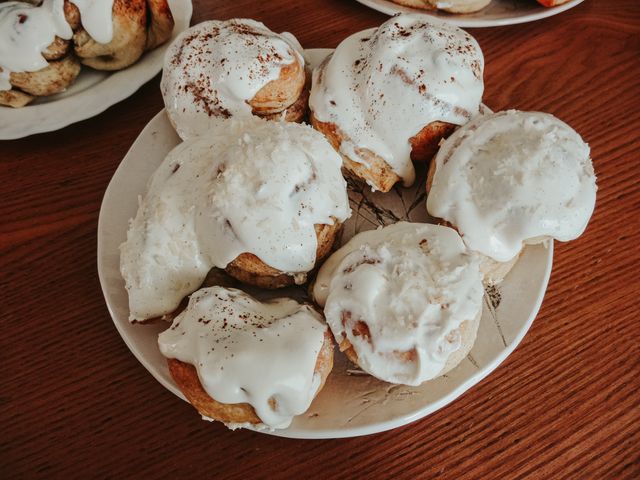


Find more like this
- Meal
- Breakfast
- Cuisine
- American
- Main ingredient
- Cream Cheese
- Diet
- VegetarianHalal
- Method
- Oven