Sourdough Seeded Multigrain Loaf
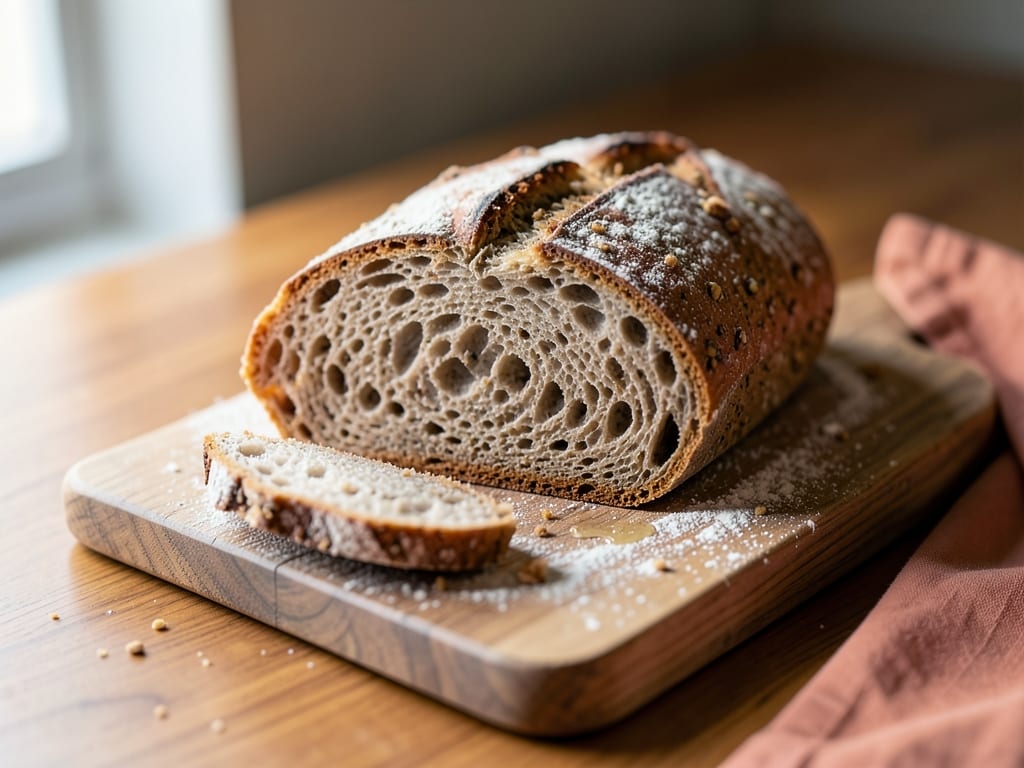
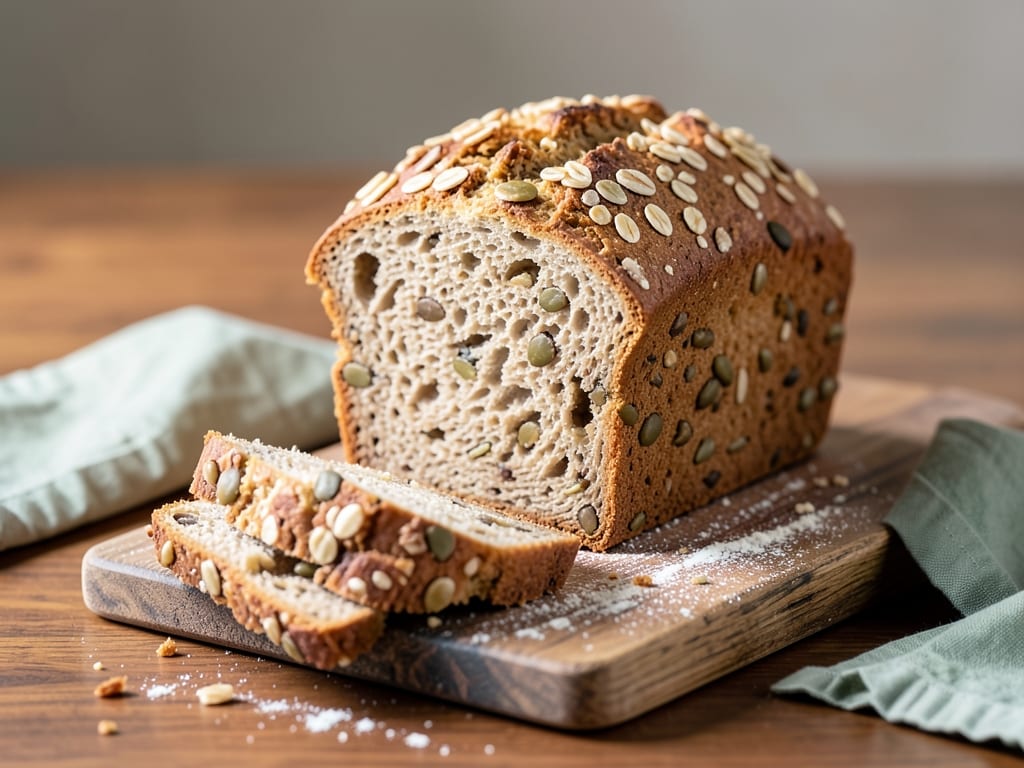
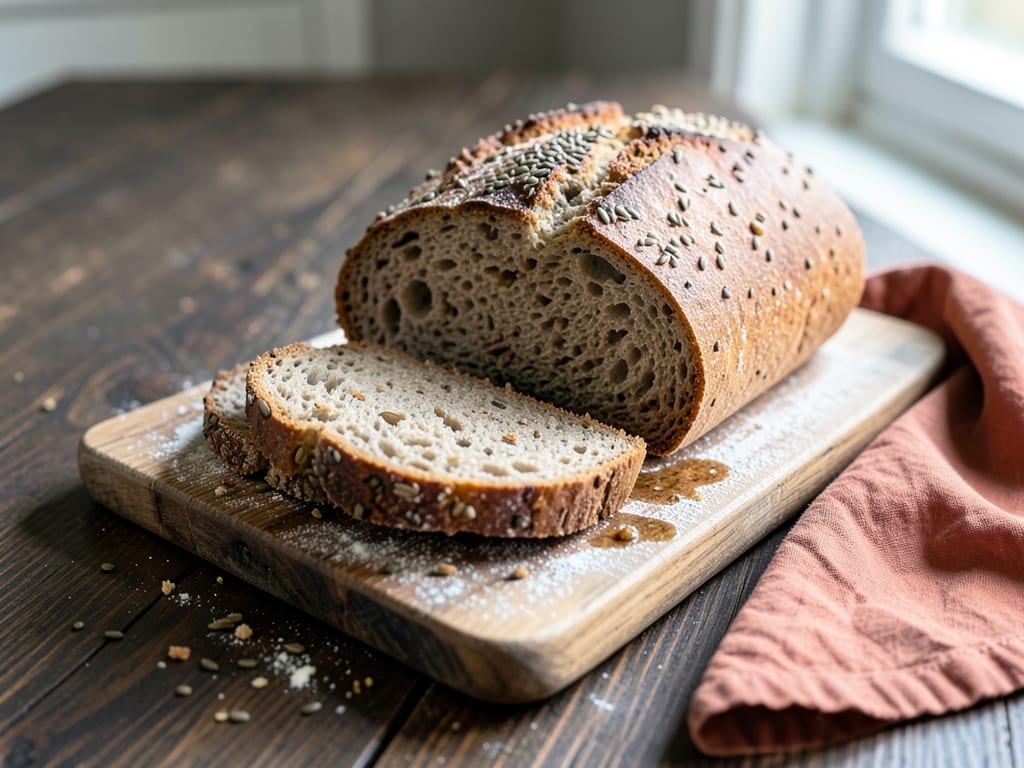
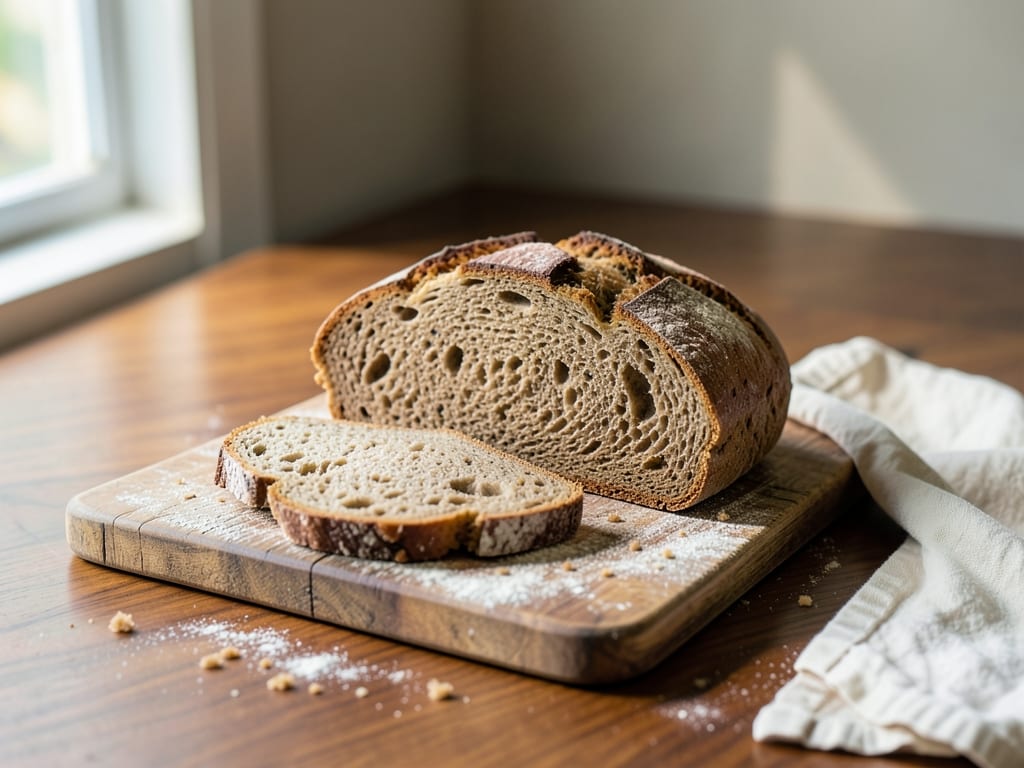
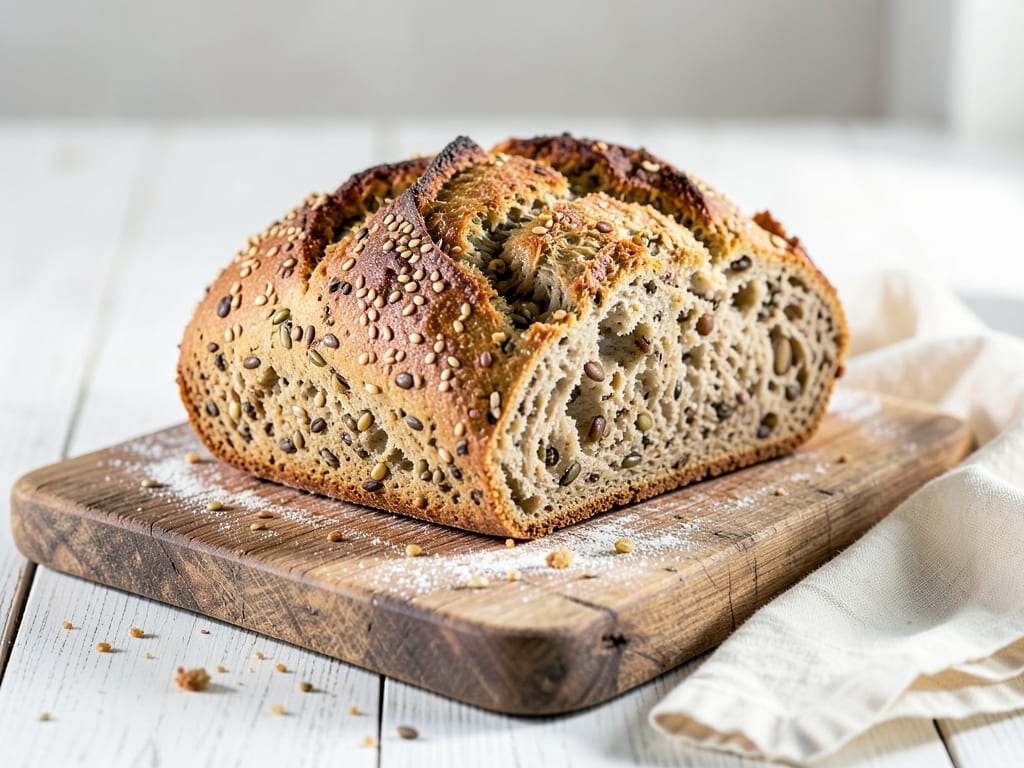
A chewy, tangy sourdough loaf with a crackly sesame crust and a moist crumb packed with soaked sunflower, flax and sesame seeds. Whole wheat adds nutty depth, and a long cold proof builds flavor while keeping the schedule flexible.
- Prep
- 48 min
- Cook
- 42 min
- Wait
- 18 hr 50 min
- Total
- 20 hr 20 min
- Makes
- 1 round loaf (about 10 slices)
Steps
Before you start
- Feed your starter 4–8 hours before you begin, so it is bubbly and has at least doubled in volume. A starter that floats in water is ready.
- Plan the schedule: mix in the afternoon or evening, bulk ferment about 4½ hours, shape, then refrigerate overnight (12–14 hours) and bake the next morning.
- Aim for a dough temperature of 75–78°F (24–26°C). In a cooler kitchen, bulk ferment will take longer, so judge by the dough, not the clock.
- Use a digital scale. Weights are far more accurate than cups for sourdough, and the metric amounts are the ones to trust.
- Have a 9-inch (23 cm) banneton or a bowl lined with a heavily floured tea towel ready for the final proof.
Soak the seeds
- Combine the sunflower seeds, flax seeds and the 20 g sesame seeds in a small heatproof bowl.
- Pour the 70 ml boiling water over them, stir, cover and set aside at room temperature.
- Leave them while you mix and rest the flour in the next step.
- The flax will turn the water into a thick gel, which is exactly what you want.
+ Show details− Hide details
Ready when: The water is fully absorbed and the mixture looks thick and gel-like.
Tip: Don't skip the soak. Dry seeds pull water out of the dough and make the crumb dense and dry.
Autolyse flours and water
- In a large bowl, stir the bread flour, whole wheat flour and 320 ml lukewarm water with a wet hand or a spatula until no dry flour remains and the dough looks shaggy.
- Cover with a damp towel or plate and rest for 45 minutes.
- This lets the flour hydrate and the gluten start to develop without any kneading.
+ Show details− Hide details
Ready when: No dry flour remains and the dough feels softer and more extensible after the rest.
Mix in starter, salt, seeds
- Spread the 100 g starter and the salt over the rested dough.
- Add the cooled seed soaker, including any gel.
- Wet your hand and pinch and squeeze the dough repeatedly, then fold it over itself in the bowl for about 3 minutes, until the starter, salt and seeds are evenly distributed and the dough feels cohesive.
- Cover and rest 30 minutes at 75–78°F (24–26°C).
+ Show details− Hide details
Ready when: The dough is sticky but holds together, with seeds evenly speckled throughout and no streaks of starter or pockets of salt.
Tip: If the seed soaker is still hot, let it cool to lukewarm first so it doesn't harm the starter.
Stretch and fold
- Do 3 more sets of stretch and folds, spaced 30 minutes apart (4 sets total counting this one).
- For each set, wet your hand, grab one edge of the dough, stretch it up until you feel resistance and fold it over the center.
- Turn the bowl a quarter and repeat 4 times in all.
- Cover between sets.
- Do the first set now, then two more at 30 and 60 minutes.
+ Show details− Hide details
Ready when: By the last set, the dough feels smooth, elastic and holds a rounded shape with resistance when stretched.
Tip: Be gentle on the last set to avoid tearing the dough, which can be rough because of the seeds.
Finish bulk fermentation
- Cover the bowl and leave the dough at 75–78°F (24–26°C) for about 2 more hours.
- Total bulk fermentation, counted from when the starter went in, should be around 4 hours, until the dough has grown by about 50%.
+ Show details− Hide details
Ready when: The dough has increased about 50% in volume, the surface is domed and jiggly, and you can see bubbles around the edges and on top.
Tip: In a cool kitchen this can take 1–2 hours longer. Judge by the dough's volume and bubbles, not the clock. Underfermented dough bakes up dense.
Pre-shape and bench rest
- Lightly flour your work surface and scrape the dough out.
- Using a bench scraper, fold the edges toward the center and flip it seam-side down.
- Drag it toward you in short pulls to form a loose, taut round.
- Leave it uncovered for 20 minutes so the gluten relaxes.
+ Show details− Hide details
Ready when: The round has spread slightly and feels relaxed and slightly puffy.
Tip: Use as little flour as possible on the counter. Too much makes it hard to build surface tension.
Shape and seed-coat
- Dust the banneton generously with the rice flour.
- Spread the 15 g coating sesame seeds on a plate.
- Flip the dough over, fold the bottom up to the center, then the sides in, then the top down, and roll it into a tight round with the seam underneath.
- Lightly mist or dampen the top with wet fingers, press the top into the sesame seeds, then place it seam-side up in the banneton, seed-side down.
+ Show details− Hide details
Ready when: The dough feels taut and the surface is coated with sesame seeds.
Tip: If the dough sticks to the banneton later, it needs more rice flour next time. Rice flour doesn't absorb moisture the way wheat flour does.
Cold proof overnight
- Cover the banneton with a shower cap or plastic bag and refrigerate for 12–14 hours.
- The cold slows fermentation, deepens the tangy flavor and makes the dough easier to score.
+ Show details− Hide details
Ready when: The dough looks puffy, and a floured finger pressed in leaves a dent that springs back slowly, only partway.
Tip: If the dent springs back immediately, proof a little longer. If it doesn't spring back at all, bake right away.
Preheat the Dutch ovenOven 475°F / 245°C
- Place the Dutch oven with its lid on the middle rack and preheat the oven to 475°F (245°C) for a full 45 minutes.
- Meanwhile, cut a piece of parchment paper to fit the pot with a bit of overhang for lifting.
+ Show details− Hide details
Ready when: The oven has been at 475°F (245°C) for at least 45 minutes.
Tip: Handle the pot with thick oven mitts. At this temperature it can cause severe burns.
Score and bake coveredOven 475°F / 245°C
- Turn the cold dough out onto the parchment, seed-side up.
- Score a single 1/2-inch (1 cm) deep curved slash with a razor blade at a shallow angle.
- Carefully lift the parchment into the hot Dutch oven, cover, and bake at 475°F (245°C) for 20 minutes.
- The trapped steam keeps the crust soft so the loaf can expand fully.
+ Show details− Hide details
Ready when: The loaf has risen noticeably, and the score has opened into an "ear"; the crust is pale golden.
Tip: Work quickly after scoring. Cold dough scores best, so score straight from the fridge.
Bake uncoveredOven 450°F / 230°C
- Remove the lid and lower the oven to 450°F (230°C).
- Bake another 20–25 minutes, until the crust is deep golden brown and the seeds are toasty.
- Lift the loaf out with the parchment and check the internal temperature.
+ Show details− Hide details
Ready when: The crust is deep golden brown, the loaf sounds hollow when tapped on the bottom, and the internal temperature is 205–210°F (96–99°C).
Tip: If the bottom is browning too fast, place a baking sheet on the rack beneath the pot.
Cool completely
- Transfer the loaf to a wire rack and let it cool for at least 1 hour before slicing.
- The crumb continues to set as it cools, and cutting too early gives a gummy texture.
- You may hear the crust crackle as it cools.
+ Show details− Hide details
Ready when: The loaf feels barely warm to the touch on the bottom.
Tip: Resist slicing early. Wait the full hour, because the crumb is still steaming and setting inside.
Good to know
Tips
- Use the dough, not the clock: a 50% rise with visible bubbles is a better bulk fermentation guide than time.
- If you don't have a Dutch oven, bake on a preheated baking stone or steel with a tray of boiling water on the lowest rack, and remove the water after 20 minutes.
- For a more open crumb, use wet hands and a gentle touch for the folds, and avoid adding extra flour while shaping.
- For a darker, crunchier crust, bake the uncovered stage for the full 25 minutes.
Make ahead
"The cold proof (step 8) can be extended to up to 18 hours in the fridge, which adds more tang. You can also mix the seed soaker up to 24 hours ahead and keep it covered in the fridge. Bring it to room temperature before using."
Storage & reheating
"Room temperature: keep cut-side down on a board or in a bread bag or cloth for up to 3 days. Fridge: not recommended, as it dries the crumb faster. Freezer: slice, wrap airtight and freeze for up to 3 months. Toast slices straight from frozen, or refresh a whole thawed loaf in a 350°F (175°C) oven for 8–10 minutes."
Substitutions
- raw sunflower seeds → pumpkin seeds (pepitas). Use the same weight. They give a slightly greener color and a similar crunch.
- whole wheat flour → whole spelt or rye flour. Use the same weight. Rye makes the dough stickier, so handle it with wet hands.
- rice flour → bread flour. Works, but the dough is more likely to stick to the banneton, so dust it thickly.
- whole flax seeds → chia seeds. Use the same weight. Chia also forms a gel when soaked.