Umeboshi Plum Cheese Scones
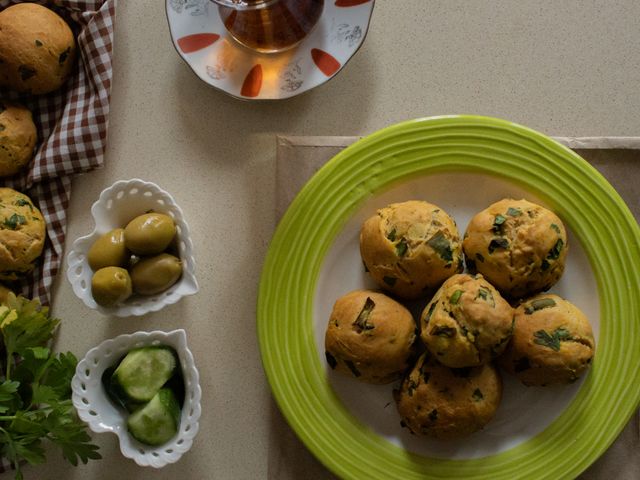
Buttery scones infused with the bright, salty-sour punch of umeboshi plums and sharp aged cheddar. The umeboshi brings an umami depth and tangy bite that cuts through the richness of cheese and cream, creating an unexpectedly sophisticated savory quick bread. Serve warm with clotted cream and jam, or alongside soup or salad.
Steps
Before you start
- Cut butter into ½-inch cubes and chill until ice-cold—at least 30 minutes ahead, or use straight from the freezer
- Preheat oven to 400°F (200°C) and line a baking sheet with parchment paper
- Pit and finely chop umeboshi plums (discard pits); measure the flesh
- Grate cheddar cheese finely; set aside
Mix dry ingredients
- In a large bowl, whisk together flour, sugar, baking powder, and salt.
- This distributes the leavening evenly and prevents lumps.
+ Show details− Hide details
Ready when: Dry ingredients are evenly combined and no lumps remain.
Tip: Sift flour if it feels compacted, to ensure tender scones.
Cut in cold butter
- Add the cold butter cubes to the flour mixture.
- Using a pastry cutter, two knives, or your fingertips, work the butter into the flour until the mixture resembles coarse breadcrumbs with some pea-sized pieces of butter still visible.
- Work quickly; warm butter melts into the flour and makes dense scones.
+ Show details− Hide details
Ready when: Mixture looks like coarse breadcrumbs with some pea-sized butter pieces visible.
Tip: Do not overmix or blend the butter completely smooth—small butter pieces create the flaky layers.
Fold in cheese and umeboshi
- Add the grated cheddar and chopped umeboshi plums to the flour mixture.
- Gently fold together with a few light strokes of a fork or wooden spoon, just until evenly distributed.
- Do not knead or compress.
+ Show details− Hide details
Ready when: Cheese and umeboshi are scattered throughout the dough with no large pockets visible.
Tip: Folding rather than stirring keeps the dough light and prevents gluten development.
Add cream and bring together
- Pour the cold cream into the mixture and fold gently with a wooden spoon or bench scraper, working from the bottom of the bowl upward, just until the dough comes together.
- The dough should be slightly shaggy and hold together when pressed, but not slick or sticky.
- If it feels very dry, add another tablespoon (15 ml) cream.
+ Show details− Hide details
Ready when: Dough holds together when pressed but is still crumbly and soft, not sticky.
Tip: Overworking the dough after adding cream develops gluten and toughens the scones. Stop as soon as it barely holds together.
Shape and cut scones
- Turn the dough out onto a lightly floured work surface.
- Gently press and pat into a ¾-inch-thick round disc, handling it as little as possible.
- Using a 2-inch (5 cm) round biscuit cutter or the rim of a teacup dipped in flour, cut out 8 scones, pressing straight down without twisting (twisting seals the edges and prevents rising).
- Place scones 2 inches (5 cm) apart on the prepared baking sheet.
+ Show details− Hide details
Ready when: 8 evenly cut scones are arranged on the baking sheet with space between them.
Tip: Press the cutter straight down and lift it straight up—twisting seals the cut edges and prevents the scones from rising fully.
Brush and bakeOven 400°F / 205°C
- Brush the tops of the scones lightly with the beaten egg wash (or a thin brush of cream for a more subtle finish).
- Place the baking sheet in the preheated 400°F (200°C) oven.
- Bake for 16–18 minutes, until the scones are golden brown on top and a skewer inserted into the center comes out clean (it will feel slightly warm and just-baked).
+ Show details− Hide details
Ready when: Scones are deep golden brown on top, firm to the touch, and a skewer inserted into the center comes out clean.
Tip: Do not open the oven door in the first 14 minutes—oven heat loss can cause them to fall flat.
Cool briefly and serve
- Transfer the baking sheet to a wire cooling rack and let the scones rest for 5 minutes.
- They will set and firm up slightly.
- Serve warm, split in half horizontally, with clotted cream and jam, or alongside a bowl of soup or salad.
+ Show details− Hide details
Ready when: Scones are warm and hold together when split; crumb is light and tender.
Tip: Serving scones warm brings out the soft, crumbly texture and the bright tang of umeboshi.
Good to know
Tips
- Umeboshi plums vary in salt and intensity—taste your plum paste first. If it is very salty, finely chop it and soak briefly in cold water (30 seconds), then squeeze dry. This mutes excessive saltiness while preserving the tangy flavor.
- For a more pronounced umeboshi flavor, increase the umeboshi to 3.5 tablespoons (50 g) and reduce the salt to ¼ teaspoon (1.5 g).
- Serve these scones warm with clotted cream and a dollop of umeboshi paste mixed with a little honey, or with Japanese apricot jam (ume-jamu) for a double umeboshi hit.
- These scones pair beautifully with a cup of hot green tea, hojicha, or even champagne.
Make ahead
Yes. Prepare the dough through step 4 (just before shaping), cover tightly, and refrigerate for up to 8 hours. Shape, cut, and bake as directed; you may need to add 2–3 minutes to the baking time if baking from cold. Alternatively, cut the scones, place them on a baking sheet, cover with plastic wrap, and freeze for up to 1 month; bake directly from frozen, adding 3–4 minutes to the baking time.
Storage & reheating
Room temperature (airtight container): up to 2 days. Refrigerator: up to 4 days. Freezer: up to 1 month (wrapped individually in plastic wrap, then in a freezer bag). Reheat gently in a 300°F (150°C) oven for 5–7 minutes, or wrap in a damp paper towel and microwave for 20–30 seconds.
Substitutions
- sharp aged cheddar cheese → Gruyère cheese or Comté. Use the same weight; these aged cheeses offer similar umami depth and nutty flavor without overpowering the umeboshi.
- umeboshi plums → Japanese pickled ginger (benishoga), finely chopped. Use the same weight; it provides bright acidity and tanginess with less saltiness. Reduce the kosher salt to ¼ teaspoon (1.5 g).
- heavy cream → Buttermilk or Greek yogurt (thinned with water if very thick). Use the same volume; these add slight tang that complements umeboshi and produce slightly more tender scones.
- unsalted butter → Cold coconut oil or lard. Use the same weight; both create equally flaky scones. Coconut oil adds subtle flavor; lard is classic British scone technique.