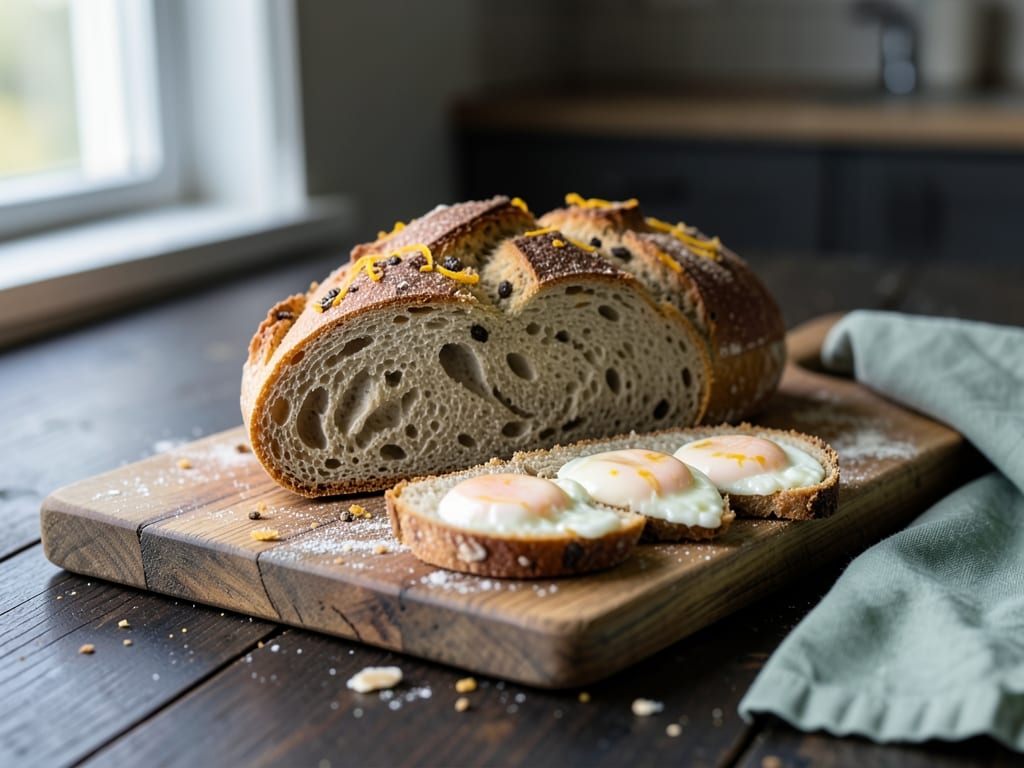
Sourdough Tsoureki
A soft, shreddable Greek Easter bread made with a wild-yeast starter, fragrant with orange zest, mastic and mahleb. Two braided loaves with a glossy, deep-gold crust and a feathery, buttery crumb.
- Prep
- 1 hr 25 min
- Cook
- 35 min
- Wait
- 8 hr 20 min
- Total
- 10 hr 20 min
- Makes
- 2 braided loaves (8 slices each)
Steps
Before you start
- Feed your starter 4–8 hours before mixing, at a 1:1:1 ratio by weight (starter:flour:water), until it has doubled, is domed and bubbly, and floats in a glass of water. A sluggish starter is the number one cause of dense tsoureki.
- Take the eggs out of the fridge and soften the butter (it should dent easily but not be greasy) about 1 hour before starting.
- This is a long, warm-room bread: plan about 10 hours from mixing to cooling. Ideal dough temperature is 76–80°F (24–27°C).
- Mastic tears and mahleb are sold in Greek and Middle Eastern shops and online. Mahleb is best bought whole and ground fresh, since it fades quickly.
Grind the spices
- Place the mastic tears and 1 teaspoon of the sugar in a spice grinder or mortar.
- Grind until you have a fine, uniform powder with no visible grit.
- Stir in the ground mahleb.
+ Show details− Hide details
Ready when: The mixture looks like pale, fine powder with no sticky lumps.
Tip: Mastic gums up when ground alone. The sugar keeps the tears brittle and stops them clumping.
Mix and rest
- In the mixer bowl, whisk together the starter, lukewarm milk, the remaining sugar and the beaten eggs until the starter is mostly dispersed.
- Add the orange zest, the ground spice mixture and the flour.
- Mix on low with the dough hook (or by hand) for 2 minutes until no dry flour remains and the dough looks shaggy.
- Cover and rest 30 minutes so the flour hydrates.
+ Show details− Hide details
Ready when: No dry flour pockets remain; the dough is sticky and shaggy.
Knead in salt and butter
- Sprinkle the salt over the dough and knead on medium-low (speed 2 on a stand mixer) for 4 minutes.
- With the mixer running, add the butter a few pieces at a time, waiting until each addition is mostly absorbed before adding more.
- Continue to knead 6–8 minutes more, scraping the hook and bowl as needed.
+ Show details− Hide details
Ready when: The dough is smooth, glossy and pulls away from the sides of the bowl. A small piece stretches into a thin, translucent window without tearing right away. Dough temperature is 76–80°F (24–27°C).
Tip: If the dough looks greasy and slack, the butter was too warm. Rest it 10 minutes and continue kneading.
Bulk ferment with folds
- Transfer the dough to a lightly oiled or buttered 4-quart (4 L) container and cover.
- Let it sit at 76–78°F (24–26°C).
- At 30 and 60 minutes, wet your hand and perform a set of stretch-and-folds: pull one side of the dough up and fold it over to the center, rotate the container a quarter turn, and repeat 4 times.
- Then leave undisturbed for the remaining time, about 4 hours total from the start, until the dough has risen by about 50–75% and looks puffy.
+ Show details− Hide details
Ready when: The dough has risen 50–75%, is domed and jiggly, with bubbles visible at the edges and sides.
Tip: Enriched sourdough ferments slower than plain loaves. If your kitchen is cool, allow up to 6 hours, and judge by the dough, not the clock.
Divide and rest
- Turn the dough out onto a lightly floured counter.
- Weigh it (about 1,300 g) and divide into 6 equal pieces of about 220 g each.
- Pre-shape each into a loose ball, cover with a towel and rest 15 minutes.
+ Show details− Hide details
Ready when: The balls feel relaxed and slightly flattened when pressed.
Roll the strands
- Working with one ball at a time on an unfloured or barely floured counter, flatten it slightly and roll it into a rope about 16 inches (40 cm) long, tapering the ends slightly.
- If it springs back, move on to the next ball and return to it in a few minutes.
+ Show details− Hide details
Ready when: All six ropes are even in thickness, about 16 inches (40 cm) long.
Tip: Too much flour on the counter prevents grip, so ropes slide instead of stretching.
Braid the loaves
- Line up 3 ropes side by side, joined at the top by pinching the ends firmly together.
- Braid loosely, over and under, from the middle toward each end rather than pulling taut, since the dough will expand.
- Pinch the ends together and tuck them under.
- Transfer to a parchment-lined baking sheet and repeat with the other 3 ropes on the second sheet.
+ Show details− Hide details
Ready when: Each braid is neat, about 12 inches (30 cm) long, with ends tucked under.
Tip: A tight braid restricts the rise and splits the crust at the seams.
Final proofOven 350°F / 175°C
- Cover each loaf loosely with a lightly oiled sheet of plastic wrap or a clean towel.
- Proof at 76–78°F (24–26°C) for about 3 hours.
- About 30 minutes before the end, position racks in the upper and lower thirds of the oven and preheat to 350°F (175°C).
+ Show details− Hide details
Ready when: Loaves are visibly puffy, about 1½ times their size. A gentle fingertip press leaves a dent that springs back slowly and partially.
Tip: If the dent springs back instantly, give them another 30 minutes. If it doesn't spring back at all, bake right away.
Wash and top
- Whisk the egg with the 1 tablespoon milk until smooth.
- Brush gently and thoroughly over both loaves, getting into the crevices of the braid without pooling.
- Scatter the sliced almonds over the tops.
+ Show details− Hide details
Ready when: Loaves look evenly glossy with almonds dotted across the tops.
Tip: Press down lightly with the brush: the proofed dough deflates easily.
BakeOven 350°F / 175°C
- Bake both sheets at 350°F (175°C) for 33–35 minutes, swapping the sheets between racks and rotating them front to back after 18 minutes.
- If the loaves are browning too fast at about 20 minutes, tent loosely with foil.
- Bake until deep mahogany-gold and the internal temperature reaches 195°F (90°C).
+ Show details− Hide details
Ready when: Crust is a deep golden brown, the loaf sounds hollow when tapped on the bottom, and an instant-read thermometer in the center reads 195°F (90°C).
Tip: The egg wash and sugar brown quickly, so watch for darkening after 20 minutes.
Cool completely
- Slide the loaves, still on the parchment, onto wire racks.
- Cool at least 45 minutes before slicing, or tear off pieces by hand once barely warm.
+ Show details− Hide details
Ready when: Loaves feel just barely warm to the touch on the bottom.
Good to know
Tips
- Judge fermentation by the dough, not the clock: enriched sourdough can take 5–6 hours for bulk and 4 hours for proof in a cool kitchen.
- Add the butter gradually: dumping it all in at once makes the dough greasy and slows gluten development.
- For the traditional red-egg look, tuck a dyed, hard-boiled egg into the center of each braid before the final proof, securing it with two thin strips of dough. Eggs baked in the loaf should be eaten within 2 days and refrigerated.
- Weigh your flour and dough pieces: even strands braid more neatly and bake at the same rate.
Make ahead
"After the stretch-and-folds (end of step 4's first hour), refrigerate the covered dough for 8–12 hours instead of the remaining room-temperature bulk. Let it sit at room temperature for 1 hour before dividing and shaping. The final proof may need 30–60 minutes longer because the dough starts cool."
Storage & reheating
"Room temperature: wrap tightly or keep in a bread bag for up to 3 days. Refrigerator: not recommended, as it stales the bread faster. Freezer: wrap tightly in plastic and foil, or slice first, and freeze for up to 3 months. Thaw at room temperature, then refresh whole loaves in a 300°F (150°C) oven for 8–10 minutes, or toast slices."
Substitutions
- mastic tears → Omit and add ¼ teaspoon extra mahleb plus ¼ teaspoon vanilla extract. The flavor will be less resinous and piney, but still pleasantly aromatic.
- ground mahleb → ¼ teaspoon almond extract plus a pinch of ground cardamom. Mimics mahleb's cherry-almond character, but is not identical.
- bread flour → All-purpose flour. The crumb will be a little softer and less chewy; reduce milk by 1 tablespoon if the dough feels slack.
- sliced almonds → Pearl sugar or sesame seeds. Use the same amount. Pearl sugar adds a crunchy, sweet top.
More yeast breads
See all →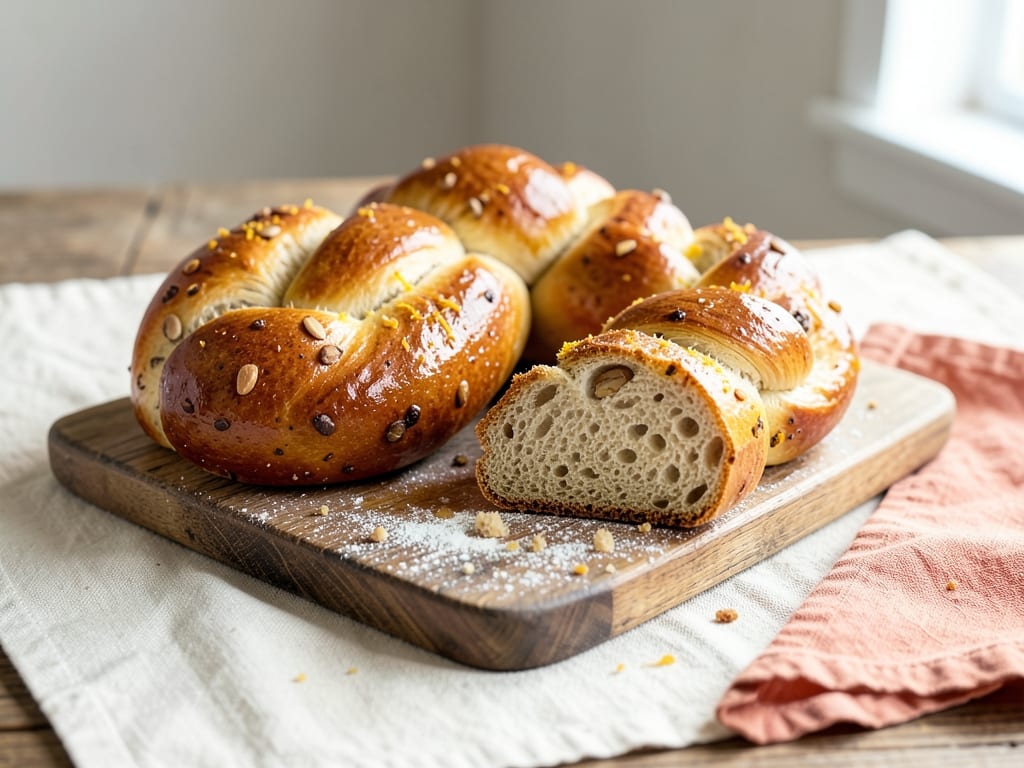
Find more like this
- Meal
- Breakfast
- Cuisine
- Greek
- Diet
- VegetarianHalal
- Quick & Easy
- Make AheadFreezer Friendly
- Occasion
- Easter