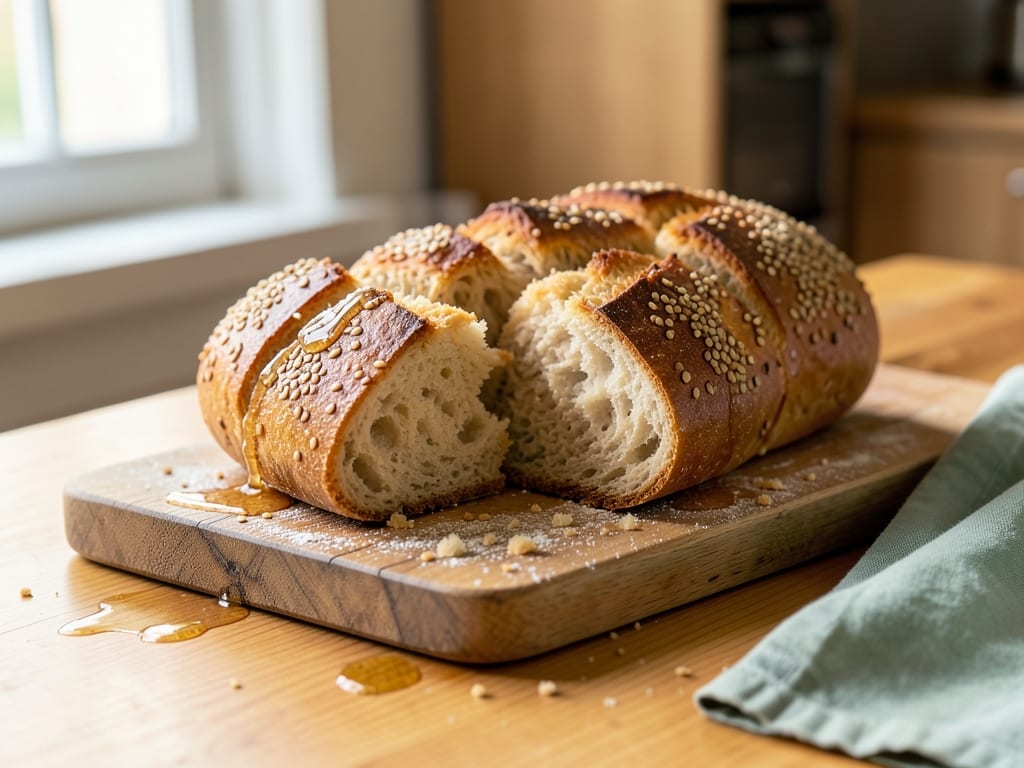
Sourdough Koulouri Thessalonikis
Sourdough Koulouri Thessalonikis is a traditional Greek street bread from the northern city of Thessaloniki. These rings of rustic sourdough are generously coated with sesame seeds and baked until golden and crispy. With a chewy interior and sturdy, seed-studded crust, they're perfect for breakfast, snacking, or with a simple tzatziki dip. The slow sourdough fermentation develops deep flavor and creates natural complexity that belies the recipe's simplicity.
- Prep
- 1 hr 20 min
- Cook
- 30 min
- Wait
- 8 hr 30 min
- Total
- 10 hr 20 min
- Makes
- 8 koulouri rings (or 10 for smaller portions)
Steps
Before you start
- Feed your sourdough starter 4-8 hours before you begin—it should be active, bubbly, and at or near its peak
- Weigh all ingredients on a kitchen scale before mixing; precision matters for sourdough
- Position your oven racks so the middle rack is clear for the baking sheet
- Choose your proofing location wisely—a warmer spot (68-75°F / 20-24°C) ferments faster than a cool kitchen
Mix and autolyse
- In a large bowl, combine bread flour, room-temperature water, and fed sourdough starter.
- Stir with a wooden spoon until all dry flour is hydrated and the mixture forms a shaggy, rough dough—a few dry streaks are fine.
- Cover the bowl with a damp kitchen towel or plastic wrap and let rest at room temperature for 30 minutes.
- This autolyse resting period allows the flour to fully absorb water and improves the dough's extensibility and flavor.
+ Show details− Hide details
Ready when: All flour is moistened; mixture is rough and shaggy
Tip: Use a kitchen scale to weigh ingredients—precision is essential for sourdough success
Knead and bulk fermentation
- Sprinkle salt over the dough and knead by hand for 10 minutes (stretching and folding it over itself repeatedly), or use a stand mixer on medium speed for 5-6 minutes until the dough becomes smooth and springs back when pressed.
- Transfer to a clean, lightly oiled bowl, cover, and let bulk ferment at room temperature.
- Over the next 4-5 hours, perform 2-3 stretch-and-folds: wet your hand, grab the dough from one side, stretch it up and fold it over itself, rotate the bowl 90°, and repeat 3-4 times.
- Do this every 45-60 minutes for the first 2 hours, then let it rise undisturbed.
- The dough is ready when it has increased 50-75% in volume and feels airy when gently shaken.
+ Show details− Hide details
Ready when: Dough has increased 50-75% in volume, feels airy and jiggly
Tip: Room temperature matters—at 68-70°F (20-21°C) expect 4.5-5 hours; at 75°F (24°C) expect 3.5-4 hours. Watch for volume increase, not clock time.
Divide the dough
- Lightly dust your work surface with flour.
- Turn the bulk-fermented dough out onto the surface and gently divide it into 8 equal pieces (about 110g each) using a bench scraper or knife.
- Shape each piece into a loose ball by folding the edges toward the center.
- Place the balls on a lightly floured surface, cover with a damp towel, and let rest for 20-25 minutes until they feel slightly relaxed and easier to handle.
+ Show details− Hide details
Ready when: Dough balls look relaxed and slightly larger
Tip: For smaller koulouri, divide into 10 pieces (about 91g each) instead—just shorten the final proof slightly
Shape into rings
- Take one dough ball and gently roll it on your work surface with both hands, working from the center outward, until you have a rope about 8-9 inches (20-23 cm) long and roughly 1 inch (2.5 cm) thick.
- Connect the two ends to form a ring, pressing and sealing them lightly with a touch of moisture if needed.
- Transfer the ring seam-side down to a piece of parchment paper on your baking sheet.
- Repeat with the remaining dough balls, spacing them about 2 inches (5 cm) apart.
+ Show details− Hide details
Ready when: All pieces are shaped into even rings with sealed ends
Tip: Keep your hands and work surface lightly floured but not wet—the dough should have enough grip to not slip
Coat with sesame seeds
- Pour the sesame seeds onto a shallow plate.
- Pour room-temperature water into a small bowl.
- Take the first ring and lightly brush or spray the top and sides with water (a light mist is enough).
- Place the wet ring directly into the sesame seeds, gently roll and press it so the seeds coat the entire surface evenly.
- Transfer it back to the parchment paper.
- Repeat with all remaining rings.
- The koulouri should be generously and completely coated with sesame seeds.
+ Show details− Hide details
Ready when: All rings are generously coated with sesame seeds on all sides
Tip: Don't oversaturate with water or the sesame will slide off—a light mist is all you need for adhesion
Final proofOven 450°F / 230°C
- Cover the baking sheet loosely with a clean kitchen towel or plastic wrap.
- Let the koulouri proof at room temperature for 60-90 minutes.
- They should look noticeably puffier than after shaping, and when you gently poke one, it should feel springy with some resistance (they should not look as puffy as bagels, or they may collapse during baking).
- Meanwhile, preheat your oven to 450°F (232°C) during the last 30 minutes of proofing, positioning the middle rack to fit the baking sheet and optionally a lower rack for a steam pan.
+ Show details− Hide details
Ready when: Rings are noticeably puffier; gentle poke leaves a slow-recovering indent
Tip: Sourdough can over-proof quickly during final proof—do not exceed 90 minutes or they may deflate in the oven
Bake the koulouriOven 450°F / 230°C
- Place the baking sheet in the middle of the preheated 450°F (232°C) oven.
- For a crispier, more developed crust, create steam by placing a pan of hot water on the bottom oven rack, or spray the rings lightly with water 2-3 times during the first 10 minutes of baking.
- Bake for 25-30 minutes until the sesame seeds are deep golden brown and the rings are golden on all sides.
- The koulouri should sound hollow when you tap the bottom.
+ Show details− Hide details
Ready when: Sesame seeds are deep golden brown, crust is firm, rings sound hollow when tapped on bottom
Tip: Don't skip the steam—it helps with oven spring and keeps the crust crispy and golden
Cool and finish
- Transfer the koulouri to a wire cooling rack and let cool for at least 30 minutes before eating.
- While they're still warm (optional), brush each ring lightly with honey and sprinkle with a tiny pinch of coarse sea salt—this is the traditional Thessaloniki finishing.
- This creates a light glaze and adds a savory-sweet edge.
- The koulouri will firm up and develop a more pleasant texture as they cool completely.
+ Show details− Hide details
Ready when: Rings are cooled to room temperature and feel firm throughout
Tip: Resist eating them straight from the oven—they're easier to bite through once cooled, and the flavor develops more fully
Good to know
Tips
- Feed your starter 4-8 hours before mixing—it should be active, bubbly, and at or near peak rise. Underripe starter makes dense, slow-rising dough; overly ripe starter may result in overproofing.
- Use a kitchen scale for all ingredients—sourdough requires precision. Cup measurements for flour vary by packing and humidity.
- Stretch-and-fold is gentler than traditional kneading and builds strength without degassing the dough. This is key to keeping the dough airy through bulk fermentation.
- Bulk fermentation time varies with room temperature. Prioritize visual cues (50-75% volume increase, airy texture) over clock time. A thermometer hanging in your kitchen helps predict timing.
- Sesame seeds will brown and darken as they bake, especially in the last 5 minutes. If they're pale at 20 minutes, don't panic—they'll deepen. Rotate the pan if one side browns faster.
Make ahead
Shape the koulouri, coat with sesame seeds, cover tightly, and refrigerate for 8-16 hours. Bake directly from cold without thawing, adding 5-10 minutes to the bake time (30-40 minutes total at 450°F / 232°C).
Storage & reheating
Store cooled koulouri in an airtight container or paper bag at room temperature for 2-3 days. Freeze in a freezer bag for up to 3 months. To reheat: wrap in foil and warm in a 325°F (160°C) oven for 10 minutes, or place directly under the broiler for 2-3 minutes to refresh the crust.
Substitutions
- Sesame seeds → Poppy seeds, nigella (black onion) seeds, or a mix of seeds. Use the same weight. Poppy seeds will be less traditional but equally delicious. Mix creates a beautiful speckled appearance.
- Honey → Extra-virgin olive oil. Brush warm koulouri with 1-2 tsp olive oil instead of honey for a savory finish. Classic in some regions of Greece.
- Active sourdough starter → Instant yeast (5g / 1.5 tsp). Reduce bulk fermentation to 2 hours and final proof to 45-60 minutes. Flavor will be milder and less complex without the sourdough's long fermentation.
- Bread flour → Whole wheat flour (up to 20% of total flour). Replace up to 100g bread flour with whole wheat flour. Add 10-15ml extra water as whole wheat absorbs more liquid. Flavor becomes nuttier.
More sourdough
See all →
Find more like this
- Meal
- Breakfast
- Cuisine
- Greek
- Method
- Oven
- Quick & Easy
- 5 Ingredients or LessMake Ahead