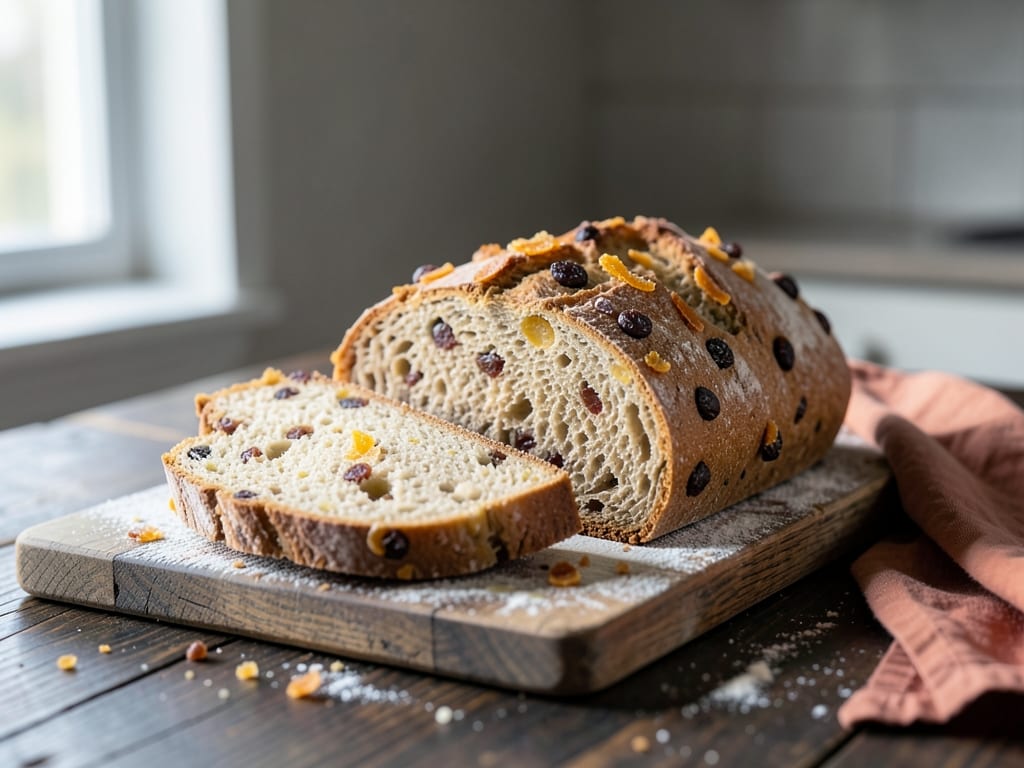
Sourdough Panettone
A traditional Italian sweet bread elevated with sourdough fermentation, enriched with butter, egg yolks, candied orange peel, and raisins. The long fermentation develops subtle complexity and flavor while the rich, buttery dough creates a tender, luxurious crumb with a delicate golden exterior. This sourdough version yields a stunning loaf with an open, airy interior—perfect for special occasions, holiday gifting, or simply indulging in an authentic homemade panettone.
- Prep
- 1 hr 10 min
- Cook
- 55 min
- Wait
- 1.2 days
- Total
- 1.3 days
- Makes
- 1 panettone loaf (12 slices)
Steps
Before you start
- Your sourdough starter should be fed 8–12 hours before you begin; it should be bubbly, doubled in volume, and at peak activity with a pleasant sour aroma
- Have all ingredients at room temperature (except water, which should be 80–85°F / 27–29°C) for even incorporation and smooth dough development
- Choose a warm location for fermentation (70–75°F / 21–24°C); panettone ferments slowly in cold kitchens and may need 2–3 extra hours per stage
- Obtain a panettone mold (4–5 inches / 10–12 cm tall) or use a 6-inch round cake pan with parchment paper; panettone's height is part of its charm
- This recipe takes 30–32 hours from mixing to final cooling; plan accordingly and ensure you have dedicated fermenting space
Prepare initial dough
- In a large bowl, combine the active sourdough starter, warm water, and bread flour.
- Stir vigorously with a spoon until all flour is incorporated and you have a shaggy, slightly wet dough.
- Add the fine sea salt and mix until fully distributed.
- The dough should be cohesive but rough.
- Cover the bowl tightly with plastic wrap or a damp towel and let rest at room temperature (70–75°F / 21–24°C) for 30 minutes.
- This autolyse allows the flour to fully hydrate and begins developing gluten.
+ Show details− Hide details
Ready when: All flour is incorporated; dough is shaggy, cohesive, and slightly sticky
Tip: Use a sourdough starter at its absolute peak—bubbly, recently fed, and doubled—for the best fermentation and flavor
Build strength with butter and egg incorporation
- After the 30-minute rest, begin a series of stretches and folds to incorporate butter and develop gluten.
- Wet your hand, grab one edge of the dough, stretch it upward over the center, and fold down.
- Rotate the bowl 90° and repeat 4 times until the dough is tighter.
- Let rest 20 minutes.
- Cut the cold butter into small cubes.
- On your next set of stretches and folds (20 minutes later), scatter 1/3 of the butter pieces over the dough before folding.
- Perform 4 stretches and folds, then let rest 20 minutes.
- On the third set of folds (20 minutes later), add another 1/3 of the butter and repeat the folding process.
- Rest 20 minutes.
- On the fourth set of folds, add the final 1/3 of butter along with the 6 beaten egg yolks that have been whisked together with the caster sugar and vanilla extract.
- To prepare this mixture, beat the 6 egg yolks with the sugar until pale and thick (about 2 minutes), then stir in the vanilla.
- Drizzle this mixture slowly into the dough during folding so it fully incorporates.
- After completing 4 folds, rest 20 minutes.
- The dough should now be smooth, glossy, and elastic, with barely a trace of stickiness.
- Cover and let bulk ferment at warm room temperature (70–75°F / 21–24°C) for approximately 8–10 hours until the dough has nearly doubled in volume, feels airy, and shows visible fermentation bubbles when gently pressed.
+ Show details− Hide details
Ready when: Dough nearly doubled, soft and airy, with visible bubbles; pressing gently leaves a slow-rising indentation
Tip: Incorporate cold butter gradually in stages so it doesn't shock the developing dough; cold butter takes time to absorb, and rushing leads to a greasy, collapsed dough. Keep your hands wet to prevent sticking
Fold in candied fruits and final bulk
- Gently pour the dough onto a clean, lightly oiled work surface.
- Do not flour heavily—oil prevents sticking without drying the dough.
- Sprinkle the chopped candied orange peel and raisins evenly over the dough.
- Using the same stretch-and-fold technique, gently incorporate the fruits by folding the sides toward the center and rotating.
- Work through 4–6 folds until the fruits are fairly evenly distributed throughout.
- Handle very gently to avoid deflating air pockets.
- Place the dough back in the bowl, cover, and let bulk ferment another 8–10 hours at warm room temperature until puffy and nearly doubled again.
- Because of the fruit weight, the rise may be less dramatic than the first bulk, but the dough should feel airy and wobble gently when the bowl is tapped.
+ Show details− Hide details
Ready when: Dough is puffy and jiggly; yields gently to a poke with no resistance; fermentation aroma is pronounced
Tip: Work extremely gently when folding in fruits to avoid deflating the developed air pockets—panettone's signature open crumb depends on preserving every bubble
Shape and proof in mold
- Line your panettone mold with parchment paper (the paper should extend above the rim).
- If using a cake pan, line it similarly with parchment.
- Have the mold ready.
- Gently turn the dough onto a very lightly oiled surface.
- Without aggressive shaping, gently coax it into a round shape, working from all sides and rotating it.
- You want to retain gas and not deflate it.
- Carefully place the dough seam-side down into the prepared mold.
- The dough should sit gently on the bottom.
- Cover the mold loosely with plastic wrap.
- Let the dough rise at warm room temperature (70–75°F / 21–24°C) for 8–12 hours, until it rises about 1 inch (2.5 cm) above the rim of the mold.
- The surface should be puffy, smooth, and spring back slowly when poked.
- The loaf should jiggle slightly when the mold is gently shaken.
+ Show details− Hide details
Ready when: Dough rises 1 inch above mold rim; surface is puffy and yields to a slow poke; loaf jiggles gently when shaken
Tip: A tall mold is essential for panettone's characteristic height and open crumb. If using a cake pan, the result will be wider and less tall, but still delicious. Ensure the dough is not over-proofed; it should not collapse when poked or baked
Bake until goldenOven 375°F / 190°C
- Preheat your oven to 375°F (190°C).
- Position a rack in the center of the oven.
- In a small bowl, whisk the reserved 1 egg yolk with 1 tablespoon of water to make an egg wash.
- Brush the top surface of the panettone gently with this wash.
- This adds shine and promotes even golden browning.
- Carefully place the panettone on the center rack of the preheated oven.
- Bake for 50–60 minutes, watching for deep golden-brown color on top.
- If the top darkens too quickly (before the interior is set), tent it loosely with foil to prevent over-browning.
- The panettone is done when the top is a rich golden brown and an instant-read thermometer inserted into the center registers 200°F (93°C).
- When unmolded slightly and tapped on the top, it should sound hollow.
+ Show details− Hide details
Ready when: Deep golden-brown top; internal temperature 200°F (93°C); sounds hollow when tapped
Tip: Panettone rises slowly and requires the full baking time; do not open the oven before 50 minutes. If the top browns too quickly, tent with foil. Sourdough panettone may color more deeply than its commercial counterparts due to the fermentation
Cool completely
- Remove the panettone from the oven and set the mold on a cooling rack.
- Let it cool in the mold for 15–20 minutes until it firms up enough to handle safely—the loaf will still be hot.
- Carefully tip the panettone out of its mold onto the cooling rack.
- Remove any parchment paper.
- Turn the loaf right-side up (top facing up) on the rack.
- Allow the panettone to cool at room temperature for at least 2 hours, preferably 4–6 hours or overnight, before slicing.
- The interior sets, the crumb firms up, and the flavors mature and integrate during this cooling period.
- The longer you allow it to cool, the better the texture and flavor.
+ Show details− Hide details
Ready when: Loaf is no longer hot to the touch; top is firm and golden; interior feels set (not still warm and custard-like)
Tip: Panettone's crumb is delicate and airy; slice with a serrated bread knife using a gentle sawing motion, not downward pressure, to preserve the beautiful open crumb and show off the interior
Good to know
Tips
- Panettone's signature open, airy crumb depends on gentle handling at every stage. Avoid aggressive mixing, rough shaping, and over-deflation during folding. Even small air bubbles, preserved carefully, contribute to the final luxurious texture.
- Temperature control is critical: panettone ferments slowly in cool kitchens (below 68°F / 20°C), and each fermentation stage may stretch 2–3 extra hours. A warm spot—such as a turned-off oven with the light on, a cooler with warm water, or a proof box set to 75°F—maintains ideal conditions.
- The cooling period is not wasted time; it is essential for flavor development. Panettone tastes noticeably better and more complex 6–12 hours after baking. Many bakers and aficionados prefer it a day or two old, once the crumb has fully set and flavors have integrated.
- For storage and gifting, keep panettone in its mold or in a tall, narrow container to preserve its characteristic shape. When slicing to eat, use a serrated knife and a gentle sawing motion to showcase the open crumb and the beautiful distribution of fruits without compressing the loaf.
Make ahead
The dough can be cold-fermented (retarded) in the refrigerator after Step 2 or Step 3 for up to 3 days. Cold fermentation actually improves sourdough flavor complexity. Simply cover the dough tightly with plastic wrap and refrigerate. When ready to continue, remove the dough 2–3 hours before the next fermentation step to let it come back to room temperature. Alternatively, after baking and cooling, the finished panettone keeps at room temperature for 2 weeks wrapped in foil, making it an ideal make-ahead gift.
Storage & reheating
Room temperature: Wrap the cooled panettone tightly in foil or store in an airtight container for up to 2 weeks. Panettone is naturally shelf-stable due to its high fat and sugar content. Refrigerator: For longer storage, keep refrigerated for up to 3 weeks; slice as needed. Freezer: Wrap tightly in plastic wrap and then in foil; freeze for up to 3 months. Thaw at room temperature for 4–6 hours before serving. The flavor and texture are best if eaten within 1 week of baking or cooling.
Substitutions
- active sourdough starter, fed and bubbly → If you lack a sourdough starter, dissolve 1/4 tsp instant (SAF) yeast in the warm water and use an extra 15g of flour to replace the starter. The dough will develop correctly, though it will lack the subtle tang and complexity that sourdough brings.. The sourdough version has superior flavor and open crumb; yeast fermentation is faster (8–12 hours less total time)
- candied orange peel → Use candied lemon peel, mixed citrus peel, or finely diced candied citrus. If citrus peel is unavailable, omit it and increase the raisins to 150g; the panettone will be less bright but still delicious.. Candied citrus adds traditional flavor and brightness; its omission shifts the profile toward richer, less zesty
- dark raisins or dried currants → Use a mix of raisins, dried currants, diced dried apricots, or dried cherries. Keep the total dried fruit amount at 100–120g to avoid overwhelming the dough.. Different dried fruits create subtle flavor variations; currants and cherries add tartness, apricots add stone-fruit notes
- unsalted butter, cold → Unsalted coconut oil or high-quality lard can replace butter in equal weight (150g), though butter provides the best traditional flavor and tender crumb.. Butter is essential to panettone's character; substitutes may yield different flavor and texture
More sourdough
See all →

Find more like this
- Meal
- Breakfast
- Cuisine
- Italian
- Main ingredient
- Eggs
- Diet
- VegetarianHalal
- Method
- Oven
- Quick & Easy
- Make Ahead
- Occasion
- Christmas