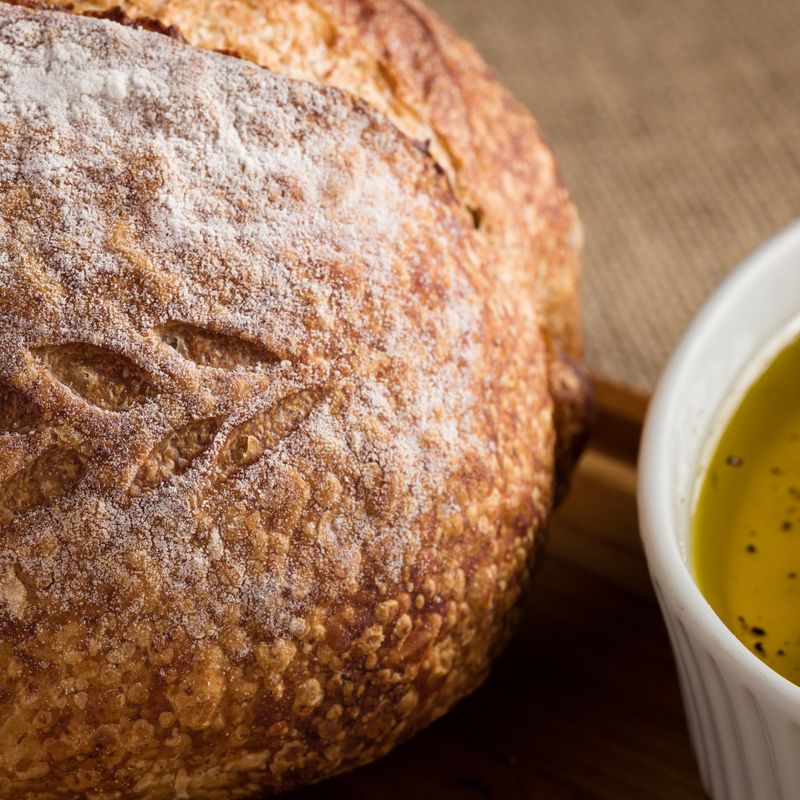
Sourdough Israeli Couscous and Roasted Zucchini Bread Bowl
A showstopping edible vessel: a hollow sourdough round filled with warm Israeli couscous, caramelized roasted zucchini, creamy feta, fresh mint, and a bright lemon-herb dressing. The crispy exterior and tender interior make the bread itself part of the dish—tear it away to scoop the Mediterranean filling.
- Prep
- 25 min
- Cook
- 50 min
- Wait
- 2 hr
- Total
- 3 hr 15 min
- Makes
- 4 bread bowls with filling
Steps
Before you start
- Have mature sourdough starter fed 4–8 hours prior (bubbly and peak volume)
- Preheat oven to 475°F (245°C) with a Dutch oven inside, 30 minutes ahead
- Measure all ingredients and prep vegetables before mixing dough
Mix the dough
- In a large bowl or the bowl of a stand mixer, combine the sourdough starter (180 ml), bread flour (325 g), water (180 ml), and salt (9 g).
- If using a stand mixer, attach the dough hook and mix on medium speed for 8–10 minutes until the dough is shaggy but well incorporated and pulls cleanly from the bowl.
- If mixing by hand, stir vigorously for 3 minutes, then knead for 5 minutes.
- The dough should be slightly tacky but hold together.
- Add the olive oil (15 ml) and continue mixing for 2 minutes until fully incorporated.
+ Show details− Hide details
Ready when: Dough is smooth, elastic, and pulls away from the bowl cleanly
Tip: If your starter is weak (not doubled in 4–8 hours), use an extra 10 minutes of autolyse—let flour and water sit for 10 minutes before adding starter and salt.
Bulk fermentation
- Cover the bowl loosely with a kitchen towel.
- Let the dough rest at room temperature (68–72°F / 20–22°C) for 3 hours, performing 4 sets of stretch-and-folds at 30-minute intervals: wet your hand, grab one side of the dough, pull it up and fold it over the center, rotate the bowl 90°, and repeat 4 times per set.
- After the final fold, let the dough rest undisturbed for 30 minutes until it looks puffy but not fully risen—it should increase 50–75% in volume.
+ Show details− Hide details
Ready when: Dough has risen 50–75%, feels airy but still holds shape
Tip: Stretch-and-folds replace aggressive kneading and help build strength in a wet dough; they also prevent over-fermentation.
Shape into rounds
- Turn the dough out onto a lightly floured surface and divide it into 4 equal pieces (each about 230 g).
- Working with one piece at a time, gently shape it into a round by pulling the edges toward the center, then rolling it seam-side down on the counter with your cupped hand to build surface tension.
- The dough should be a taut ball about 3½ inches (9 cm) in diameter.
- Place each round seam-side up in a small floured banneton or bowl lined with a kitchen towel.
+ Show details− Hide details
Ready when: Four smooth, taut rounds resting seam-side up
Tip: Don't overwork the dough; if it resists, let it rest 5 minutes and shape again. Surface tension helps the bread expand upward in the oven.
Final proof
- Cover the bannetons or bowls and let them rest at room temperature for 1 hour (or up to 8 hours refrigerated).
- The dough should look pillowy and spring back slowly when poked with a floured finger—it should not be so risen that it doesn't bounce back at all.
- If using the fridge, remove the dough 20 minutes before baking to take the chill off.
+ Show details− Hide details
Ready when: Dough springs back slowly when poked; feels pillowy
Tip: Poke gently 1 inch from the edge; if the indent holds, it's ready. If it springs back too fast, give it more time.
Prepare zucchiniOven 475°F / 245°C
- While the dough proofs, heat the oven to 475°F (245°C).
- Toss the sliced zucchini (450 g) with 3 tablespoons olive oil (45 ml), minced garlic (20 g), salt, and freshly ground black pepper.
- Spread in a single layer on a sheet pan and roast for 20–22 minutes, stirring halfway through, until the zucchini is tender, lightly caramelized at the edges, and golden.
- Set aside.
+ Show details− Hide details
Ready when: Zucchini is soft, edges are golden brown, liquid has mostly evaporated
Tip: Don't crowd the pan; a single layer ensures caramelization. If zucchini is very wet, pat it with paper towels before roasting.
Cook Israeli couscous
- While the zucchini roasts, bring the broth (600 ml) to a boil in a small saucepan.
- Add the Israeli couscous (240 g) and stir.
- Return to a boil, then reduce heat to low, cover tightly with a lid, and simmer for 10 minutes.
- The couscous should be tender and have absorbed most of the liquid.
- Remove from heat and let it stand, covered, for 2 minutes.
- Fluff with a fork.
+ Show details− Hide details
Ready when: Couscous is tender, broth is absorbed, grains are separate and fluffy
Tip: Don't peek or stir once you've covered the pan; steam builds pressure that cooks the couscous evenly.
Make the dressing
- In a small bowl, whisk together the lemon juice (45 ml), olive oil (30 ml), dried oregano (1 g), and minced garlic (5 g).
- Season with a pinch of salt and black pepper.
- Set aside.
+ Show details− Hide details
Ready when: Dressing is emulsified and fragrant
Tip: Make this just before serving so the garlic stays vibrant and the flavors haven't dulled.
Bake the bread bowlsOven 475°F / 245°C
- Carefully place the hot Dutch oven on the stovetop and transfer one dough round to parchment paper cut to size.
- Gently flip the dough seam-side down into the preheated Dutch oven.
- Cover with the lid and bake at 475°F (245°C) for 22–24 minutes.
- Remove the lid and bake for another 8–10 minutes until the crust is deep golden brown.
- Transfer to a wire rack.
- Repeat with the remaining 3 dough rounds, using the same Dutch oven (it will stay hot; reheat in the oven if needed for 3 minutes between batches).
+ Show details− Hide details
Ready when: Crust is deep golden brown and sounds hollow when tapped on the bottom
Tip: The Dutch oven traps steam, creating a crispy exterior; if your bread is pale, increase final uncovered baking time by 2–3 minutes.
Cool and hollow out
- Let the baked rounds cool for 10 minutes on a wire rack until they are cool enough to handle but still slightly warm.
- Using a sharp serrated knife or a small spoon, carefully cut a circle (2–2.5 inches / 5–6.5 cm in diameter) about ½ inch (1.3 cm) from the top of each round.
- Remove the lid and, using a small spoon or melon baller, gently scoop out the interior crumb, leaving about ¾ inch (2 cm) of bread on the sides and bottom to form a sturdy bowl.
+ Show details− Hide details
Ready when: Bread has a hollow interior while walls remain intact
Tip: Work gently to avoid cracking the bowl; if a side tears, you can still use it but be extra careful. Reserve scooped crumbs for dipping if desired.
Assemble and serve
- In a large bowl, combine the cooked couscous, roasted zucchini, crumbled feta (150 g), and chopped fresh mint (20 g).
- Drizzle with the lemon-herb dressing and toss gently to combine.
- Taste and adjust seasoning with salt and pepper.
- Spoon the warm filling into each bread bowl, dividing evenly.
- Serve immediately while the bread is still warm and the filling is hot.
+ Show details− Hide details
Ready when: All components are combined, warm, and the bread is ready to serve
Tip: If the bread bowls cool too much, place them in a 300°F (150°C) oven for 5 minutes to warm through without further browning.
Good to know
Tips
- Sourdough timing is flexible: you can cold-proof for 8 hours in the fridge to develop deeper flavor and convenience, then bake from cold—add 5 minutes to the covered baking time.
- For a vegetarian version, substitute the vegetable broth for chicken broth, which works equally well.
- If your couscous is still watery after simmering, drain it in a fine-mesh sieve for 30 seconds and return to the pot to dry out.
- The bread bowls are edible vessels—tear off pieces of the bread and use them to scoop the filling, so nothing goes to waste.
Make ahead
The sourdough dough can be shaped and refrigerated up to 8 hours before baking. The roasted zucchini and cooked couscous can be made up to 1 day ahead and reheated gently before assembly. The bread bowls are best served the same day they are baked but can be reheated, covered loosely with foil, in a 325°F (160°C) oven for 8–10 minutes.
Storage & reheating
Store cooled bread bowls in an airtight container at room temperature for up to 2 days. Freeze wrapped bread bowls for up to 1 month; thaw and reheat covered in a 325°F (160°C) oven for 10–12 minutes. Store the filling separately in the refrigerator for up to 3 days; reheat gently on the stovetop over medium-low heat, stirring occasionally, until warm through (about 5 minutes).
Substitutions
- Israeli couscous (pearl couscous) → Regular couscous or farro. Regular couscous will cook in 10 minutes; farro needs 25–30 minutes and a 1:3 grain-to-broth ratio. Both work but Israeli couscous has the best texture and appearance in this dish.
- crumbled feta cheese → Goat cheese or ricotta salata. Goat cheese is creamier; ricotta salata is firmer. Either provides a tangy, briny character similar to feta.
- medium zucchini → Summer squash, eggplant, or bell peppers. Yellow squash or Japanese eggplant work beautifully; bell peppers add sweetness. Adjust roasting time if using thicker vegetables (eggplant may need 25–28 minutes).
- fresh mint leaves → Fresh parsley or basil. Parsley is milder; basil adds warmth. Use the same volume; add just before serving so the flavor stays bright.
More yeast breads
See all →
Find more like this
- Meal
- Lunch
- Cuisine
- Mediterranean
- Diet
- HalalSugar-Free
- Method
- Oven
- Occasion
- Parties