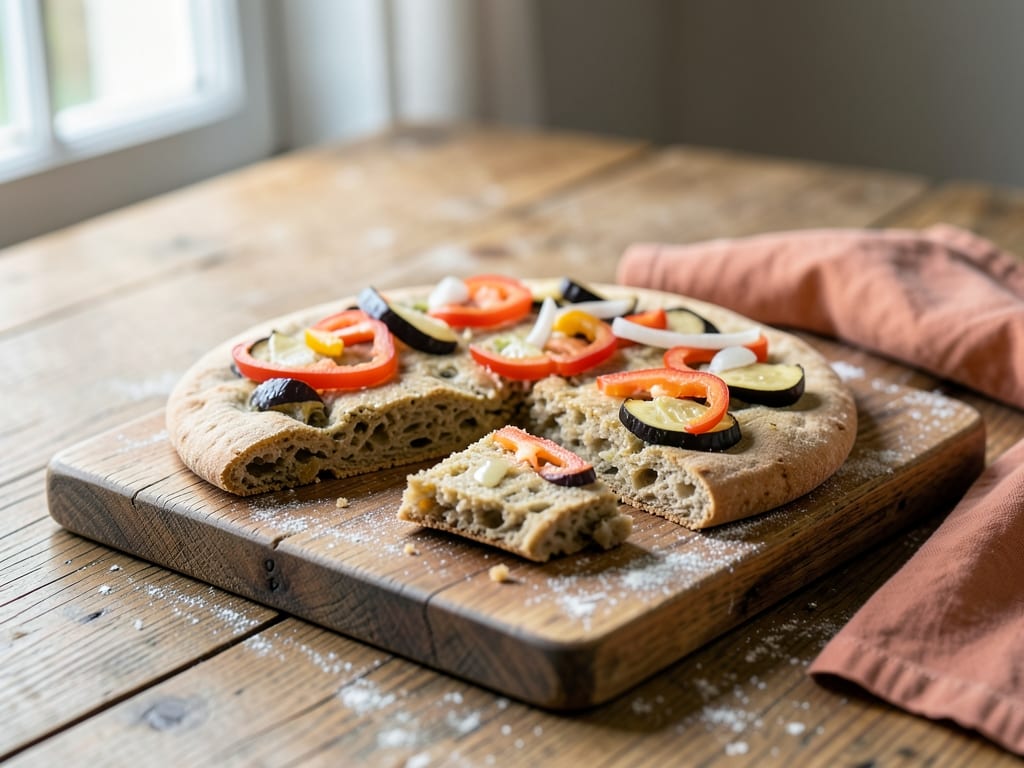
Sourdough Coca de Verduras
This Spanish vegetable flatbread uses sourdough starter and overnight cold fermentation to develop complex, tangy flavor. Topped with roasted bell peppers, onions, and eggplant, it's crispy and golden on the outside, tender and chewy inside. Perfect as an appetizer, lunch, or light dinner. Coca de Verduras is a traditional specialty of Catalonia and Valencia.
- Prep
- 1 hr
- Cook
- 53 min
- Wait
- 15 hr 40 min
- Total
- 17 hr 33 min
- Makes
- One 17×12-inch flatbread (8 appetizer servings or 4-6 main servings)
Steps
Before you start
- Have active sourdough starter (fed 4-8 hours before mixing, bubbly and at peak) ready
- Plan for 12-16 hours cold fermentation overnight; final shaping and baking take 2-3 hours the following day
- Vegetables can be prepped the evening before or the morning of baking
Mix the sourdough dough
- Combine bread flour, active sourdough starter, room-temperature water, salt, and olive oil in a large mixing bowl or the bowl of a stand mixer.
- If mixing by hand, stir with a sturdy spoon or use folding motions until all flour is hydrated and the ingredients form a shaggy, sticky dough.
- If using a stand mixer with dough hook, mix on medium speed for 8-10 minutes until the dough becomes smooth, elastic, and slightly sticky but holding together.
- You should see it wrap around the hook and come away from the bowl sides.
+ Show details− Hide details
Ready when: dough is smooth, elastic, and slightly sticky, wrapping around mixer hook or holding together when folded by hand
Tip: If hand-mixing, don't worry if it takes longer than 10 minutes; the goal is a smooth, cohesive dough that's not too wet
Cold ferment the dough overnight
- Transfer the dough to a lightly oiled large bowl or container.
- Cover loosely with a damp cloth or plastic wrap.
- Place in the refrigerator and let ferment for 12-16 hours (overnight and into the next morning).
- The cool temperature develops complex, tangy flavor and makes the dough easier to handle.
- You'll notice the dough rises slowly and becomes more relaxed.
+ Show details− Hide details
Ready when: dough is visibly puffier, increased in volume by 30-50%, with slight bubbles visible on the surface
Tip: Don't panic if the dough doesn't double—the cold fermentation is gentler than room-temperature fermentation. Even a 30-50% rise is perfect.
Prepare the vegetables
- While the dough ferments, prepare the vegetables: Rinse and core the bell peppers, removing seeds and membranes, then slice into ½-inch strips.
- Slice the onion into ½-inch wedges.
- Trim the eggplant and dice into ½-inch cubes.
- Place the diced eggplant in a colander, sprinkle generously with salt (about 1 teaspoon), and let drain for 15 minutes.
- This removes excess moisture.
- After 15 minutes, pat the eggplant dry with paper towels.
- You can complete this step the evening before (store prepped vegetables in a sealed container in the fridge) or the morning of baking.
+ Show details− Hide details
Ready when: vegetables are evenly sliced and diced; eggplant is dry after draining and patting
Tip: Salting and draining eggplant prevents it from releasing water during roasting, which would make the coca crust soggy
Roast the vegetablesOven 425°F / 220°C
- Preheat the oven to 425°F (220°C).
- Spread the prepared peppers, onions, and eggplant on a large roasting pan.
- Drizzle with 80ml olive oil (about ⅓ cup), sprinkle with salt, black pepper, and the fresh rosemary if using.
- Toss gently until all vegetables are coated.
- Spread in a single, mostly even layer.
- Roast for 25 minutes, stirring and turning the vegetables halfway through (around the 12-13 minute mark), until the vegetables are tender, edges are lightly caramelized, and peppers show slight charring.
- Remove from the oven and let cool while you prepare the dough.
- Leave the oven on, reducing the temperature to 400°F (200°C) for baking the coca.
+ Show details− Hide details
Ready when: vegetables are tender, lightly caramelized at edges, peppers show light charring
Tip: Roasting brings out the natural sweetness in peppers and onions; don't crowd the pan or they'll steam instead of roast
Warm and shape the dough
- Remove the cold dough from the refrigerator.
- Let it sit at room temperature for 30 minutes to warm up and become more relaxed—it will be much easier to stretch this way.
- Meanwhile, lightly oil a 17×12-inch (43×31 cm) sheet pan (a standard half-sheet pan).
- After 30 minutes, transfer the dough to the oiled pan.
- Using lightly oiled hands, a dough scraper, or a combination, gently stretch the dough from the center outward, gradually filling the pan.
- Work slowly and avoid tearing; if the dough resists, let it rest for 3-5 minutes and continue stretching.
- The dough should eventually stretch to fill most of the pan with a thickness of about ½ inch.
+ Show details− Hide details
Ready when: dough fills the sheet pan, is about ½ inch thick, and is relatively uniform across the surface
Tip: Cold dough is stiff and resistant; giving it time to warm to room temperature makes stretching much easier and less likely to tear
Final rise and top with vegetablesOven 400°F / 205°C
- Cover the shaped dough loosely with a damp cloth or plastic wrap.
- Let it rise at room temperature for 60 minutes until puffy and light to the touch.
- About 15 minutes before the end of the rise, check that your oven is preheated to 400°F (200°C).
- Once the dough has risen for 60 minutes, use your fingertips to gently dock (poke) the surface, creating small indentations all over to prevent large air bubbles from forming during baking.
- Lightly brush the surface with some of the cooled roasted vegetables' oil (about 1 tablespoon), or a little more olive oil if needed.
- Scatter the cooled roasted vegetables evenly over the surface, and sprinkle with additional salt and freshly ground black pepper to taste.
+ Show details− Hide details
Ready when: dough is visibly puffy and springs back slowly when poked gently with a finger
Tip: Docking prevents large air pockets from forming, which would create holes and uneven texture in the finished coca
Bake until goldenOven 400°F / 205°C
- Bake the coca at 400°F (200°C) for 25-28 minutes until the crust is deep golden brown, especially at the edges and bottom.
- The bottom should sound hollow when you tap it with a wooden spoon.
- If the edges brown too quickly (before the bottom crisps), tent loosely with aluminum foil for the remaining time.
- Once baked, remove from the oven and let rest on the sheet pan for 5-10 minutes before serving.
- This allows the crust to set and cool slightly.
- For an even crispier crust, transfer to a cooling rack after 2-3 minutes.
- The coca can be served warm or at room temperature.
+ Show details− Hide details
Ready when: crust is deep golden brown, especially at edges; bottom sounds hollow when tapped with a wooden spoon
Tip: A darker golden-brown crust tastes better and is crispier—don't be afraid of deep color at this temperature and duration
Good to know
Tips
- The overnight cold fermentation is essential for developing the complex, tangy sourdough flavor that makes coca de verduras special. Don't skip it or rush it; even 12 hours helps tremendously.
- Coca should have a crispy, golden-brown crust, especially at the edges. If you prefer a softer crust, reduce baking time by 2-3 minutes.
- Leftover coca reheats beautifully and is excellent as a lunch the next day, either warm or cold.
- Use room-temperature (not cold) water for the dough to ensure fermentation proceeds at a normal rate without acceleration or delay.
Make ahead
Sourdough dough can be prepared and fermented for up to 24 hours in the refrigerator; longer fermentation actually improves flavor. Vegetables can be roasted the day before and stored in an airtight container in the refrigerator for up to 3 days. Shape and bake the coca the next day.
Storage & reheating
Room temperature: Coca keeps loosely covered for 1-2 days, though the crust softens after a day. Refrigerator: Wrap tightly in plastic wrap and refrigerate for up to 5 days; reheat in a 350°F (175°C) oven for 8-10 minutes until crisped. Freezer: Wrap well in plastic wrap and foil, and freeze for up to 2 months. Thaw overnight in the refrigerator and reheat as directed above.
Substitutions
- bread flour → all-purpose flour. Coca will be slightly less chewy and more tender; the result is still delicious
- red and yellow bell peppers → any color bell peppers, or a mix with long hot peppers such as Fresno or poblano peppers. Different peppers add variety and different flavor notes; hot peppers add a spicy kick
- eggplant → zucchini or summer squash. Omit the salting and draining step; zucchini and squash release less water
- fresh rosemary → dried rosemary (1 teaspoon dried instead of 1 tablespoon fresh) or oregano. Dried herbs are more concentrated; oregano adds a different Mediterranean flavor profile
More flatbreads
See all →

Find more like this
- Meal
- Lunch
- Cuisine
- Spanish
- Main ingredient
- EggplantBell Peppers
- Method
- Oven
- Quick & Easy
- Make Ahead