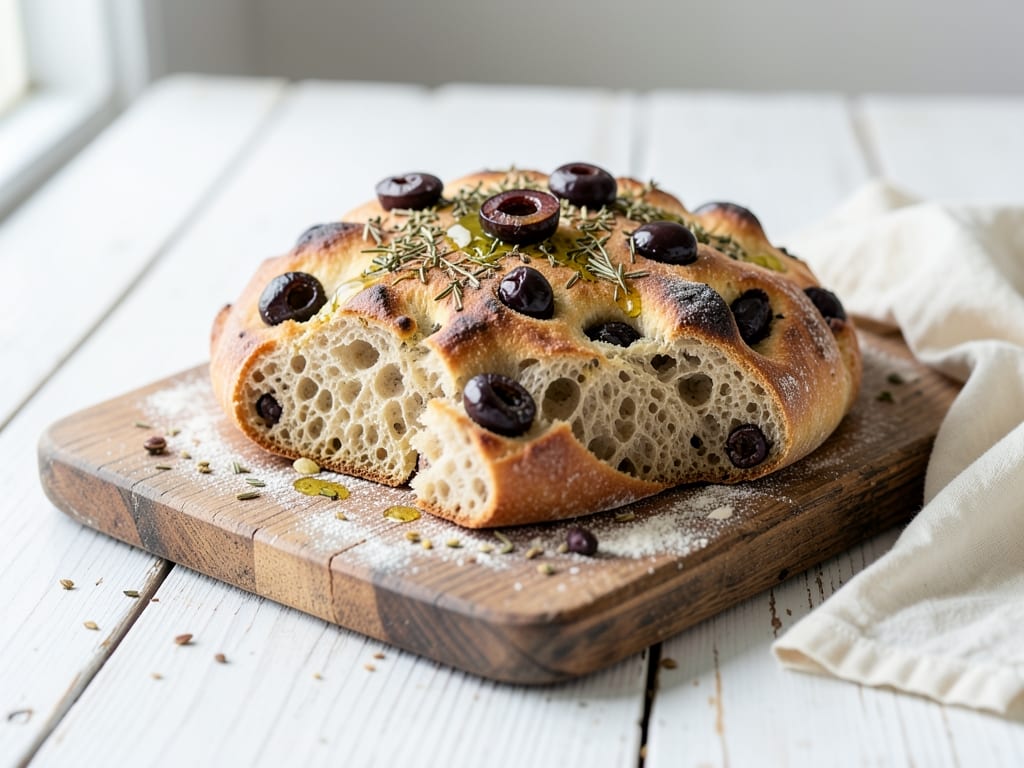
Sourdough Fougasse with Olives and Herbes de Provence
A rustic Provençal flatbread with the earthy tang of sourdough, studded with briny olives and fragrant dried herbs. The distinctive leaf-shaped fougasse has crispy-edged diagonal slashes that bake up golden and airy, with a soft, open crumb inside. Perfect for dipping in soups, tearing for sharing, or serving alongside cheese.
- Prep
- 30 min
- Cook
- 28 min
- Wait
- 7 hr 5 min
- Total
- 8 hr 3 min
- Makes
- 2 fougasse, approximately 10x8 inches each; serves 8-12 as part of a meal
Steps
Before you start
- Ensure your sourdough starter is active and bubbly, fed 4-8 hours before you begin
- Pit your olives if using whole ones; halve them beforehand
- Have all equipment and parchment paper ready
- Read through the timing: fermentation and proofing span 6+ hours total
Mix flour, water, and starter
- In a large bowl, combine bread flour (4 cups / 500g), room-temperature water (1.5 cups / 350ml), and active sourdough starter (about 2/3 cup / 150g).
- Stir with a wooden spoon or dough whisk until all flour is hydrated and no dry bits remain.
- The dough will look shaggy and rough.
- Cover the bowl with a damp towel and let rest undisturbed for 30 minutes.
- This autolyse period allows flour to fully absorb moisture and gluten to begin developing naturally without kneading.
+ Show details− Hide details
Ready when: Shaggy dough with all flour hydrated and no dry bits visible
Tip: Autolyse improves final texture and reduces mixing effort; skipping this step makes the dough harder to work with and less extensible.
Incorporate salt and olive oil
- Sprinkle fine sea salt (2 tsp / 10g) and 2 tbsp (30ml) olive oil over the rested dough.
- Using wet hands or a stand mixer with dough hook, mix for about 5 minutes until the salt is fully dissolved and oil is evenly distributed throughout.
- The dough should come together as a smooth, cohesive mass.
- If mixing by hand, wet hands prevent sticking better than adding flour.
+ Show details− Hide details
Ready when: Smooth, cohesive dough with salt and oil fully incorporated and no dry streaks
Tip: Keep hands wet rather than floured to avoid toughening the dough with extra flour.
Bulk fermentation with stretch and folds
- Cover the bowl loosely with a damp towel or plastic wrap.
- Let the dough rest at room temperature (68-72°F / 20-22°C) for 4-5 hours.
- During the first 2 hours, perform 4 sets of stretch and folds: every 30 minutes, grab the dough from one side, stretch it up and fold it over itself toward the center, rotate the bowl a quarter turn, and repeat 4 times per set.
- After the first 2 hours, stop folding and let the dough rise undisturbed.
- The dough should increase in volume by 50-75% and feel soft and airy with visible bubbles throughout.
- A gentle toothpick poke should leave a slow-to-recover indentation.
+ Show details− Hide details
Ready when: Dough has risen 50-75%, feels soft and airy with visible bubbles; toothpick poke leaves slow indentation
Tip: If your kitchen is cool, bulk fermentation may take 5-6 hours; if warm, it may finish in 3-4 hours. Adjust based on your space, not the clock.
Divide dough into two pieces
- Turn the fermented dough onto a lightly floured work surface.
- Using a dough scraper or bench knife, gently divide the dough into 2 equal pieces.
- Shape each piece loosely into a rough rectangle without pressing out gas, then place each on its own piece of parchment paper.
- Cover loosely with a damp towel and let rest for 20 minutes while gluten relaxes.
+ Show details− Hide details
Ready when: Two evenly sized dough pieces resting on parchment, covered
Tip: Handle gently to preserve the bubbles you have developed; this resting period makes final shaping much easier.
Shape into leaf-form fougasse
- Working with one piece at a time, gently stretch and flatten the dough into a rectangle approximately 12 inches x 8 inches (30 x 20 cm), about 1/2 inch (1.25 cm) thick.
- Using a sharp knife or dough cutter, make 5-6 diagonal cuts from a center line outward to each long edge, spacing them about 2 inches apart.
- The cuts should go most of the way through but not completely separate the dough—it should hold together at the base.
- Gently open up the slashes by pulling each section slightly so the cuts become visible; the loaf will now resemble a leaf with veins.
- Repeat with the second piece, keeping both on their parchment.
+ Show details− Hide details
Ready when: Two leaf-shaped doughs with visible diagonal vein cuts, still intact at the base
Tip: Do not cut all the way through the dough or it will separate completely and lose its shape. A wet sharp knife makes cleaner, less ragged cuts.
Add toppings and proof
- Brush each shaped dough lightly with 1 tbsp (15ml) olive oil total.
- Scatter the halved black olives (100g / 3/4 cup total) evenly over the surface of both loaves, pressing them gently into the dough.
- Sprinkle 2 tsp (10ml) herbes de Provence divided between the two fougasse.
- Cover loosely with a damp towel and let proof at room temperature for 1-2 hours.
- The dough should look visibly puffy and soft; a light poke with your finger should leave an indentation that rises back slowly.
+ Show details− Hide details
Ready when: Puffy, soft dough; finger poke leaves slow-to-recover indentation
Tip: If you've refrigerated the dough overnight (cold retard), proof at room temperature for only 30-45 minutes instead, as the dough will already be partially proofed from cold storage.
Preheat oven and bakeOven 450°F / 230°C
- About 20 minutes before baking, preheat your oven to 450°F (232°C).
- Place a small oven-safe pan with 1 cup water on the oven floor or lowest rack to generate steam.
- Transfer the fougasse on their parchment to the middle oven rack.
- Bake for 25-28 minutes until the crust is deep golden brown and the top and sides are crispy.
- The bottom should sound hollow when tapped with a knife.
+ Show details− Hide details
Ready when: Deep golden-brown crust on all sides; bottom is crispy and hollow-sounding when tapped
Tip: Do not open the oven door during the first 15 minutes—steam is building inside and creates the crispy, shattered crust characteristic of great bread.
Cool before serving
- Remove the fougasse from the oven and transfer them (still on parchment if helpful) to a wire cooling rack.
- Let cool for at least 15-20 minutes before tearing or slicing.
- During cooling, the interior crumb continues to set and any residual steam escapes.
- Serve warm or at room temperature.
+ Show details− Hide details
Ready when: Cool enough to handle comfortably; interior is firm, not gummy
Tip: Slicing too soon will compress the open crumb structure and make the bread dense; 15-20 minutes of cooling is essential for proper texture.
Good to know
Tips
- Sourdough baking depends on temperature: cooler kitchens mean slower fermentation, warmer ones mean faster. Adjust timing accordingly. If bulk fermentation feels slow, wrap the bowl in a kitchen towel to trap warmth.
- The cold retard (overnight refrigeration after shaping) is a game-changer for home bakers: it develops deeper sourdough flavor, gives you schedule flexibility, and makes the dough easier to handle. This is highly recommended.
- Steam in the oven is essential for good crust development. If you don't have a separate pan for water, place an oven-safe skillet on the lower rack while preheating, then carefully pour 1 cup boiling water into it when you load the bread.
- Do not skip the autolyse step (Step 1). Even 30 minutes of rest makes a dramatic difference in hydration, gluten development, and final texture—it reduces mixing effort and improves open crumb structure.
Make ahead
Yes. Prepare through Step 4 (pre-shape and rest), then cover and refrigerate overnight (up to 24 hours). The next morning, remove from the fridge, let sit at room temperature for 30 minutes, shape (Step 5), add toppings (Step 6), and proof at room temperature for 45 minutes to 1 hour before baking. This cold retard overnight develops deeper sourdough flavor and is actually easier for home cooks. Alternatively, freeze fully shaped, unbaked fougasse (after Step 5 but before final proof) wrapped in plastic and foil for up to 2 months; thaw at room temperature for 2 hours, then proceed with toppings and final proof.
Storage & reheating
Room temperature: Keep in an airtight container or bread bag for up to 2 days. Reheat in a 350°F (175°C) oven for 8-10 minutes until warm. Refrigerator: Store in an airtight container for up to 4 days; reheat at 350°F (175°C) for 10-12 minutes. Freezer: Wrap cooled loaves well in plastic wrap and foil; freeze for up to 1 month. Thaw overnight in the refrigerator, then reheat at 350°F (175°C) for 12-15 minutes.
Substitutions
- black olives, pitted → Green olives, Castelvetrano olives, or a mix of brined varieties. Green olives are less briny; Castelvetrano are buttery and mild. Use the same weight (100g). Mixed olives add depth and visual interest.
- herbes de Provence, dried → Italian seasoning, or equal parts dried rosemary, thyme, and oregano. Herbes de Provence includes lavender for a distinctive Provençal flavor. Italian seasoning lacks lavender but provides similar herbaceous notes.
- active sourdough starter → 1 tsp instant yeast mixed into a paste with 1/2 cup (120ml) water and 1/2 cup (60g) whole-wheat flour, rested 2 hours. This quick starter approximation will bake faster and lack sourdough's tangy complexity, but works in a pinch. Reduce bulk fermentation to 2-3 hours.
- bread flour, unbleached → All-purpose flour (use 480g / 3.75 cups instead). All-purpose flour is slightly lighter than bread flour, yielding a slightly less chewy crumb. Hydration may feel different; add 10ml extra water if the dough feels stiff.
More flatbreads
See all →

Find more like this
- Meal
- Lunch
- Cuisine
- French
- Method
- Oven
- Quick & Easy
- Make Ahead