Sourdough Tiganopsomo
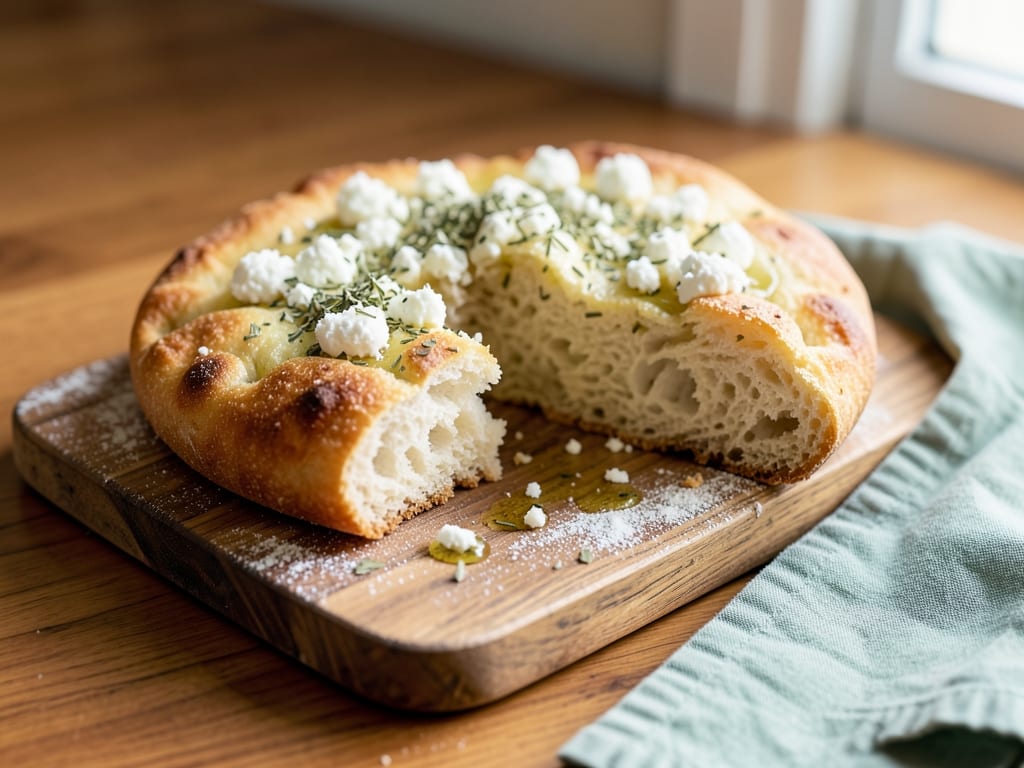
Greek fried flatbread made from sourdough discard, puffed golden in olive oil and topped with warm crumbled feta and oregano. These crispy, airy breads are best eaten immediately while still warm and tender. Perfect as an appetizer, snack, or side dish.
Steps
Before you start
- Ensure your sourdough starter is active and fed 4–8 hours before starting; a sluggish starter will result in dense bread.
- Measure and gather all ingredients before you begin.
- Line a baking sheet with parchment paper for resting the shaped dough discs.
- Crumble the feta cheese and measure out the oregano ahead of time.
Mix the dough
- In a large mixing bowl, combine 200g (3/4 cup) active sourdough discard, 250g (2 cups) all-purpose flour, 5g (1 tsp) fine sea salt, and 0.5 tsp dried oregano.
- Stir with a wooden spoon or dough scraper until a shaggy dough forms with no visible dry flour.
- If the dough seems very stiff or dry, add 30ml (2 tbsp) room-temperature water a little at a time, stirring until the dough just comes together.
- Do not overmix; rough texture is fine.
+ Show details− Hide details
Ready when: Shaggy dough with no dry flour visible
Tip: Don't overmix; the dough will come together as it rests. Rough texture is fine at this stage.
Knead and rest dough
- Turn the dough out onto a lightly floured work surface.
- Knead for 3–5 minutes, folding it over itself repeatedly, until the dough becomes smooth and slightly elastic (it does not need to be fully developed).
- Form into a ball, place back in the bowl, and coat lightly with 15ml (1 tbsp) olive oil, turning the dough to coat all sides.
- Cover the bowl with a clean kitchen towel and let rest at room temperature for 30–45 minutes.
- The dough should be noticeably puffy and relaxed.
+ Show details− Hide details
Ready when: Dough is smooth, supple, and visibly puffy
Tip: This rest period allows the gluten to relax and the sourdough discard to ferment slightly, developing flavor and ensuring good rise during frying.
Divide into portions
- Turn the dough out onto a lightly floured work surface.
- Using a bench scraper or knife, cut the dough into 8 equal pieces.
- Gently shape each piece into a loose ball and set aside.
+ Show details− Hide details
Ready when: 8 evenly sized dough balls
Shape into flat discs
- Take one dough ball and gently flatten it between your palms on a lightly floured work surface.
- Shape it into a disc about 4 inches (10 cm) wide and 1/4 inch (6 mm) thick.
- Place on a parchment-lined baking sheet.
- Repeat with the remaining dough balls, spacing them so they don't touch.
- You should have 8 discs total.
+ Show details− Hide details
Ready when: 8 flat discs, roughly 4 inches across and 1/4 inch thick
Tip: Consistent thickness helps even cooking. Rustic, uneven shapes are characteristic of tiganopsomo; don't stress about perfect circles.
Heat the oilOven 375°F / 190°C
- Pour 37ml (2.5 tbsp) olive oil into a large 12-inch (30 cm) skillet.
- Heat over medium-high heat until the oil shimmers and moves freely when you tilt the pan.
- The temperature should reach about 375°F (190°C).
- To test, carefully drop a small piece of dough into the oil; it should sizzle immediately and float to the top within a few seconds.
+ Show details− Hide details
Ready when: Oil shimmers; small dough piece sizzles and floats immediately
Tip: Oil that is too cool will make the bread greasy; oil that is too hot may burn the outside before the inside cooks through. Use a cooking thermometer if you have one.
Fry in batches
- Working in batches of 2–3 discs (don't overcrowd the pan), carefully place the tiganopsomo into the hot oil.
- Fry for 3–4 minutes on the first side until the bottom is golden brown and puffed.
- Using a slotted spoon, gently flip and fry the other side for 2–3 minutes until it is also golden brown and the bread feels light and sounds hollow when tapped.
- Transfer to paper towels to drain.
- Return the oil to temperature between batches if needed.
- Repeat with the remaining discs.
+ Show details− Hide details
Ready when: Both sides golden brown; bread is puffed and sounds hollow when tapped
Tip: The oil temperature will drop when you add the dough; expect the first side to take slightly longer on the first batch. Maintain medium-high heat throughout frying.
Top and serve
- While the tiganopsomo are still warm (but cool enough to handle), divide the 150g (1 cup) crumbled feta cheese evenly among them, using about 2–3 tablespoons per piece.
- Sprinkle the remaining 1 tsp dried oregano over the top.
- If desired, drizzle with honey (about 1 tsp per piece).
- Serve immediately while the bread is still warm and crispy.
+ Show details− Hide details
Ready when: Feta is warm and distributed over all pieces; oregano is visible
Tip: Top the warm bread while it retains heat; the residual warmth will soften the feta without completely melting it, creating the ideal texture.
Good to know
Tips
- Use an active, vigorous sourdough discard that was fed 4–8 hours before you start. If your discard is sluggish or not rising well in the jar, the tiganopsomo will be dense and won't puff when fried.
- Don't skip the 30–45-minute rest in Step 2. This time allows the gluten to relax and the sourdough cultures to ferment slightly, resulting in better rise and more flavorful bread.
- Oil temperature is critical. At 375°F (190°C), the bread will puff immediately and absorb minimal oil. If the oil is too cool, the bread will be greasy; if too hot, the outside may brown before the inside cooks through.
- Top the tiganopsomo while they are still warm, ideally within 1–2 minutes of coming out of the oil. The residual heat will warm and slightly soften the feta without melting it completely.
Make ahead
Prepare the dough through the resting step (Step 2) up to 4 hours ahead. Cover and refrigerate. Bring to room temperature (about 30 minutes on the counter) before shaping and frying. Alternatively, shape the discs, cover with plastic wrap, and refrigerate for up to 8 hours; fry directly from the refrigerator, adding 1–2 minutes per side to the frying time.
Storage & reheating
Room temperature: Store in an airtight container for up to 2 hours; reheat gently in a warm skillet with a little olive oil or in a 350°F (175°C) oven for 3–5 minutes. Refrigerator: Not recommended; the bread becomes tough and chewy. Freezer: Cool completely, wrap individual pieces in parchment, place in a freezer bag, and freeze for up to 1 month. Reheat from frozen in a 350°F (175°C) oven for 8–10 minutes until warm and crispy.
Substitutions
- active sourdough discard → Active dry yeast or instant yeast. Use 1/2 tsp (2g) active dry yeast or 1/4 tsp instant yeast instead. The dough will rise more quickly (15–20 minutes instead of 30–45) and will not have the characteristic sourdough tang.
- crumbled feta cheese → Crumbled goat cheese or fresh ricotta. Goat cheese offers a similar tang and crumbly texture; ricotta is milder and creamier. Use the same quantity.
- dried oregano → Fresh oregano. Use 1 tbsp (5g) fresh oregano leaves, torn or chopped. Add fresh oregano only to the topping, not the dough, for a brighter flavor.
- extra virgin olive oil → Vegetable oil or canola oil. Any neutral oil with a smoke point above 400°F (200°C) works for frying. You may use the same oil for coating the dough and frying.