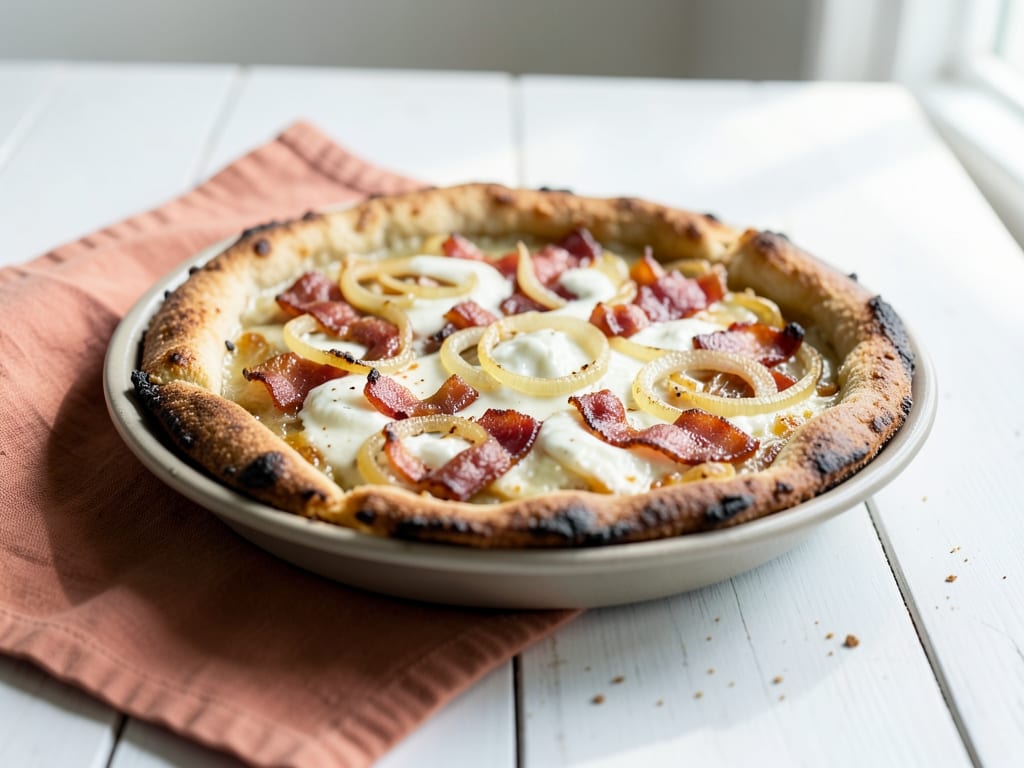
Sourdough Discard Tarte Flambée
A rustic Alsatian tart with a thin, crispy sourdough crust topped with tangy crème fraîche, crispy bacon lardons, and sweet caramelized onions. This is the perfect way to use up your sourdough discard while creating an impressive main course or appetizer that tastes far more difficult than it actually is.
- Prep
- 15 min
- Cook
- 20 min
- Wait
- 50 min
- Total
- 1 hr 25 min
- Makes
- 1 tart (8 slices)
Steps
Before you start
- If using cold sourdough discard from the fridge, let it come to room temperature for 20–30 minutes before starting
- Preheat your oven to 475°F (245°C) about 15 minutes before you plan to shape the dough
- If using a pizza stone, place it on the middle oven rack to preheat
- Have all toppings prepared and ready before shaping the dough, as the timeline moves quickly once baking begins
Mix dough ingredients
- In a large bowl, combine the sourdough discard, all-purpose flour, room-temperature water, olive oil, and salt.
- Stir with a fork or wooden spoon until a shaggy dough forms and no dry flour remains, about 1 minute.
+ Show details− Hide details
Ready when: dough is shaggy with no dry flour visible
Tip: Don't overmix; the dough should be rough and slightly sticky, not smooth
Rest dough
- Cover the bowl loosely with a kitchen towel and let it rest at room temperature for 30–45 minutes.
- If using very active, bubbly discard, 20–30 minutes may be sufficient.
- The dough should look slightly puffy and stretch more easily.
+ Show details− Hide details
Ready when: dough has puffed slightly and stretches easily when gently pulled
Cook bacon until crispy
- While the dough rests, place the bacon pieces in a medium skillet over medium heat.
- Cook, stirring occasionally, until the bacon is golden and crispy and most of the fat has rendered, about 8–10 minutes.
- Transfer the bacon to a paper towel-lined plate, leaving about 2 tablespoons of bacon fat in the pan.
- Set the bacon and fat aside.
+ Show details− Hide details
Ready when: bacon is golden and crispy, most fat has rendered into the pan
Tip: Save the rendered fat—it adds tremendous savory flavor to the onions
Caramelize onions
- To the skillet with the bacon fat, add the sliced onions and a tiny pinch of salt.
- Cook over medium heat, stirring frequently, until the onions are very soft and deeply golden brown, about 12–15 minutes.
- They should smell sweet and caramelized.
- In the last minute, add the cooked bacon pieces back to the pan and stir to combine.
- Season lightly with salt and fresh pepper, then transfer to a bowl and set aside.
+ Show details− Hide details
Ready when: onions are deeply golden brown, very soft, and smell sweet and caramelized
Tip: Low and slow is the key—rushing this step leaves raw or undercooked onions inside
Preheat oven and prepare surfaceOven 475°F / 245°C
- About 15 minutes before you're ready to shape the dough, preheat your oven to 475°F (245°C).
- If using a pizza stone, place it on the middle oven rack to preheat.
- If using a baking sheet, line it with parchment paper—you can shape the dough directly on the parchment.
- Allow the oven at least 15 minutes to reach full temperature.
+ Show details− Hide details
Ready when: oven reaches 475°F on the thermometer
Shape dough thin
- Turn the rested dough onto a lightly floured work surface.
- Gently stretch it into a thin rectangle roughly 12 × 14 inches (30 × 35 cm), about 1/8 inch (3 mm) thick—almost translucent in places is ideal.
- If the dough resists, let it rest for 5 minutes, then continue stretching.
- Transfer the dough to your prepared pizza stone or parchment-lined baking sheet, gently stretching to fit the surface.
- A rustic, uneven shape is perfect for tarte flambée.
+ Show details− Hide details
Ready when: dough is stretched to about 1/8 inch thick and fits on the baking surface
Tip: Don't aim for perfection—rustic is the goal. If small holes form, pinch them closed gently
Spread crème fraîche
- Using the back of a spoon or an offset spatula, spread the cold crème fraîche evenly over the dough, leaving a 1/2-inch (1 cm) border around the edges.
- A thin, even layer is better than thick—you want the tart to stay crispy.
- Aim for about 1/8 to 1/4 inch (3–6 mm) thick.
+ Show details− Hide details
Ready when: crème fraîche is spread in a thin, even layer across the dough
Tip: Don't pile it on—too much crème fraîche makes the tart soggy instead of crispy
Add caramelized onions and bacon
- Scatter the caramelized onion and bacon mixture evenly over the crème fraîche.
- If using Gruyère cheese, sprinkle it over the toppings.
- Lightly season the surface with a tiny pinch of salt and a few grinds of fresh black pepper.
+ Show details− Hide details
Ready when: toppings are evenly distributed over the crème fraîche layer
Bake until goldenOven 475°F / 245°C
- Carefully transfer the tart to the preheated 475°F (245°C) oven.
- If the dough is on parchment and you're using a stone, slide the parchment and dough together onto the hot stone; otherwise, just place the baking sheet in the oven.
- Bake for 15–18 minutes, until the crust is deep golden brown and the edges are crispy and dark.
- The crème fraîche may brown slightly around the edges—this is normal and delicious.
+ Show details− Hide details
Ready when: crust is deep golden brown, edges are dark and crispy
Tip: If your oven runs hot, check at 12–14 minutes; baking time varies by oven
Cool and serve
- Remove the tart from the oven and let it rest on a wire rack for 2–3 minutes.
- This allows the crust to firm up so it won't be droopy when you cut it.
- If desired, garnish with fresh thyme sprigs.
- Slice into 8 pieces and serve warm or at room temperature.
+ Show details− Hide details
Ready when: crust has firmed enough to slice cleanly without bending
Good to know
Tips
- Tarte flambée is happiest eaten fresh, but it stores and reheats better than you might expect. The secret to reheating is a hot, brief oven to re-crisp the crust.
- If your sourdough discard is cold from the fridge, let it come to room temperature for 20–30 minutes before using—it won't develop structure if cold.
- The thinner you can stretch the dough, the crispier the final tart. Aim for 1/8 inch (3 mm) or thinner; you should almost see through it to the work surface.
- Caramelizing the onions is not optional—they provide the sweetness and depth that balances the tangy crème fraîche and salty bacon. Don't rush this step.
Make ahead
The dough can be made up to 4 hours ahead and left at room temperature, covered loosely. For longer storage, refrigerate and bring to room temperature before shaping. The bacon and caramelized onions can be cooked and refrigerated up to 2 days ahead; warm them gently before assembling. The finished tart is best served fresh but can be stored and reheated (see storage).
Storage & reheating
Room temperature: up to 2 hours (crust softens over time). Refrigerator: up to 3 days, wrapped tightly; reheat in a 375°F (190°C) oven for 5–7 minutes to re-crisp. Freezer: up to 3 months; freeze the baked, cooled tart tightly wrapped, and reheat from frozen at 375°F for 15–18 minutes.
Substitutions
- sourdough discard → 1/4 teaspoon active dry yeast mixed into the dough. The flavor will be less complex and more obviously yeasty, but the tart will still be delicious and crispy. Use the same amounts of flour, water, and oil.
- crème fraîche → Equal parts sour cream and heavy cream mixed together, or fromage blanc. Sour cream alone is too tart and thin; mixing it with heavy cream creates the right flavor and texture. Use the same total amount (150 g).
- thick-cut bacon → Prosciutto, pancetta, or smoked salmon. Skip the first cooking step; instead, tear or chop the cured meat into pieces and scatter it raw over the crème fraîche just before baking.
- Gruyère cheese → Emmental, Alsatian Munster, sharp cheddar, or omit entirely. Munster is traditional in Alsace and adds an earthy flavor. Use the same amount, finely grated. The tart is excellent without cheese.
More flatbreads
See all →

Find more like this
- Meal
- Dinner
- Cuisine
- French
- Diet
- Sugar-Free
- Quick & Easy
- Easy