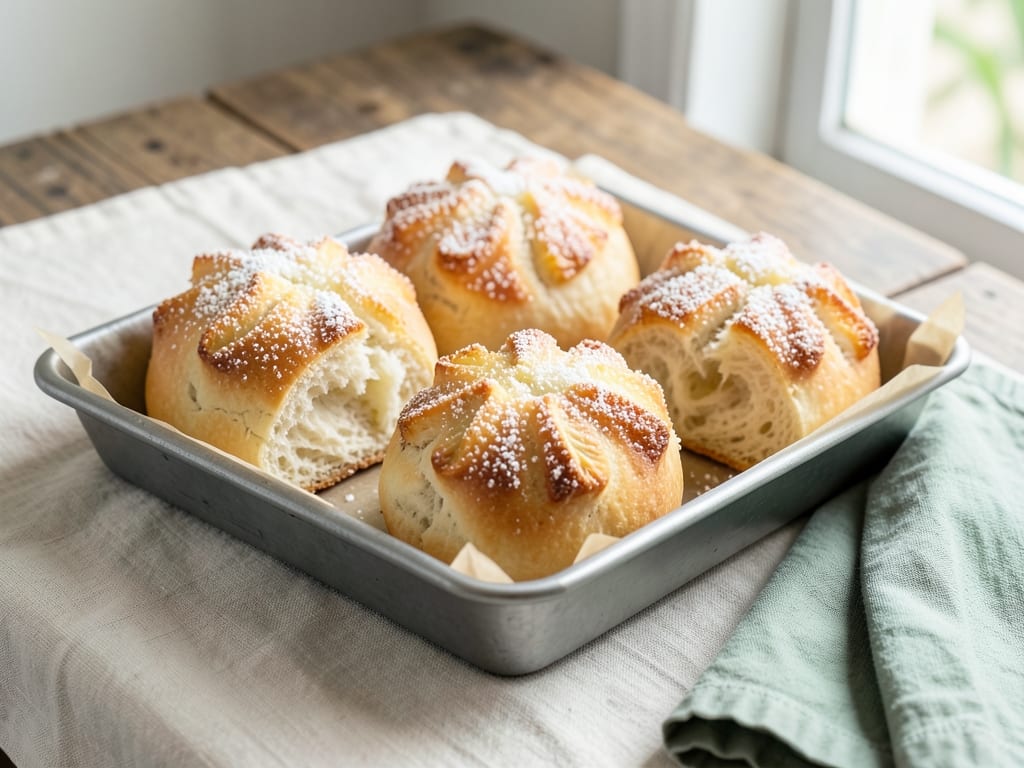
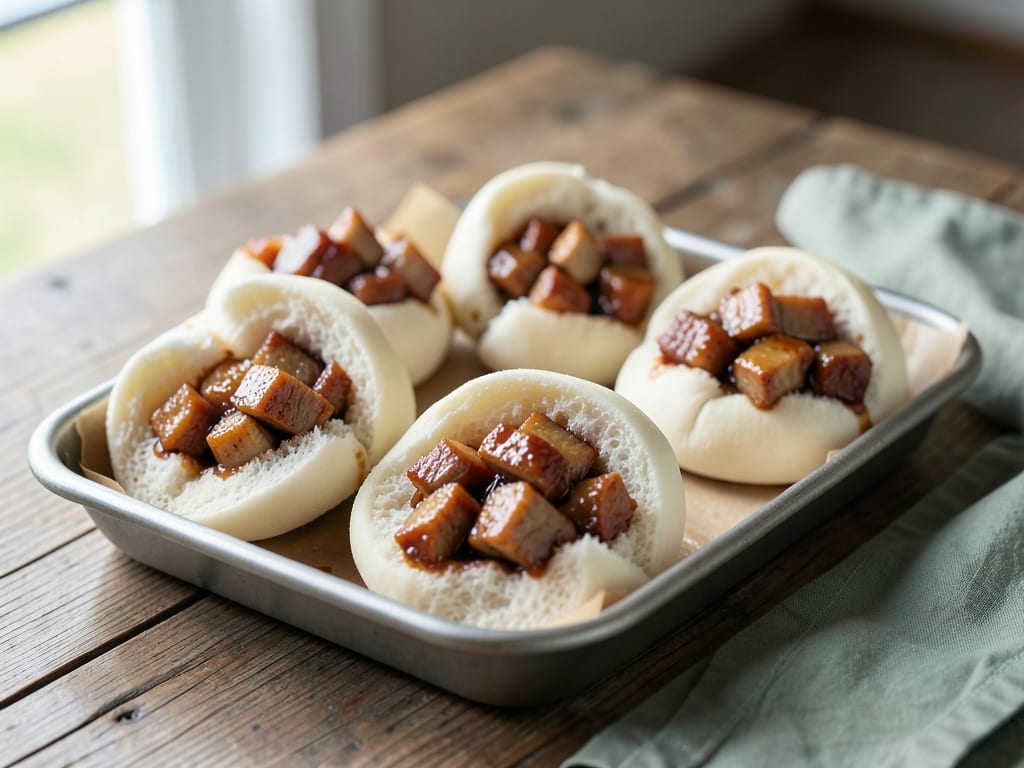
Sourdough Chinese Soy Ginger Dinner Rolls
Soft, tender dinner rolls infused with the savory depth of soy sauce, the bright heat of fresh ginger, and the nutty aroma of sesame oil. Built on a sourdough base for complex flavor and better digestibility, these rolls are perfect alongside Asian meals or enjoyed on their own. The dough develops overnight for maximum taste, and the rolls bake to golden perfection in about 20 minutes.
- Prep
- 20 min
- Cook
- 25 min
- Wait
- 9 hr 30 min
- Total
- 10 hr 15 min
- Makes
- 12 rolls
Steps
Before you start
- Ensure your sourdough starter is active and bubbly (fed 4–8 hours before, at room temperature)
- Use bread flour for better structure and chew
- Have all ingredients at room temperature before mixing
Mix the dough
- In a large bowl, combine 120 g active sourdough starter, 180 ml room-temperature water, 45 ml soy sauce, and 22 ml sesame oil.
- Stir until well incorporated, about 1 minute.
- Add 330 g bread flour and mix using a dough whisk or your hand until a shaggy mass forms with no dry flour visible.
- The dough will be slightly sticky.
- Cover with a damp towel and let rest 30 minutes (autolyse).
+ Show details− Hide details
Ready when: No dry flour visible; dough is cohesive
Tip: This rest improves gluten development and flavor without additional kneading.
Add salt and knead
- Sprinkle 8 g salt and 18 g minced fresh ginger evenly over the dough.
- Using wet hands, fold the dough onto itself repeatedly for 8–10 minutes, incorporating the salt and ginger thoroughly.
- The dough should become smoother and more elastic.
- You can use a dough whisk or switch to hand-kneading halfway through.
- The dough is ready when it feels tacky but springs back slowly when poked.
+ Show details− Hide details
Ready when: Dough is smooth, elastic, springs back slowly when poked, and no streaks of ginger remain
Tip: Keep your hands damp to prevent sticking; wet dough is easier to work than dry.
First rise in bulk
- Shape the dough into a round and return it to the bowl.
- Cover with a damp towel and let it rise at room temperature (68–72°F / 20–22°C) for 4–5 hours, until puffy and increased by about 50 percent.
- You should see bubbles at the surface.
- (Alternatively, refrigerate overnight for 8–12 hours for enhanced flavor; bring to room temperature before proceeding.)
+ Show details− Hide details
Ready when: Dough has increased by ~50%, surface shows bubbles, feels airy when gently poked
Tip: Cold fermentation overnight produces more complex flavor; use this method if timing allows.
Divide and shape rolls
- Turn the dough out onto a lightly floured surface.
- Gently press to deflate slightly without crushing all the gas.
- Divide into 12 equal pieces (roughly 45–50 g each) using a bench scraper or knife.
- Work with 4 pieces at a time; keep the rest covered.
- Roll each piece between your palms into a smooth ball, pinching the bottom to seal.
- Place seam-side down in a 10×14-inch baking pan, arranging them in a 3×4 grid with a little space between each.
+ Show details− Hide details
Ready when: All 12 rolls are smooth, round, and arranged evenly in the pan
Tip: If the dough springs back too much, let it rest 2–3 minutes between rolling batches.
Second rise (proof)Oven 425°F / 220°C
- Cover the pan with a damp towel and let the rolls rise at room temperature for 1.5–2 hours, until they have grown visibly larger and are touching each other slightly.
- They should feel puffy and yield gently to a light poke.
- Meanwhile, preheat your oven to 425°F (220°C) about 15 minutes before baking.
+ Show details− Hide details
Ready when: Rolls have grown visibly, are touching lightly, feel puffy to a gentle poke
Tip: If your kitchen is cool, place the pan in a warm spot like an oven with the light on (not preheating yet).
Finish and bakeOven 425°F / 220°C
- Just before baking, brush the tops of the rolls lightly with water (this creates a more delicate crust).
- If using optional garnishes, sprinkle white sesame seeds and/or sliced scallions over the tops.
- Place the pan in the preheated 425°F (220°C) oven and bake for 20–25 minutes, until the tops are deep golden brown and the rolls sound hollow when tapped on the bottom (rotate the pan halfway through if your oven has hot spots).
+ Show details− Hide details
Ready when: Tops are deep golden brown, rolls sound hollow when tapped on the bottom, internal temp ~205°F / 96°C
Tip: Rotate the pan halfway through if your oven browns unevenly; rotate from front to back and side to side.
Cool and serve
- Turn the rolls out onto a wire rack or clean kitchen towel to cool for 10–15 minutes.
- They will firm up slightly as they cool.
- Serve warm, at room temperature, or split and toasted.
- The soy and ginger flavors will develop more as the rolls cool.
+ Show details− Hide details
Ready when: Rolls are cool enough to handle safely
Tip: Cooling on a rack keeps the bottoms from steaming and becoming soft; avoid covering while warm.
Good to know
Tips
- Use active, bubbly starter fed 4–8 hours before mixing. Sluggish starter will result in slow rises and dense rolls.
- Bread flour (12–14% protein) gives these rolls better structure and chew than all-purpose. If using all-purpose flour, reduce by 2 tablespoons (25 g) total flour to account for lower protein.
- Cold fermentation (overnight in the fridge) intensifies the soy and ginger flavors and makes the dough easier to handle. Plan ahead if possible.
- The optional sesame seeds and scallions are traditional garnishes in Chinese bakeries; add just before baking for best texture and appearance.
Make ahead
The dough can be mixed and refrigerated after the autolyse (step 1) and kept for up to 12 hours. Cold fermentation actually improves flavor. Bring dough to room temperature before the bulk rise (step 3). Baked rolls can be frozen for up to 3 months; thaw at room temperature for 2–3 hours before reheating.
Storage & reheating
Room temperature: up to 2 days, covered loosely with a clean towel. Refrigerator: up to 5 days, wrapped well in plastic wrap or an airtight container. Reheat in a 325°F (160°C) oven for 8–10 minutes until warm through. Freezer: up to 3 months, wrapped individually or in an airtight container. Thaw at room temperature for 2–3 hours, then reheat as for refrigerated rolls.
Substitutions
- active sourdough starter → 1⁄2 cup (120 g) active all-purpose or whole-wheat starter. Any live sourdough culture works; all-purpose starter will produce slightly milder flavor. Maintain the same weight.
- fresh ginger → 1 teaspoon (2 g) ground ginger, or 1⁄2 teaspoon (1 g) ginger powder mixed with 1 tablespoon finely minced crystallized ginger. Ground ginger is more intense; use only 1 tsp total. Crystallized adds sweetness and texture. Fresh is preferred for brightness.
- low-sodium soy sauce → tamari (gluten-free) or coconut aminos. Tamari delivers similar umami; coconut aminos is slightly milder and less salty. Adjust salt down by 1⁄4 teaspoon if using coconut aminos.
- toasted sesame oil → neutral oil (grapeseed or sunflower) mixed with 1⁄2 teaspoon sesame paste. This preserves the sesame flavor when toasted sesame oil is unavailable. Use toasted sesame oil for best results.