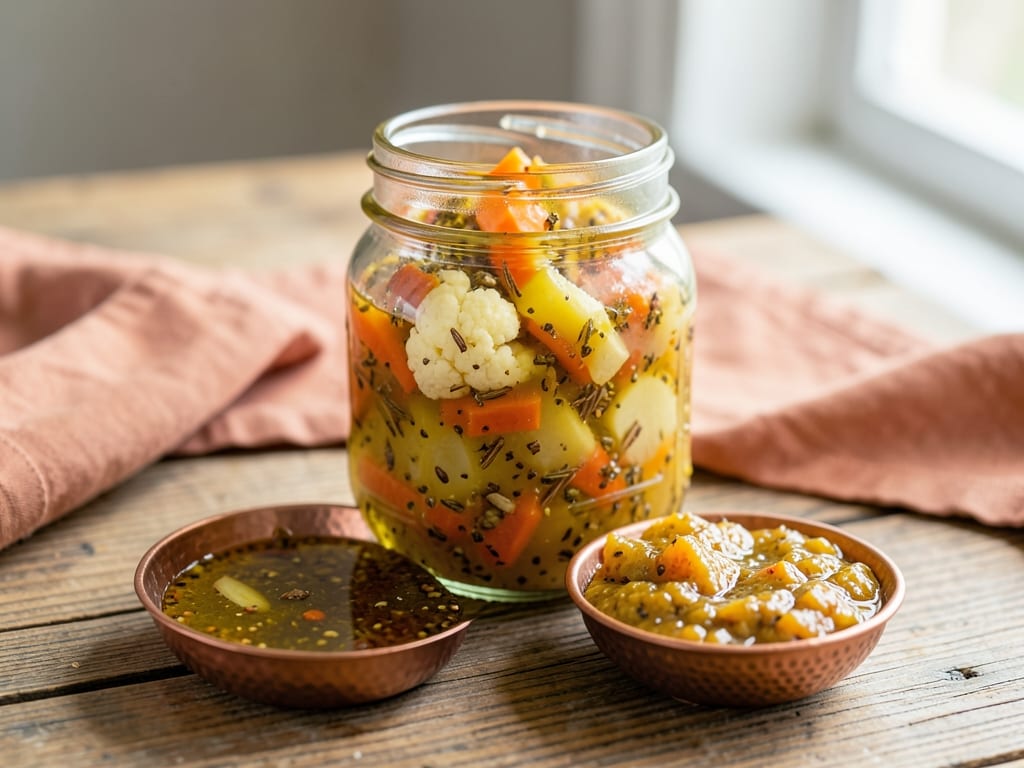
Punjabi Mixed Vegetable Achar (Gajar-Gobi-Shalgam Ka Achar)
A tangy, pungent North Indian pickle of carrot, cauliflower and turnip, cured in hot-then-cooled mustard oil with toasted fennel, mustard and fenugreek. It ripens in a warm spot in about five days and stays crunchy.
- Prep
- 40 min
- Cook
- 10 min
- Wait
- 5.2 days
- Total
- 5.2 days
- Makes
- 1 quart (about 1 liter) jar, about 16 servings of 2 tablespoons
Steps
Before you start
- Start this on a dry, warm day. Moisture is the enemy of oil pickles, so every bowl, towel, spoon and jar must be completely dry.
- Buy mustard oil labeled for food use. Some US bottles say 'for external use only'. If yours does, use a food-safe alternative such as cold-pressed sunflower or avocado oil and expect a milder flavor.
- Plan for about 5½ hours of mostly hands-off drying and cooling on day one, then 5 days of ripening.
- Open a window or run the exhaust fan before heating the oil. Mustard oil gives off sharp fumes.
Wash and cut vegetables
- Wash the carrots, cauliflower and turnips and peel the carrots and turnips.
- Cut the carrots and turnips into 2-inch (5 cm) long batons about ½ inch (1.25 cm) thick.
- Cut the cauliflower into 1-inch (2.5 cm) florets.
- Put all the vegetables in a large dry bowl.
+ Show details− Hide details
Ready when: Pieces are fairly uniform so they cure and soften at the same rate.
Tip: Cut cauliflower florets no bigger than 1 inch (2.5 cm) or the centers stay bland.
Salt the vegetables
- Sprinkle the salt and 1 teaspoon of the turmeric over the vegetables and toss well with your hands until every piece is yellow.
- Leave uncovered at room temperature for 2 hours.
- The salt will draw out a pool of liquid.
- Drain in a colander and discard the liquid, but don't rinse.
+ Show details− Hide details
Ready when: Vegetables have released a noticeable pool of liquid and look slightly wilted.
Air-dry the vegetables
- Spread the drained vegetables in a single layer on clean cotton towels.
- Dry them in direct sun, or near a fan or open window, for 3 hours, turning them once halfway.
- Blot any damp spots with a dry towel.
+ Show details− Hide details
Ready when: Surfaces feel dry to the touch and the pieces are slightly shrunken and pliable, not brittle.
Tip: If the day is humid, dry them in front of a fan for 4 hours instead.
Sterilize the jarOven 250°F / 120°C
- While the vegetables dry, wash the jar and lid in hot soapy water and rinse well.
- Stand the jar upside down on a baking sheet and heat in a 250°F (120°C) oven for 15 minutes.
- Turn the oven off and leave the jar inside to cool completely, about 30 minutes.
- Wipe the lid dry and let it air-dry.
+ Show details− Hide details
Ready when: Jar is bone dry inside and cool to the touch before filling.
Tip: Don't use a metal lid that has rusted. A plastic-lined lid or a clean glass lid is safest with vinegar.
Toast and crush spices
- Combine the fennel, mustard seeds and fenugreek in a small dry skillet over medium-low heat.
- Toast, shaking the pan constantly, for 2 minutes.
- Tip onto a plate to cool for 5 minutes, then crush coarsely in a mortar or by pulsing in a spice grinder 3–4 times.
+ Show details− Hide details
Ready when: Seeds smell nutty and fragrant, the mustard seeds begin to pop, and the fennel turns a shade darker. The mix should be cracked, not powdery.
Tip: Fenugreek turns bitter fast. If any seeds blacken, start over.
Heat the oil
- Pour the main oil and the extra oil into a small saucepan.
- Heat over medium-high for 4–5 minutes until it turns pale and the first thin wisps of smoke rise.
- Remove from the heat and let it cool for 30–40 minutes, until just warm to the touch (about 100°F / 38°C).
+ Show details− Hide details
Ready when: Oil lightens in color and gives off thin wisps of smoke; the raw, harsh bite of the oil mellows.
Tip: Don't leave the pan unattended and keep water away from hot oil. Pour oil on the vegetables only when it's warm, never hot.
Mix the achar
- Put the dried vegetables in a large dry bowl.
- Add the crushed spices, nigella seeds, remaining 1 teaspoon turmeric, chili powder, amchur, asafoetida (if using) and the vinegar.
- Pour in 1¼ cups (300 ml) of the cooled oil and toss with a dry spoon for 2 minutes until every piece is coated in a thick, red-gold masala.
+ Show details− Hide details
Ready when: No dry spice patches remain and the vegetables look glossy and evenly coated.
Tip: Taste a carrot piece. It should be assertively salty and sour; it mellows as it ripens.
Pack the jar
- Spoon the vegetables and every bit of masala into the sterilized jar, pressing down firmly with a dry spoon to remove air pockets.
- Pour in enough of the reserved oil to cover the vegetables by about ½ inch (1.25 cm), leaving 1 inch (2.5 cm) of headspace.
- Cover the mouth with a clean cotton cloth secured with a rubber band, or set the lid on loosely.
+ Show details− Hide details
Ready when: Vegetables are packed tightly with a layer of oil on top.
Tip: Any vegetable poking above the oil can grow mold. Press it under or add more oil.
Ripen in a warm place
- Set the jar in a sunny window or a warm spot (75–85°F / 24–29°C) for 5 days.
- Each day, close the lid, shake the jar and turn it upside down once, then remove the lid and press the vegetables back under the oil with a clean dry spoon.
- Leave the jar loosely covered between mixings.
+ Show details− Hide details
Ready when: On day 5 the carrots are tender but still snap, the raw mustard smell has softened to a tangy aroma, and the oil has turned deep orange.
Tip: Always use a dry spoon. A single drop of water can spoil the jar.
Store and serve
- Tighten the lid and move the jar to the refrigerator or a cool, dark cupboard.
- Serve 1–2 tablespoons alongside parathas, dal and rice, or with makki di roti.
+ Show details− Hide details
Tip: Flavor deepens over the next 1–2 weeks.
Good to know
Tips
- Dryness is everything: any water left on the vegetables, jar or spoon can cause mold, so don't skip the drying step.
- Cool the oil until it's warm, not hot, before mixing; hot oil cooks the vegetables and makes them soft.
- Always keep vegetables below the oil line. Top up with cooled, heated oil if the level drops.
- Discard the pickle if you see fuzzy mold, or if it smells yeasty or rotten.
Make ahead
The achar is itself make-ahead. It is ready to eat after 5 days of ripening and tastes even better after 2 weeks.
Storage & reheating
Room temperature: up to 1 week in a cool spot while ripening. Refrigerator: up to 2 months, always with the vegetables submerged in oil and served with a clean, dry spoon. Freezer: not recommended because the vegetables turn soft. Serve straight from the fridge; the oil may cloud and thicken, which is normal and clears at room temperature.
Substitutions
- food-grade mustard oil → cold-pressed sunflower or avocado oil. Use if you can't find food-grade mustard oil. The flavor will be milder and less pungent. Still heat it until just warm-smoking, then cool.
- dried mango powder (amchur) → 1 tbsp (15 ml) lemon juice added with the vinegar. Adds sourness but a little extra moisture, so keep the vegetables well submerged and refrigerate.
- turnips → daikon radish. Same size batons; slightly milder and crunchier.
- Kashmiri red chili powder → 1½ tsp cayenne pepper plus 1½ tsp sweet paprika. Approximates the color and heat of Kashmiri chili powder.
More pickles & chutneys
See all →
Find more like this
- Meal
- Lunch
- Cuisine
- North Indian
- Main ingredient
- CauliflowerCarrots
- Quick & Easy
- Make Ahead