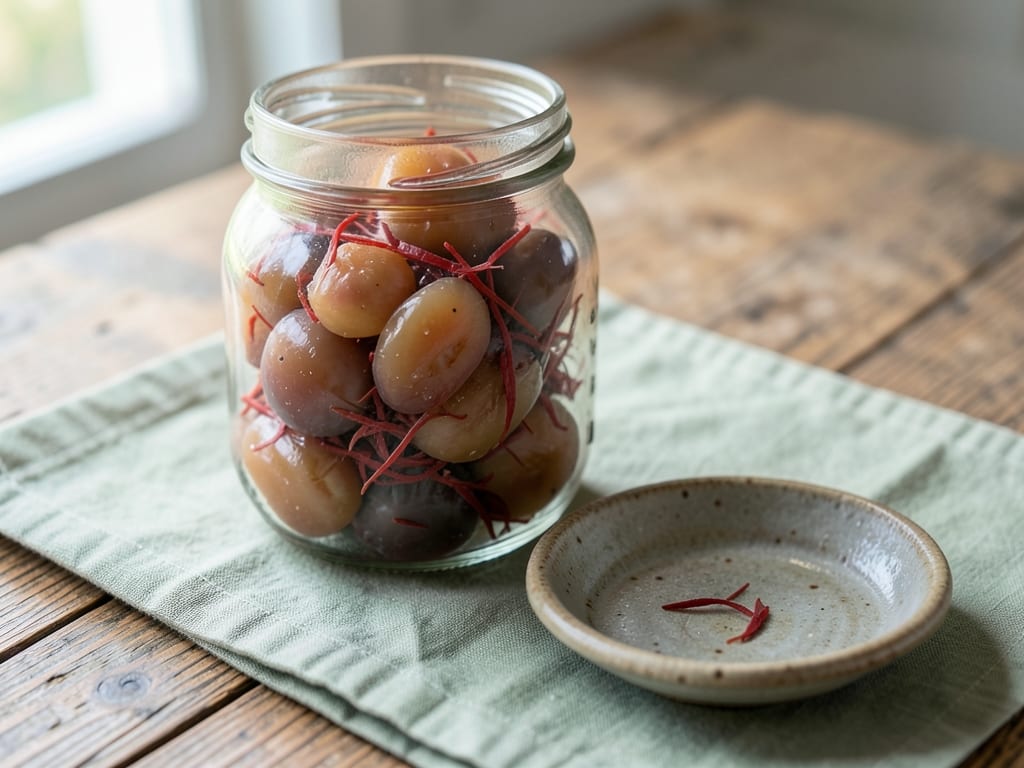
Umeboshi (Salted Pickled Plums with Red Shiso)
Traditional Japanese salt-cured ume plums, made with 18% salt by weight for safe, reliable preserving. They are colored with salted red shiso and sun-dried for three days. The result is tart, salty, fruity and deeply savory. You also get a bonus jar of ruby-red umezu (plum brine) to use as a seasoning vinegar.
- Prep
- 2 hr 10 min
- Cook
- —
- Wait
- 60.2 days
- Total
- 60.3 days
- Makes
- About 35 umeboshi (from 1 kg plums) plus about 200 ml umezu brine
Steps
Before you start
- Timing: this is a project of about 2 months. Ripening takes 3 days, salt curing about 3 weeks, shiso 1 week and sun-drying 3 days. Then age the plums at least 1 month. Plan around fresh ume (late May to June), red shiso (June to July) and a stretch of 3 sunny days.
- Buy ripe, yellow, fragrant ume with no bruises. Green unripe ume are for umeshu and make harsh, hard umeboshi.
- Use a non-reactive container (glass, glazed ceramic or food-grade plastic). Never use aluminum, copper or bare metal because the salt and acid will corrode it.
- Do not reduce the salt. 18% of the plum weight is what keeps the plums from molding and spoiling, so weigh the plums and salt on a scale.
- Everything that touches the plums must be clean and fully dry. Water on the fruit or container invites mold.
Ripen the plums
- Spread the ume in a single layer on a tray or in a shallow basket at cool room temperature, out of direct sun.
- Leave them for about 3 days, until they are fully yellow, slightly soft at the shoulders and smell strongly fruity.
- Discard any with dark spots or mold.
+ Show details− Hide details
Ready when: Plums are evenly yellow, fragrant and give slightly when pressed
Tip: Do not wait until they are bruised or wrinkled.
Soak and de-stem
- Put the plums in a large bowl, cover with the 2 liters (2 quarts) of cold water and soak for 2 hours to remove bitterness.
- Drain.
- Use a bamboo skewer to pop out the small dark stem nub on each plum, taking care not to pierce the flesh.
+ Show details− Hide details
Ready when: Every stem nub is removed and the skin is unbroken
Tip: Ripe plums bruise easily. Handle them gently and do not scrub.
Dry the plums
- Wipe each plum with a clean towel, then lay them on dry towels in a single layer, out of direct sun.
- Air-dry for about 2 hours, wiping again if any beads of moisture remain, especially around the stem dimple.
+ Show details− Hide details
Ready when: Plums feel completely dry to the touch with no damp spots
Tip: Moisture left on the plums is the number one cause of mold.
Sterilize the container
- Wash the jar or crock, plate and weights with hot soapy water, rinse well and dry completely.
- Pour the shochu into the jar, swirl to coat the entire inside, then wipe the plate with a clean paper towel dampened with the shochu.
- Pour out any leftover shochu and let the jar air-dry for 5 minutes.
+ Show details− Hide details
Ready when: Container smells faintly of alcohol and looks dry
Tip: Keep the shochu away from open flame.
Layer plums and salt
- Sprinkle a thin layer of the plum salt over the bottom of the jar.
- Add a layer of plums, then sprinkle with salt.
- Repeat, using about 150 g of the salt in total in the layers, and finish with the remaining 30 g spread over the top so the plums are fully covered.
+ Show details− Hide details
Ready when: All 180 g of salt is used and no plum is left bare on top
Tip: Weigh the salt first and divide it by eye, saving a little extra for the top, where mold starts.
Weigh down and wait
- Set the plate on top of the plums and add weights totaling 2 kg (twice the weight of the plums).
- Cover the jar loosely with a clean cloth or plastic wrap and tie it on.
- Keep in a cool, dark place for about 3 days.
- Brine (umezu) will rise and should cover the plums.
+ Show details− Hide details
Ready when: Brine comes up to or above the top layer of plums
Tip: If the brine has not covered the plums after 3 days, leave the heavy weight on for another day or two.
Lighten the weight and cure
- Once the brine covers the plums, replace the weights with ones totaling about 1 kg (equal to the plum weight).
- Re-cover and keep in a cool, dark place for 2 weeks, checking every few days.
- If white mold forms, spoon it off and wipe the sides with a shochu-dampened towel.
+ Show details− Hide details
Ready when: Plums are submerged and slightly wrinkled, and the brine is cloudy and amber
Tip: Never pour off the brine. It protects the plums.
Salt the shiso
- Wash the shiso leaves and dry them very well with towels.
- Place in a bowl with 30 g of the shiso salt and rub firmly with your hands for 2 minutes.
- Squeeze hard and discard the dark, bitter liquid.
- Repeat with the remaining 10 g salt, rubbing and squeezing again, and discard that liquid too.
- Ladle 3 tablespoons (45 ml) of brine from the plums over the leaves and mix until the leaves turn bright red-pink.
+ Show details− Hide details
Ready when: Leaves are limp and bright magenta-red, and the dark liquid has been discarded
Tip: Wear gloves because the dye stains hands and counters. Skipping the discarded squeezes makes the pickles bitter and dull brown.
Add shiso and steep
- Remove the weights and plate.
- Spread the shiso over and between the top plums, pour in the colored liquid and press so the leaves are submerged.
- Replace the plate and the 1 kg weight and re-cover.
- Leave for 1 week in a cool, dark place, until the plums look rosy red.
+ Show details− Hide details
Ready when: Plums and brine are a deep ruby red
Sun-dry the plums
- Pick a stretch of 3 sunny days.
- Lift the plums from the brine and arrange them on the tray in a single layer without touching.
- Set in direct sun, ideally with air movement, for 3 days, turning each plum once a day.
- Bring the tray inside at night and when it rains.
- Dry some shiso leaves alongside if you like, for crumbling into rice as a seasoning.
+ Show details− Hide details
Ready when: Skins are slightly wrinkled and the plums feel tacky but still soft and plump
Tip: No sunshine? Use a dehydrator at 113°F (45°C) for 8–12 hours, until the surface is tacky and slightly wrinkled.
Jar and age
- Return the dried plums to the clean, dry jar and pour the umezu over them.
- Cover and keep in a cool, dark place or the refrigerator.
- Wait at least 1 month before eating so the saltiness rounds out.
- They are best after 3 months and keep improving for years.
+ Show details− Hide details
Ready when: Plums are soft and deeply colored, and taste salty and sour without harshness
Tip: Use only clean, dry utensils to remove plums.
Good to know
Tips
- Weigh, don't measure by cups. 18% salt by plum weight is the safety margin.
- Keep the plums submerged in brine at all times during curing, because exposed plums mold.
- Save the umezu. It is a salty, fruity seasoning for dressings, sushi rice and marinades.
- Do not lower the salt below 15% for home curing, as lower-salt versions need refrigeration and can spoil.
Make ahead
This recipe is itself a make-ahead preserve. Plums can wait in the brine for months before the sun-drying step as long as they stay fully submerged.
Storage & reheating
Store in the sealed jar with the umezu in a cool, dark place for up to 1 year, or in the refrigerator for several years, since flavor improves with age. Do not freeze. No reheating needed. Eat straight from the jar, in rice balls, or in tea or sauces.
Substitutions
- shochu or other 35% ABV clear spirit → Vodka or white rum (35–40% ABV). Used only to sanitize, so any clear high-proof spirit works.
- red shiso leaves → Omit entirely for plain white umeboshi (shiroboshi). Skip the shiso steps. The flavor is the same, just without the red color, and the plums still need the sun-drying.
- coarse sea salt → Fine unrefined sea salt. Use the same weight, 180 g. Do not substitute by volume. Avoid iodized table salt.
- ripe yellow ume plums → Slightly underripe ume. Hold at room temperature until yellow. Hard green fruit will not work.
More pickles & chutneys
See all →
Find more like this
- Meal
- Breakfast
- Cuisine
- Japanese
- Quick & Easy
- 5 Ingredients or LessMake Ahead