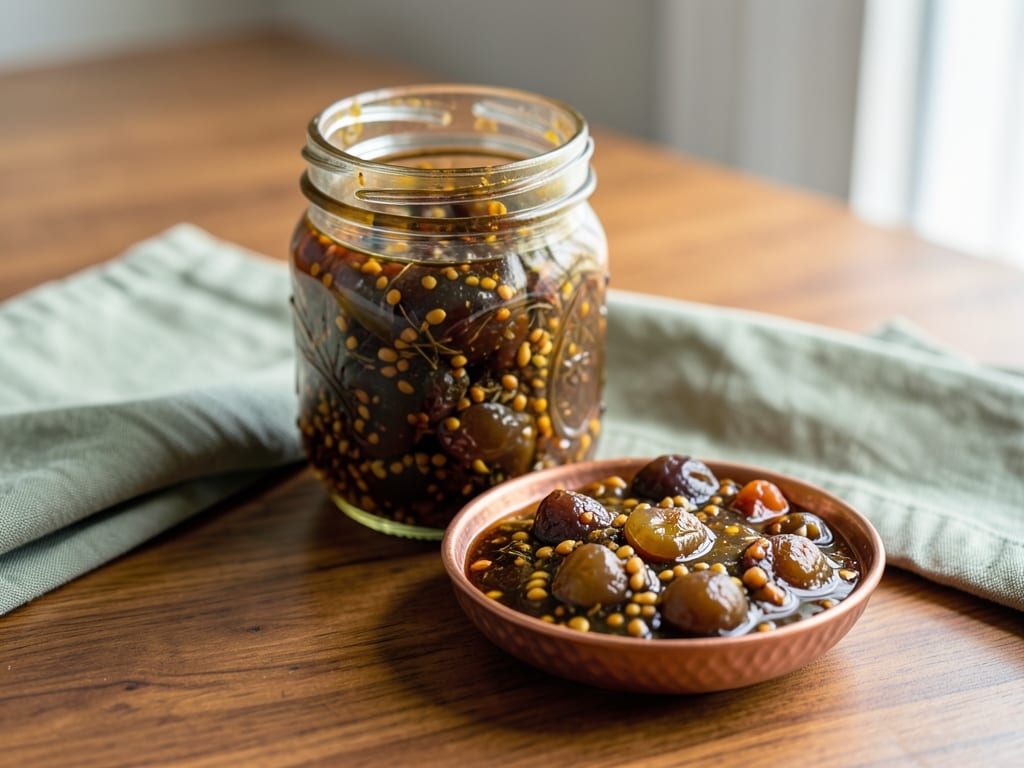
Amla Gooseberry Pickle (Oil-Cured Indian Amla Achar)
Tangy, spicy and deeply savory, this North Indian-style pickle softens firm Indian gooseberries in a quick boil, then cures them in a mustard, fennel and fenugreek masala under a seal of hot-then-cooled mustard oil. It's ready to eat after a week and keeps for months.
- Prep
- 1 hr 3 min
- Cook
- 30 min
- Wait
- 7.1 days
- Total
- 7.2 days
- Makes
- About 1 quart (1 liter) pickle, enough for 16 servings of 2 tablespoons
Steps
Before you start
- Plan on about 1 week from start to first taste: about 4 hours of kitchen work and drying on day one, then 7 days of curing.
- Sterilizing the jar is step 1: wash it, then dry it in a 250°F (120°C) oven. Any moisture in the jar or on the fruit can cause mold.
- Choose firm, pale green, unblemished amla. Soft or brown-spotted fruit turns mushy.
- Open a window or run the hood fan when heating mustard oil; it gives off sharp fumes.
Sterilize the jarOven 250°F / 120°C
- Heat the oven to 250°F (120°C).
- Wash a 1-quart (1 liter) glass jar and its lid in hot soapy water and rinse well.
- Stand the jar and lid upright on a baking sheet and dry in the oven for 10 minutes.
- Remove with oven mitts and set aside to cool completely.
+ Show details− Hide details
Ready when: Jar and lid are hot and completely dry, with no condensation inside.
Tip: If the lid has a rubber seal or plastic liner, skip the oven for the lid and air-dry it fully instead.
Wash the amla
- Rinse 500 g (1.1 lb) amla under cool running water, discarding any with soft spots or dark blemishes.
- Pat each fruit dry with a clean towel.
+ Show details− Hide details
Ready when: Fruits are firm, unblemished and wiped free of surface water.
Tip: Handle gently; bruised fruit spoils faster in the jar.
Boil until just tender
- Bring 1 quart (1 liter) water to a rolling boil in a large pot over high heat.
- Add the whole amla, return to a boil, then reduce to medium and simmer 6-7 minutes.
- Drain in a colander.
+ Show details− Hide details
Ready when: Skins turn dull olive-green and a fork pierces the flesh with slight resistance; the fruit still holds its shape and has not split open.
Tip: Don't overcook. Fruit that splits or turns soft and mushy won't stay crisp in the pickle.
Cool and segment
- Spread the drained amla on a tray and cool 20 minutes until comfortable to handle.
- Pull each fruit apart along its natural lines into 6 segments, or cut along the grooves with a small knife.
- Discard the hard inner stones.
+ Show details− Hide details
Ready when: All segments are free of stones and about ½ inch (1.5 cm) thick.
Tip: Wipe your hands dry as you go; amla juice stains and wet hands add moisture.
Dry the segments
- Spread the segments in a single layer on clean dry towels or a baking sheet.
- Leave in a breezy spot, turning once, for 2 hours.
+ Show details− Hide details
Ready when: Segments feel dry and slightly tacky, with no wet sheen when pressed on a paper towel.
Tip: Moisture is the main cause of mold in oil pickles. If in doubt, dry another 30 minutes.
Toast and grind spices
- In a small dry skillet over low heat, toast the mustard seeds, fennel seeds and fenugreek seeds, shaking the pan, for 2-3 minutes.
- Tip onto a plate and cool 10 minutes.
- Grind to a coarse, sandy powder, not a fine flour.
- Stir in the turmeric, chili powder, asafoetida and salt.
+ Show details− Hide details
Ready when: Fennel smells sweet and nutty and the mustard seeds begin to pop; fenugreek turns light golden, not dark brown.
Tip: Overtoasted fenugreek turns bitter. Remove the pan from the heat as soon as it smells fragrant.
Heat the mustard oil
- Warm 160 ml (⅔ cup) mustard oil in a small saucepan over medium-high heat for 4-5 minutes until it shimmers and gives off a faint wisp of smoke.
- Remove from the heat and let cool about 40 minutes until just warm to the touch.
+ Show details− Hide details
Ready when: A faint wisp of smoke rises and the sharp raw smell mellows; the oil lightens slightly in color.
Tip: Never pour hot oil over the amla or spices. It will cook them and scorch the spices, giving a bitter pickle.
Mix amla and masala
- Put the dry amla segments in a large dry bowl.
- Sprinkle with the spice mixture and toss with a dry spoon until every piece is coated.
- Pour in the cooled oil and toss again.
+ Show details− Hide details
Ready when: Segments are evenly coated in a deep orange-red paste with no dry pockets of spice.
Tip: Taste a piece for salt. It should taste assertively salty and sour, since flavors mellow as it cures.
Pack the jar
- Spoon the pickle into the sterilized 1-quart jar, pressing down firmly with a clean dry spoon to remove air pockets.
- Scrape in all the oil and spices from the bowl.
- Add a little extra mustard oil if needed so about ½ inch (1 cm) of oil sits above the fruit.
- Leave 1 inch (2.5 cm) headspace and seal.
+ Show details− Hide details
Ready when: A thin layer of oil fully covers the top of the pickle.
Tip: Fruit poking above the oil can mold, so keep it submerged.
Cure for a week
- Keep the jar in a warm, bright spot (a sunny windowsill is ideal) for 7 days.
- Once a day, gently shake or turn the jar so the amla stays coated.
- The segments will soften slightly and release juices that blend with the oil.
+ Show details− Hide details
Ready when: Segments are tender but still slightly firm, the oil is deep orange, and the smell is tangy and spicy with no yeasty or off odors.
Tip: Discard the pickle if you see fuzzy mold or smell yeasty or rotten odors.
Good to know
Tips
- Keep everything bone dry: fruit, bowl, spoon and jar. Moisture is the number one cause of pickle spoilage.
- Salt and oil are the preservatives. Don't reduce either by much, or the pickle won't keep.
- For a more mellow pickle, cure the jar 10-14 days before eating; the flavor deepens over time.
- If the fruit absorbs oil during the first few days and surfaces are exposed, warm and cool an extra 2 tbsp mustard oil and top up the jar.
Make ahead
The amla can be boiled, segmented and dried a day ahead, then stored uncovered on a tray in a cool, dry spot or refrigerated in a dry container. Spices can be ground up to 1 week ahead.
Storage & reheating
Store in the sealed jar in a cool, dark cupboard for up to 1 month, or refrigerate for up to 6 months (the oil may cloud and thicken; let it sit at room temperature 15 minutes before serving). Always use a clean, dry spoon and keep the fruit under oil. Not recommended for freezing. Serve cold or at room temperature with rice, dal, parathas or curd rice.
Substitutions
- mustard oil → cold-pressed sesame (gingelly) oil or sunflower oil. Milder flavor. Heat only until it shimmers (no need to smoke), then cool completely.
- Kashmiri red chili powder → paprika for color plus ½ tsp cayenne. Gives a similar color with adjustable heat.
- asafoetida (hing) → 1 finely grated garlic clove or omit. Garlic adds a different savory note and slightly shortens shelf life; omitting is fine for gluten-free versions.
- yellow or brown mustard seeds → mustard powder (1 tbsp). Skip toasting and add directly to the spice mix.
More pickles & chutneys
See all →
Find more like this
- Meal
- Lunch
- Cuisine
- North Indian
- Quick & Easy
- Make Ahead