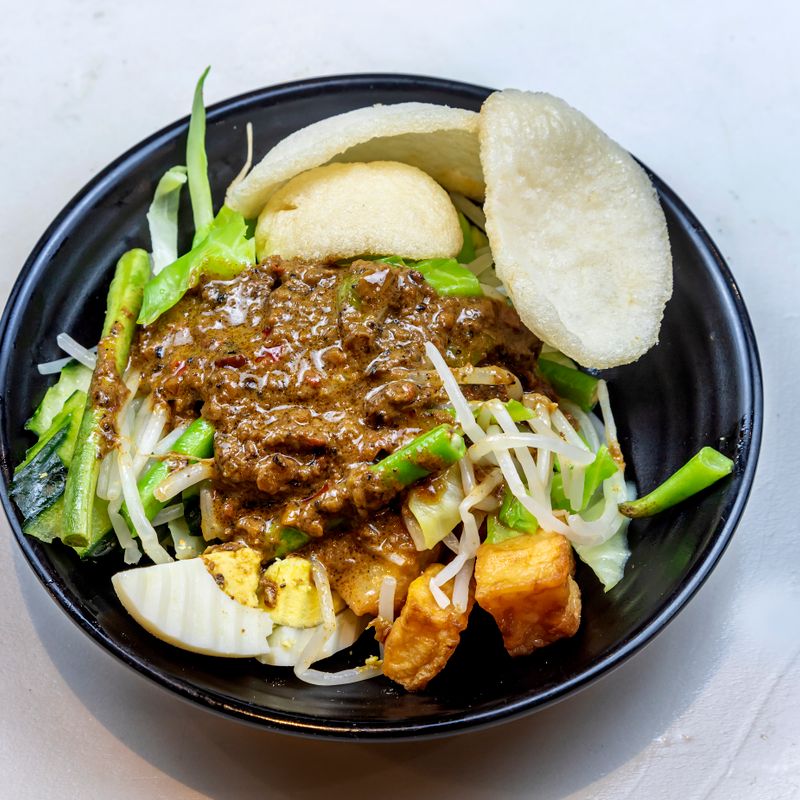
Indonesian Gado-Gado Lasagna
A creative fusion of Indonesian gado-gado and Italian lasagna, layering crispy tofu and tempeh, blanched vegetables, and a rich spiced peanut sauce between lasagna noodles. Topped with a golden crust of roasted chickpeas and sesame seeds, this vegetarian dish brings the bright, complex flavors of Southeast Asia to a beloved comfort food format.
- Prep
- 45 min
- Cook
- 45 min
- Wait
- 15 min
- Total
- 1 hr 45 min
- Makes
- 1 lasagna (8 servings), about 9×13 inches
Steps
Before you start
- Press tofu and tempeh between paper towels for at least 30 minutes to remove excess moisture
- Preheat oven to 375°F (190°C)
- Have all vegetables prepped and blanched before assembling
Cook lasagna noodles
- Bring a large pot of salted water to a boil.
- Add lasagna noodles and cook according to package directions until al dente, usually 9–10 minutes.
- Drain in a colander, rinse gently with cool water, and lay noodles flat on a clean kitchen towel to prevent sticking.
- Set aside.
+ Show details− Hide details
Ready when: Noodles bend easily without snapping
Tip: Don't oil the noodles; the slight stickiness helps them adhere to the sauce layers.
Fry tofu and tempeh
- Heat ¼ cup (60 ml) of vegetable oil in a large skillet over medium-high heat.
- Working in batches to avoid crowding, fry the pressed tofu cubes for 4–5 minutes per side until golden brown and crispy at the edges.
- Transfer to a paper towel–lined plate.
- In the same skillet, add the tempeh cubes and fry for 3–4 minutes per side until browned.
- Transfer to the plate with tofu.
- Season with salt and pepper.
+ Show details− Hide details
Ready when: Tofu and tempeh are golden brown with crispy edges
Tip: Ensure tofu and tempeh are very dry before frying; pressing them well prevents splattering and ensures a crispy exterior.
Make peanut sauce
- In a blender or food processor, combine peanut butter, coconut milk, tamarind paste, sambal oelek, soy sauce, lime juice, minced garlic, minced ginger, and brown sugar.
- Blend until smooth and well combined, about 1 minute.
- Taste and adjust seasonings (add more tamarind for tanginess, sambal for heat, or lime for brightness).
- The sauce should be pourable but rich; if too thick, add 2–3 tablespoons of warm water.
- Set aside.
+ Show details− Hide details
Ready when: Sauce is smooth and pourable
Tip: Don't skip the tamarind—it adds essential tanginess that defines gado-gado; lime alone won't provide the same depth.
Blanch vegetables
- Bring a large pot of salted water to a boil.
- Working in batches, blanch broccoli for 3 minutes, green beans for 4 minutes, cabbage for 2 minutes, and carrots for 3 minutes, each until just tender-crisp.
- Use a slotted spoon to transfer each batch to an ice bath to stop cooking, then drain well and pat dry.
- Set aside.
- (The raw bell pepper and cucumber, if using, do not need blanching.)
+ Show details− Hide details
Ready when: Vegetables are just tender-crisp, still have slight crunch
Tip: Don't overblanch; vegetables continue cooking slightly in the oven, so slightly underdone is better than soft.
Roast chickpea toppingOven 375°F / 190°C
- On a small baking sheet, toss drained and dried chickpeas with 2 tablespoons (30 ml) of vegetable oil, salt, and pepper.
- Spread in a single layer and roast at 375°F (190°C) for 12–15 minutes, stirring halfway through, until golden and crispy.
- Remove from oven and let cool slightly, then toss with sesame seeds.
- Set aside.
+ Show details− Hide details
Ready when: Chickpeas are golden and crispy on the outside, sesame seeds are lightly toasted
Tip: Dry the chickpeas thoroughly so they crisp instead of steam; damp chickpeas won't become crunchy.
Assemble lasagna baseOven 375°F / 190°C
- Preheat oven to 375°F (190°C).
- Spread a thin layer of peanut sauce (about ½ cup/120 ml) on the bottom of a 9×13-inch (23×33 cm) baking dish.
- Arrange 3–4 lasagna noodles to cover the bottom (they can overlap slightly and touch the edges).
- Spread another thin layer of sauce over the noodles.
+ Show details− Hide details
Tip: Use just enough sauce to coat; too much sauce makes the lasagna soggy and prevents proper layering.
Layer vegetables and proteins
- Spread about one-third of the blanched vegetables (broccoli, green beans, cabbage, carrots) over the sauce, then scatter one-third of the fried tofu and tempeh over the vegetables.
- Drizzle with 1 cup (240 ml) of peanut sauce.
- Repeat with noodles, sauce, vegetables, proteins, and sauce two more times (3 layers total), pressing gently after each layer.
- You should end with a layer of noodles topped with the remaining peanut sauce (about ½ cup/120 ml).
+ Show details− Hide details
Tip: Distribute vegetables evenly in each layer so every slice contains a good mix of toppings; don't let them pile in one corner.
Top with chickpeas and roasted seeds
- Scatter the roasted chickpea and sesame seed mixture evenly over the top layer of peanut sauce.
- If using fresh bell pepper or cucumber, scatter the slices over the chickpeas now (raw vegetables will soften slightly without cooking through during baking).
+ Show details− Hide details
Tip: Reserve some cilantro and scallions for garnishing after baking; they taste fresher when added just before serving.
Bake coveredOven 375°F / 190°C
- Cover the baking dish loosely with aluminum foil (don't let it touch the sauce).
- Bake at 375°F (190°C) for 25 minutes.
- The foil prevents the top from drying out while the lasagna heats through and the flavors meld.
+ Show details− Hide details
Tip: Place the baking dish on a baking sheet to catch any peanut sauce that might drip through the bottom.
Uncover and finish bakingOven 375°F / 190°C
- Remove the foil carefully (watch for steam) and bake uncovered for another 12–15 minutes at 375°F (190°C) until the top is lightly set and the edges of the lasagna are bubbling slightly at the sides of the pan.
- The chickpea topping should be fully crisp and the peanut sauce should be just barely bubbling (not aggressively boiling, which breaks down the sauce).
+ Show details− Hide details
Ready when: Edges are bubbling gently, chickpeas are crispy, sauce is set but not dry
Tip: Don't overbake; the peanut sauce can separate if it gets too hot. You want gentle, minimal bubbling only at the edges.
Rest and garnish
- Remove the lasagna from the oven and let it rest for 10–15 minutes before cutting.
- This allows the layers to set so they don't slide apart when serving.
- Just before serving, scatter fresh cilantro and sliced scallions (white and light green parts) over the top.
- Drizzle extra lime juice if desired, and serve warm.
+ Show details− Hide details
Tip: Resting is crucial; cutting into a hot lasagna will cause it to fall apart. A long rest (10–15 minutes) gives the best results.
Good to know
Tips
- This lasagna is best served warm but not piping hot; let it rest 10–15 minutes after removing from the oven so the layers hold together and the peanut sauce doesn't taste too oily.
- Press the tofu for at least 30 minutes (up to 1 hour) before frying; excess moisture prevents browning and causes the oil to splatter. Wrap it in a clean kitchen towel and place a heavy pan on top.
- If your tamarind paste is very concentrated, start with 1½ tablespoons and add more to taste; overseasoning with tamarind makes the sauce unpalatably sour.
- For a less spicy version, reduce sambal oelek to ½ teaspoon or omit it entirely; the sauce will still be flavorful from the other ingredients.
Make ahead
Assemble the lasagna fully (up to the point of baking) up to 8 hours ahead. Cover with plastic wrap and refrigerate. Add an extra 10–15 minutes to the total baking time if baking from cold. Alternatively, prepare the peanut sauce, blanch vegetables, and fry tofu/tempeh up to 1 day ahead; store each component separately in airtight containers in the refrigerator.
Storage & reheating
Room temperature: up to 2 hours loosely covered. Refrigerator: store leftovers in an airtight container for up to 3 days. Reheat in a 350°F (175°C) oven for 15–20 minutes until warmed through (cover with foil if the top begins to brown too quickly). Freezer: lasagna can be frozen unbaked for up to 3 months; thaw overnight in the refrigerator before baking, adding 10–15 minutes to baking time. Do not freeze after baking, as the peanut sauce separates upon thawing.
Substitutions
- natural creamy peanut butter → unsweetened almond or cashew butter. Use in equal quantity; cashew butter is milder and slightly sweeter. Skip or reduce the brown sugar slightly if using cashew. The sauce will be less traditional but still delicious.
- tamarind paste → 2 tablespoons rice vinegar or white vinegar mixed with 1 teaspoon lime juice. Tamarind provides unique tanginess; vinegar is a workable substitute but slightly sharper and less fruity. The gado-gado flavor will be less authentic but still pleasant.
- tempeh → extra-firm tofu (use 8 oz / 225 g total), or 1 cup (150 g) cashews. If using all tofu, increase frying time slightly. Roasted cashews provide crunch but less protein. Press cashews between paper towels and pan-fry at medium-high heat for 3–4 minutes until fragrant.
- sambal oelek or red chili paste → ½–1 teaspoon cayenne pepper or red pepper flakes, or 1–2 fresh red chilies, minced. Sambal has garlic and spices; the substitutes are hotter and lack the fermented flavor. Start with less and taste as you go.
More lasagna
See all →
Find more like this
- Meal
- Dinner
- Cuisine
- Vietnamese
- Method
- Oven