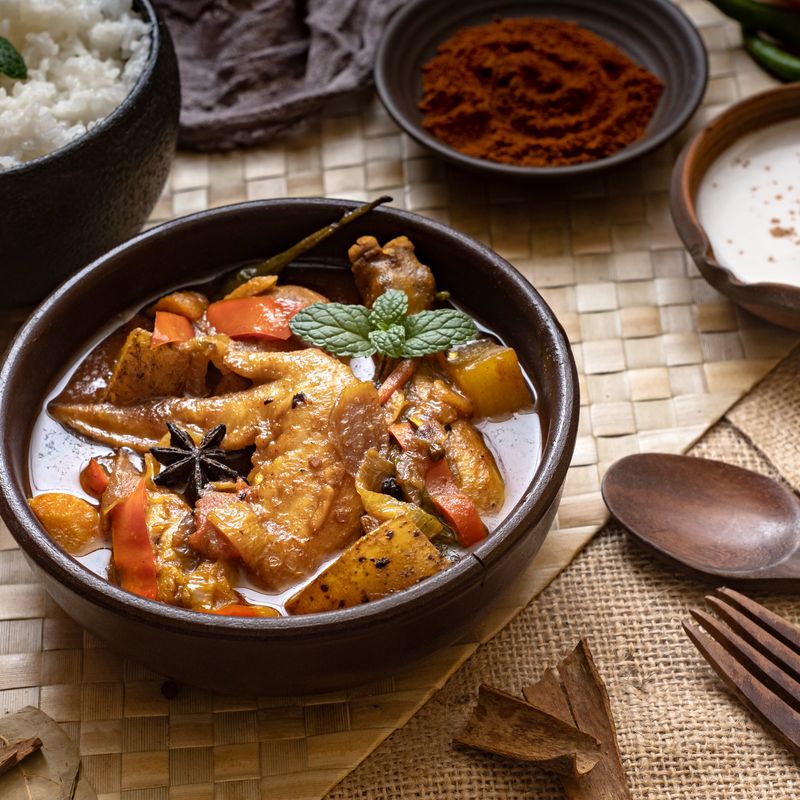
Filipino Afritada Lasagna
A creative fusion dish that transforms the beloved Filipino afritada stew—tender pork, potatoes, and carrots in a savory soy and tomato sauce—into layers of creamy, baked lasagna. The rich, aromatic filling is studded with vegetables and bound with béchamel and cheese, then nestled between sheets of pasta and finished with a golden crust. Perfect for introducing Filipino flavors to a familiar Italian format, or for anyone craving comfort food with an Asian twist.
- Prep
- 45 min
- Cook
- 1 hr
- Wait
- 1 hr 30 min
- Total
- 3 hr 15 min
- Makes
- 1 lasagna (8 servings)
Steps
Before you start
- Preheat your oven to 375°F (190°C) 15 minutes before assembling
- Have all ingredients prepped and your 9×13-inch (23×33 cm) baking dish ready
- Cook the pork and vegetables for the filling while you prepare the béchamel
- Use room-temperature béchamel for easier layering
Brown the pork
- Heat the oil in a large pot over medium-high heat (5–6 minutes to get it shimmering).
- Working in two batches to avoid overcrowding, add the pork cubes and sear for 4–5 minutes per batch until browned on all sides.
- Transfer the browned pork to a plate.
+ Show details− Hide details
Ready when: Pork is deep golden brown on all surfaces
Tip: Don't skip browning—it builds deep savory flavor. Pat the pork dry before searing for better color.
Sauté aromatics and tomato paste
- Add the diced onion to the same pot and cook for 2 minutes, stirring occasionally.
- Add the minced garlic and cook for 1 minute more until fragrant.
- Stir in the tomato paste and cook for 2 minutes, stirring constantly so it caramelizes slightly and darkens.
+ Show details− Hide details
Ready when: Tomato paste is dark rust-colored and coats the pot
Tip: Cooking out the tomato paste removes its raw flavor and adds sweetness and depth to the sauce.
Deglaze and simmer filling
- Pour in the soy sauce and broth, scraping the bottom of the pot with a wooden spoon to lift up any browned bits.
- Return the pork to the pot along with the potatoes and carrots.
- Bring to a gentle simmer, then reduce heat to medium-low.
- Cover partially and simmer for 25 minutes, stirring occasionally, until the pork is tender and vegetables are almost cooked through.
- Add the bell pepper in the last 5 minutes of cooking.
+ Show details− Hide details
Ready when: Pork shreds easily with a fork and reaches 145°F (63°C) at the center, potatoes break apart when pressed, carrots are fork-tender
Tip: Keep the liquid at a gentle simmer (not a rolling boil) to prevent the pork from getting tough. Use an instant-read thermometer to confirm the pork reaches the safe internal temperature of 145°F (63°C).
Season the filling
- Taste the filling and season generously with salt and black pepper.
- The sauce should taste rich and savory, with the soy sauce and tomato providing depth.
- Remove from heat and set aside to cool slightly (about 5 minutes) until lukewarm.
+ Show details− Hide details
Ready when: Filling is no longer steaming but still warm to the touch
Tip: Season while the filling is still warm so you can taste properly. You'll add more salt than you might expect because the layers will dilute the flavor.
Make the béchamel
- In a medium saucepan, melt the butter over medium heat.
- Sprinkle in the flour and whisk constantly for 1–2 minutes to form a smooth paste (a roux) without browning.
- Gradually pour in the warm milk while whisking to avoid lumps.
- Continue whisking for 5–8 minutes until the sauce thickens and coats the back of a spoon (it should reach about 160°F/71°C and be thick enough that a line drawn through it on the spoon holds for a moment).
- Stir in the nutmeg, then season lightly with salt and pepper.
- Let cool to room temperature, stirring occasionally (about 10 minutes).
+ Show details− Hide details
Ready when: Sauce coats the back of a spoon and reaches 160°F (71°C); no lumps visible
Tip: Warm milk whisks in smoothly without lumps. Add it slowly and whisk constantly to avoid a grainy sauce.
Cook the lasagna noodles
- Bring a large pot of salted water to a rolling boil.
- Add the lasagna noodles and cook for 1 minute less than the package directs (usually 8–9 minutes total) for al dente texture.
- Drain, rinse briefly with cool water to stop cooking, and lay them flat on a clean kitchen towel or parchment paper, lightly oiling between layers so they don't stick.
+ Show details− Hide details
Ready when: Noodles bend without snapping; no hard center when bitten
Tip: Undercooking slightly prevents the noodles from becoming mushy during baking. Oil them so they separate easily when you assemble.
Assemble the lasagnaOven 375°F / 190°C
- Preheat the oven to 375°F (190°C).
- Spread a thin layer of béchamel (about ⅓ cup/80 ml) on the bottom of the baking dish.
- Arrange 3 noodles in a single layer, slightly overlapping.
- Spread half of the afritada filling (about 2 cups/480 ml) evenly over the noodles, then spread ⅓ of the remaining béchamel (about ½ cup/120 ml) on top.
- Sprinkle with ½ cup (50 g) of mozzarella and 2 tbsp (20 g) of Parmesan.
- Layer 3 more noodles, then the remaining filling, then another ⅓ of the béchamel (about ½ cup/120 ml), then ½ cup (50 g) mozzarella and 2 tbsp (20 g) Parmesan.
- Top with the final 3 noodles, spread the remaining béchamel over them, and finish with the remaining 1 cup (100 g) mozzarella and remaining ½ cup (50 g) Parmesan.
+ Show details− Hide details
Ready when: All layers are even and the top layer of cheese covers the noodles
Tip: Spread each layer evenly and use your offset spatula to ensure béchamel coats thoroughly. Even layers ensure even baking and pulling slices without collapsing.
Bake until goldenOven 375°F / 190°C
- Place the baking dish on a large baking sheet (to catch any drips).
- Bake at 375°F (190°C) for 40–45 minutes, until the top is golden brown and the edges bubble gently around the pan.
- If the top browns too quickly (after 25 minutes), loosely tent with foil.
- A knife inserted into the center should meet no resistance, and the lasagna should jiggle slightly but not slosh when gently shaken.
+ Show details− Hide details
Ready when: Top is deep golden brown, edges bubble gently, center is set but slightly jiggly
Tip: Use a baking sheet underneath to catch any spills. The slight jiggle in the center will set as it cools, so don't overbake.
Rest before serving
- Remove from the oven and let the lasagna rest, uncovered, for 15–20 minutes.
- This allows the layers to set so slices hold together cleanly when cut.
+ Show details− Hide details
Ready when: Steam no longer rises from the top, and the surface firms up slightly
Tip: Don't skip the rest—it's the difference between clean slices and a sloppy serving.
Garnish and serve
- Slice the lasagna into 8 portions (cut into a 4×2 grid, or adjust size to your preference).
- Scatter the sliced scallion greens over each serving if desired.
- Serve warm, spooning any filling or sauce from the dish onto the plate.
+ Show details− Hide details
Ready when: Slices cut cleanly with a sharp knife and hold their shape
Tip: Use a long, hot knife to cut clean slices—wipe between cuts if needed. The scallions add fresh color and a gentle onion bite that echoes the original afritada.
Good to know
Tips
- This recipe is all about layering flavors: the soy-tomato filling provides umami, the béchamel creates silky richness, and the cheese brings salt and browning. Don't rush any step—the quality of each component shows in the final dish.
- If your lasagna releases excess liquid during baking (more than ¼ inch at the edges), reduce the broth in the afritada filling to 1¾ cups (420 ml) next time. Some vegetables release more water depending on season and variety.
- Afritada is traditionally a one-pot Filipino stew often served over rice; this lasagna format celebrates those same flavors and textures in a heartier, more structured presentation. It's excellent for feeding a crowd because it can sit at the table and stay warm.
- For a vegetarian version, substitute the pork and broth with mushrooms (cremini, oyster, or a mix), cut into ¾-inch pieces, and vegetable broth; the cooking time remains the same.
Make ahead
You can make the afritada filling up to 2 days ahead; store it in an airtight container in the refrigerator and reheat gently on the stovetop before assembling. The béchamel can be made up to 1 day ahead and refrigerated; bring to room temperature or reheat gently before layering. Assemble the lasagna up to 8 hours before baking and cover tightly with plastic wrap; add 5–10 minutes to the baking time if baking straight from the refrigerator. Do not freeze the unbaked lasagna, as the filling can separate during thawing.
Storage & reheating
Store leftover lasagna (covered) in the refrigerator for up to 3 days. To reheat, cover loosely with foil and warm in a 325°F (160°C) oven for 20–25 minutes until heated through. Individual portions can be microwaved on 70% power for 2–3 minutes. The lasagna does not freeze well due to the high moisture content of the filling and béchamel; frozen portions will separate and weep when thawed.
Substitutions
- pork shoulder, cut into ¾-inch (2 cm) cubes → chicken thighs, cut into 1-inch pieces. Reduce the initial braise time to 15–18 minutes since chicken cooks faster than pork. The flavor will be milder but still deeply savory. Chicken must also reach 165°F (74°C) at the center.
- chicken or pork broth → low-sodium beef broth or a 1:1 blend of broth and pork braising liquid saved from previous cooking. Beef broth adds earthiness; mixing with reserved cooking liquid concentrates afritada flavor.
- whole milk, warmed → half-and-half or light cream. Creates a richer, silkier béchamel. Use the same volume; no adjustments needed.
- whole milk mozzarella cheese, shredded → a 1:1 blend of mozzarella and fontina cheese. Fontina adds a slightly nutty, more complex flavor while still melting smoothly. Shred fresh and avoid pre-shredded if possible.
More lasagna
See all →
Find more like this
- Meal
- Dinner
- Main ingredient
- Pork Shoulder
- Diet
- Sugar-Free
- Method
- Oven