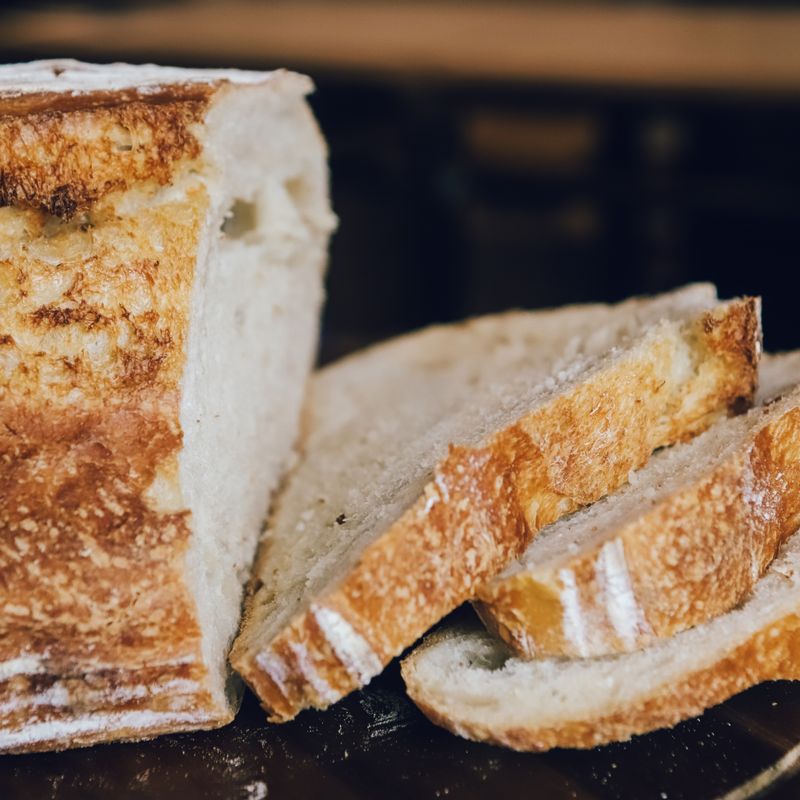
Eid Celebration Pistachio Cream and Date Swirl Bread
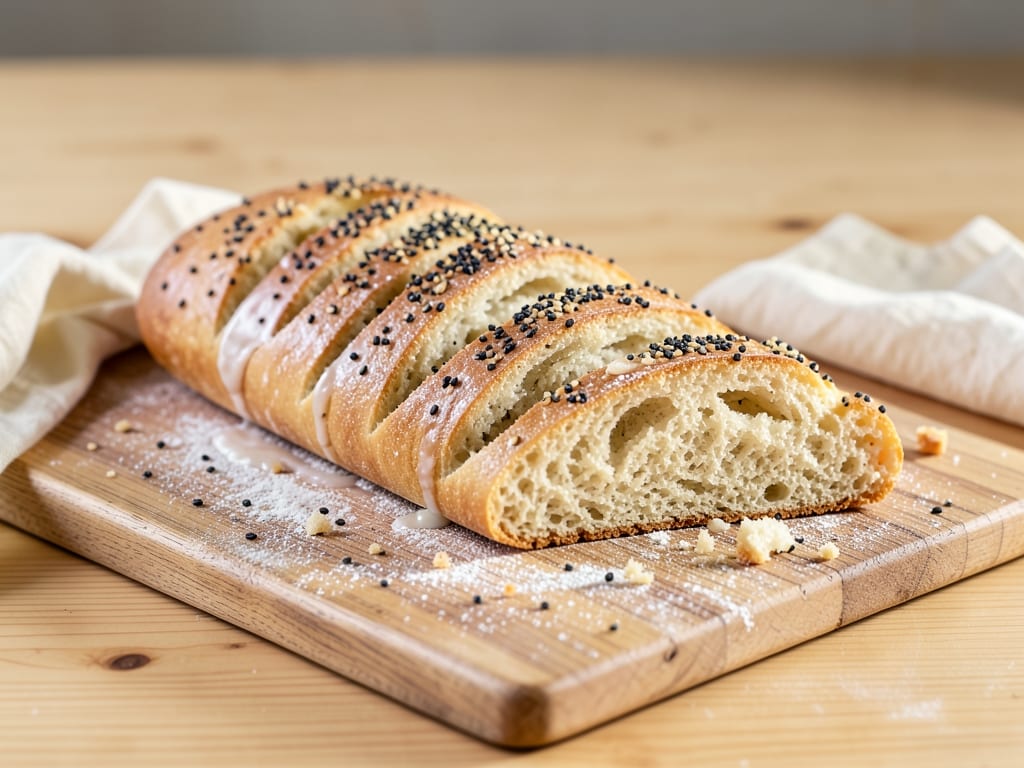
A beautifully swirled sourdough loaf celebrating Eid with creamy pistachio filling and caramelized dates infused with warm cardamom. The tender, open crumb and rich swirls make this a show-stopping centerpiece for your festive table. Perfect for sharing and breaking bread with loved ones.
- Prep
- 30 min
- Cook
- 40 min
- Wait
- 9 hr
- Total
- 10 hr 10 min
- Makes
- 1 loaf (12–14 slices)
Steps
Before you start
- Have your active sourdough starter at peak ripeness (doubled, bubbly, 100% hydration)
- Measure flour by weight for accuracy—volume measurements add 15–20% variance
- Read through the bulk fermentation timeline; ambient temperature affects scheduling by ±2 hours
- Prepare the pistachio-date filling ahead so it's cool and ready to spread
Mix dough
- In a large mixing bowl, combine 150 g active sourdough starter, 310 ml lukewarm water, and 450 g bread flour.
- Stir until no dry flour remains and the shaggy dough comes together, about 2 minutes.
- Cover and let rest at room temperature (68–72 °F / 20–22 °C) for 30 minutes.
- This autolyse allows the flour to fully hydrate.
+ Show details− Hide details
Ready when: Dough is shaggy and fully moistened, no dry streaks remain
Tip: Do not skip the autolyse—it improves extensibility and reduces mixing time needed later.
Incorporate salt and develop gluten
- After the autolyse rest, sprinkle 10 g fine sea salt evenly over the dough.
- Wet your hand and pinch and fold the dough over itself 8–10 times, rotating the bowl a quarter turn between folds, until the salt is fully incorporated and the dough feels slightly more cohesive, about 3 minutes.
- The dough should still be sticky and shaggy—this is normal for high-hydration sourdough.
+ Show details− Hide details
Ready when: Salt is fully distributed, no white specks visible; dough is uniformly sticky
Tip: Wet hands prevent sticking and make folding easier. Do not overmix or knead at this stage; gentle folding preserves the open crumb structure.
First bulk fermentation with coil folds
- Leave the dough in the covered bowl at room temperature (68–72 °F / 20–22 °C).
- Perform a set of 4–5 coil folds every 30 minutes for the first 2 hours: wet your hand, grip the center of the dough from underneath, and fold it toward you, then turn the bowl 90° and repeat.
- After 2 hours of folds (total elapsed time ~2.5 hours), stop folding and let the dough rest undisturbed for another 3 hours, until it has increased by 50–75% in volume, feels airy, and jiggles when the bowl is tapped gently.
+ Show details− Hide details
Ready when: Dough rises 50–75%, visible bubbles at surface and sides, slight doming of top
Tip: Coil folds replace traditional slap-and-fold for gentler gluten development. The dough should be stronger but still extensible after 5.5 hours total—not fully doubled, or it will collapse during shaping.
Prepare pistachio-date filling
- While the dough ferments, make the filling: warm 60 ml whole milk gently (do not boil).
- In a small bowl, combine 120 g room-temperature pistachio butter with the warm milk, stirring until smooth and spreadable.
- Add 30 g honey, 1.5 tsp (3 g) ground cardamom, 0.5 tsp (2.5 ml) vanilla extract, and 0.25 tsp (1 g) fine sea salt.
- Stir until fully blended.
- Gently fold in 200 g chopped medjool dates until evenly distributed.
- Taste and adjust cardamom or salt if needed.
- Transfer to a shallow bowl and cool to room temperature before using.
- The filling should be thick, pourable, and creamy.
+ Show details− Hide details
Ready when: Filling is smooth, creamy, fully blended, and cooled to room temperature
Tip: Make the filling early so it cools completely before spreading. If honey is cold and thick, warm it slightly to make blending easier.
Pre-shape and rest
- Turn the bulk-fermented dough onto a lightly floured work surface (do not use a bench scraper—gentle handling is key).
- Using a bench scraper and your hands, pre-shape the dough into a round by folding the edges toward the center, rotating and tucking gently, 4–5 times.
- Let it rest uncovered on the floured surface for 20–25 minutes.
- The dough should relax, flatten slightly, and feel slightly less tense.
+ Show details− Hide details
Ready when: Dough is relaxed, retains gentle finger poke impression, surface is smooth
Tip: A wet poke test: gently poke the dough; it should slowly spring back halfway. Under-proofed dough springs back fully; over-proofed deflates.
Final shape with swirl
- Dust the pre-shape lightly with flour.
- Using your palms, gently flatten it into a rough 10×12-inch (25×30 cm) rectangle on the floured surface.
- Spread the cooled pistachio-date filling evenly across the surface, leaving a ½-inch (1 cm) border on all sides.
- Starting from the far long edge, roll the dough tightly toward you, sealing the seam gently with the heel of your hand.
- Shape the log into a coil by rolling it up from one end like a cinnamon roll, tucking and sealing the outer edge.
- Place seam-side up in a floured banneton or bowl lined with a kitchen towel.
+ Show details− Hide details
Ready when: Dough is tightly rolled, seam is sealed, log transitions smoothly into coil
Tip: Roll tightly but not so hard that you compress the air. A loose roll traps large air pockets; a tight roll gives a tighter crumb and better swirl definition.
Cold final proof overnightOven 500°F / 260°C
- Cover the banneton with plastic wrap or a large ziplock bag.
- Refrigerate at 38–40 °F (3–4 °C) for 12–16 hours (overnight is ideal).
- The cold slows fermentation, develops sour flavor, and makes the dough easier to score.
- About 1 hour before baking, preheat your Dutch oven in a 500 °F (260 °C) oven.
+ Show details− Hide details
Ready when: Dough is fully chilled, holds its shape, poke leaves a slow-to-recover indentation
Tip: A cold dough is easier to score and score definition is sharper. If you prefer a warmer proof, room-temperature final proof takes 4–5 hours instead; reduce oven time by 5 minutes.
Score and bake with steamOven 500°F / 260°C
- Remove the chilled dough from the refrigerator.
- Carefully invert the banneton onto a piece of parchment paper so the seam side is down and the smooth, domed side faces up.
- Using a sharp lame, knife, or kitchen shears, make 2–3 confident, ¼-inch (6 mm) deep scores in a pattern of your choice—consider a leaf or spiral motif to complement the swirl.
- Remove the preheated Dutch oven from the 500 °F (260 °C) oven.
- Carefully transfer the parchment and dough into the hot Dutch oven (the parchment protects the swirled filling).
- Cover with the lid.
- Bake at 500 °F (260 °C) for 20 minutes with the lid on, trapping steam.
+ Show details− Hide details
Ready when: Steam rises from the vent (if open); lid may be fogged with condensation
Tip: Do not open the Dutch oven during the first 20 minutes or steam escapes and oven spring is compromised. The loud crackle and pop you may hear is normal.
Finish baking with colorOven 450°F / 230°C
- Remove the lid from the Dutch oven and reduce the oven temperature to 450 °F (232 °C).
- Continue baking for 15–18 minutes until the crust is a deep golden brown, especially around the swirls.
- The loaf should sound hollow when tapped on the bottom (use an oven mitt).
- If browning too quickly, tent loosely with foil for the last 5 minutes.
+ Show details− Hide details
Ready when: Crust is deep golden brown, loaf sounds hollow when tapped, internal temp is 205–210 °F (96–99 °C)
Tip: If the crust browns unevenly, rotate the Dutch oven halfway through this phase for even color.
Apply egg wash and garnish (optional)Oven 450°F / 230°C
- If desired, remove the loaf from the Dutch oven and brush the warm crust with a beaten egg wash (1 egg beaten with 1 tbsp / 15 ml water).
- Scatter 30 g roughly chopped roasted salted pistachios over the top.
- Return to the 450 °F (232 °C) oven for 2–3 minutes until the egg wash sets and pistachios are lightly toasted.
+ Show details− Hide details
Ready when: Egg wash is glossy and set (no longer wet), pistachios are fragrant and lightly golden
Tip: This step is optional but adds festive shine and flavor. Serve to guests with pride.
Cool completely
- Transfer the loaf to a wire rack and cool at room temperature for at least 1 hour before slicing.
- The interior continues to set during cooling and crumb structure stabilizes.
- Once cooled, slice with a serrated bread knife using a gentle sawing motion to showcase the pistachio-date swirl.
+ Show details− Hide details
Ready when: Loaf is cool to the touch, interior is no longer steaming, slices cleanly
Tip: Do not slice warm bread—the crumb is still setting and will compress. A serrated knife makes a cleaner cut through the swirled filling.
Good to know
Tips
- Sourdough timing is temperature-dependent: at 72 °F (22 °C), fermentation happens faster; at 65 °F (18 °C), it slows. Adjust your schedule accordingly—use the visual and poke cues (50–75% rise, gentle indent) rather than strict timing.
- Pistachio paste can separate; stir well before using. If you have access to Middle Eastern or specialty shops, look for 100% pistachio paste without added oils, which gives the cleanest flavor.
- The cardamom flavor intensifies during fermentation and baking. Start with 1.5 tsp and taste the cooled filling; if you prefer a subtle hint, use 1 tsp instead. You can always add more.
- Toast the pistachio garnish in a dry skillet over medium heat for 2–3 minutes (optional but recommended) to unlock their fragrance and deepen their flavor before scattering over the egg wash.
Make ahead
You can make the dough and fill it up to 2 days ahead: shape and refrigerate the filled dough at 38–40 °F (3–4 °C), then bake directly from cold. The longer cold fermentation (24–48 hours) deepens sour flavor and improves digestibility. Alternatively, freeze the shaped, unbaked loaf for up to 3 months; thaw overnight in the refrigerator before baking (add 5 minutes to bake time).
Storage & reheating
At room temperature: store in a sealed paper bag or wrapped in a clean kitchen towel for up to 2 days; the crust will soften but the interior stays tender. Refrigerator: wrap tightly and store for up to 5 days; refresh in a 350 °F (175 °C) oven for 10 minutes. Freezer: wrap tightly in plastic wrap and foil; freeze for up to 3 months. To reheat from frozen: thaw at room temperature for 4 hours, then warm in a 350 °F (175 °C) oven for 15 minutes until heated through.
Substitutions
- unsweetened pistachio butter → almond butter or tahini (sesame seed paste). Almond butter gives a milder nuttiness; tahini provides earthiness and pairs beautifully with cardamom and dates. Use the same amount.
- medjool dates, pitted → Deglet Noor dates or dried figs, chopped. Deglet Noor dates are less sweet; figs add a subtly different sweetness and chewiness. Use the same weight.
- ground cardamom → warm spice blend (½ tsp ground cinnamon + ½ tsp ground ginger + ¼ tsp ground clove). Creates a chai-like spice profile. Adjust to taste as these spices are assertive.
- raw honey → agave nectar or maple syrup. Both are slightly thinner than honey; use the same volume (30 ml). Maple syrup gives deeper molasses notes.
More yeast breads
See all →


Find more like this
- Meal
- Breakfast
- Cuisine
- Middle Eastern
- Main ingredient
- Dates
- Diet
- VegetarianHalal
- Method
- Oven
- Quick & Easy
- Make Ahead
- Occasion
- Eid