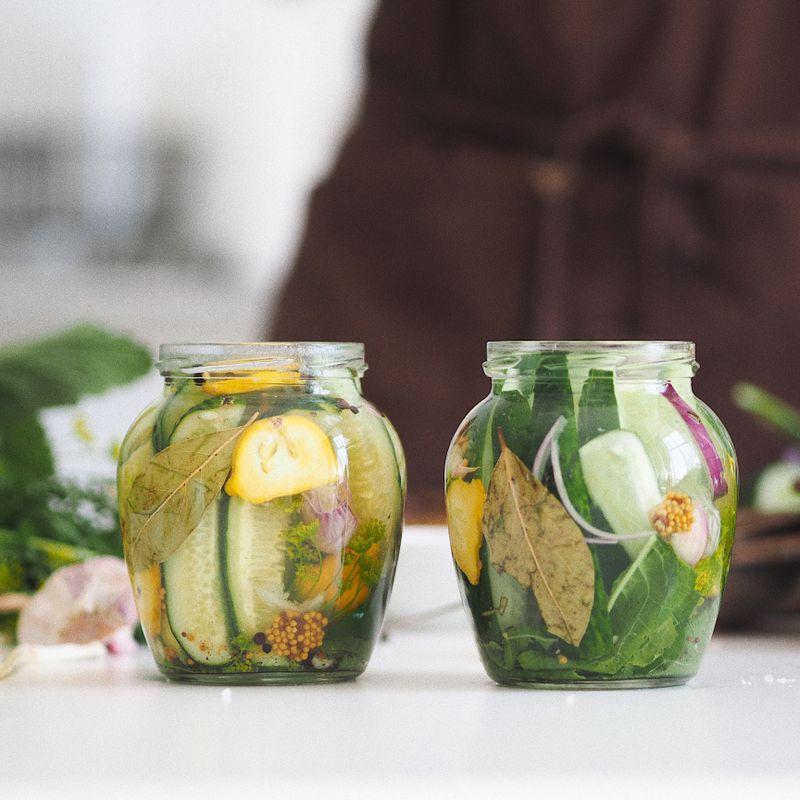
Dưa Cải Chua (Vietnamese Pickled Mustard Greens)
Crisp-tender mustard greens fermented in a lightly sweet salt brine with scallions until pleasantly sour in about three days. Served the Vietnamese way, they cut through rich braised pork, fried fish and grilled meats, and they're also great in soups and stir-fries.
- Prep
- 30 min
- Cook
- 5 min
- Wait
- 3.1 days
- Total
- 3.1 days
- Makes
- About 2 quarts (1 jar), 8 side servings
Steps
Before you start
- Plan for about 3 days at room temperature (2 to 4 depending on how warm your kitchen is). Start on a day when you can check the jar daily.
- Buy mature, leafy mustard greens (cải bẹ xanh) with thick, juicy stems, not baby mustard greens, which turn limp. Choose about 2 large bunches.
- Wash a 2-quart (2 L) wide-mouth jar, a small plate or zip-top bag filled with brine, and your hands with hot soapy water; rinse well. Clean equipment keeps the ferment sour, not spoiled.
- Use non-iodized salt (fine sea salt or pickling salt) and measure it by weight. Table salt with anti-caking agents can cloud the brine, and iodine can slow fermentation.
Trim and wash greens
- Pull the mustard greens apart into individual leaves and stalks.
- Discard any yellow, slimy or wilted outer leaves and trim off the dry bottom ½ inch (1 cm) of each stalk.
- Rinse every leaf under cold running water, rubbing the stalk grooves to remove grit.
- Shake off the excess water.
+ Show details− Hide details
Ready when: Leaves are free of sand and soil and no yellow or soft spots remain.
Tip: Mustard stems trap grit; check the base of each stalk before moving on.
Cut the greens
- Stack a few leaves at a time on a cutting board and cut crosswise into 2-inch (5 cm) pieces.
- Cut very thick stalks in half lengthwise first so they are about ¾ inch (2 cm) wide at most and ferment evenly.
- You should have about 800 g of cut greens.
- Cut the scallions into 2-inch (5 cm) lengths and set aside.
+ Show details− Hide details
Ready when: Pieces are roughly uniform, 2 inches long, with no stem wider than about ¾ inch.
Make the brine
- In a small saucepan, combine the water, salt and sugar.
- Bring to a boil over medium-high heat, stirring, and boil for 2 minutes.
- Remove from heat and set aside to cool completely while the greens wilt in the next step.
+ Show details− Hide details
Ready when: Salt and sugar are fully dissolved and the liquid is clear.
Tip: Never pour warm brine over the greens. Heat kills the good bacteria and makes the greens soft and olive-colored.
Wilt the greens
- Spread the cut greens in a single loose layer on baking sheets or clean kitchen towels.
- Leave them in a breezy, dry spot indoors (or in gentle sun, if available) for 3 hours, tossing once halfway.
- They should lose some of their bulk and bounce.
+ Show details− Hide details
Ready when: Leaves look limp and slightly shrunken, and stems bend without snapping. They should still feel fresh, not dried out. The brine is no longer warm to the touch.
Tip: In humid weather, wilt a bit longer or use a fan; wet greens dilute the brine.
Pack the jar
- Add the wilted greens and scallion pieces to the clean 2-quart jar in loose handfuls, pressing down firmly after each addition and mixing in the scallions as you go.
- Leave at least 1½ inches (4 cm) of headspace at the top.
+ Show details− Hide details
Ready when: Jar is packed snugly with at least 1½ inches (4 cm) of space below the rim.
Tip: Don't overfill. Fermenting greens release gas and liquid, and a too-full jar will bubble over.
Add brine and weigh down
- Pour the cooled brine over the greens until every piece is fully covered.
- Tuck a fermentation weight or a zip-top bag filled with a little leftover brine on top to keep everything submerged.
- Loosely rest the lid on top without tightening, so gas can escape.
+ Show details− Hide details
Ready when: No greens poke above the brine surface.
Tip: Greens exposed to air can grow mold. If the brine falls short, mix 1 cup (240 ml) water with 1 tsp salt and top it up.
Ferment at room temperature
- Set the jar on a plate, out of direct sun, at 72–78°F (22–26°C).
- Let it ferment for 2 to 4 days.
- Each day, press the greens down with a clean spoon to release trapped gas and keep them submerged.
- From day 2, taste a piece daily.
+ Show details− Hide details
Ready when: Brine is cloudy and slightly bubbly, the greens have turned from bright green to yellowish-olive, and they taste pleasantly sour yet still crunchy. It smells tangy, like sauerkraut.
Tip: Warm kitchens ferment faster; check at 2 days. If you see fuzzy mold or smell something rotten rather than sour, discard the batch.
Chill and serve
- When the sourness suits you, tighten the lid and refrigerate the jar.
- Chill for at least 2 hours before serving for the best crunch.
- Serve straight from the jar with rice dishes, braised or grilled meats, or use in canh chua-style soups.
+ Show details− Hide details
Ready when: Pickles are cold, crisp-tender and tangy.
Tip: Rinse very sour pickles briefly, or squeeze out the brine, before stir-frying.
Good to know
Tips
- Weigh the salt. A brine of about 3% salt keeps bad microbes out while letting good bacteria thrive; too little risks spoilage and too much stalls fermentation.
- To jump-start fermentation in a cool kitchen, add 1 tbsp of brine from a previous batch, or a few tablespoons of cooled rice cooking water.
- Keep greens fully submerged. Anything above the brine will discolor or grow mold.
- Use the sour brine too: a splash adds tang to dipping sauces, soups or marinades.
Make ahead
"The pickles are best made 3 to 5 days before you need them. Once fermented to your liking, they hold well in the fridge for up to 2 weeks, getting gradually more sour."
Storage & reheating
Room temperature: keep the jar out of direct sun for the 2 to 4 day fermentation only. Fridge: refrigerate in the brine in a sealed jar for up to 2 weeks, keeping the greens submerged. Freezer: not recommended, as the greens turn soft. Serve cold, or stir-fry briefly with pork or in soup to cook them.
Substitutions
- mustard greens (cải bẹ xanh) → Napa cabbage or green cabbage. Gives a milder, softer pickle. Cut napa into 2-inch (5 cm) pieces and wilt for only 1 to 2 hours.
- scallions → Chinese chives or garlic chives. Use the same weight, cut in 2-inch (5 cm) lengths, for a more pungent flavor.
- granulated sugar → Light brown sugar or palm sugar. Use the same weight; the brine will be slightly darker with a subtle caramel note.
- fine sea salt or pickling salt → Kosher salt (Diamond Crystal). Use about 40 g because its flakes are lighter; always weigh rather than measure by volume.
More pickles & chutneys
See all →
Find more like this
- Meal
- Lunch
- Cuisine
- Vietnamese
- Method
- Stovetop
- Quick & Easy
- 5 Ingredients or LessEasyMake Ahead