Dinner Party Scallop and Champagne Carnaroli Risotto
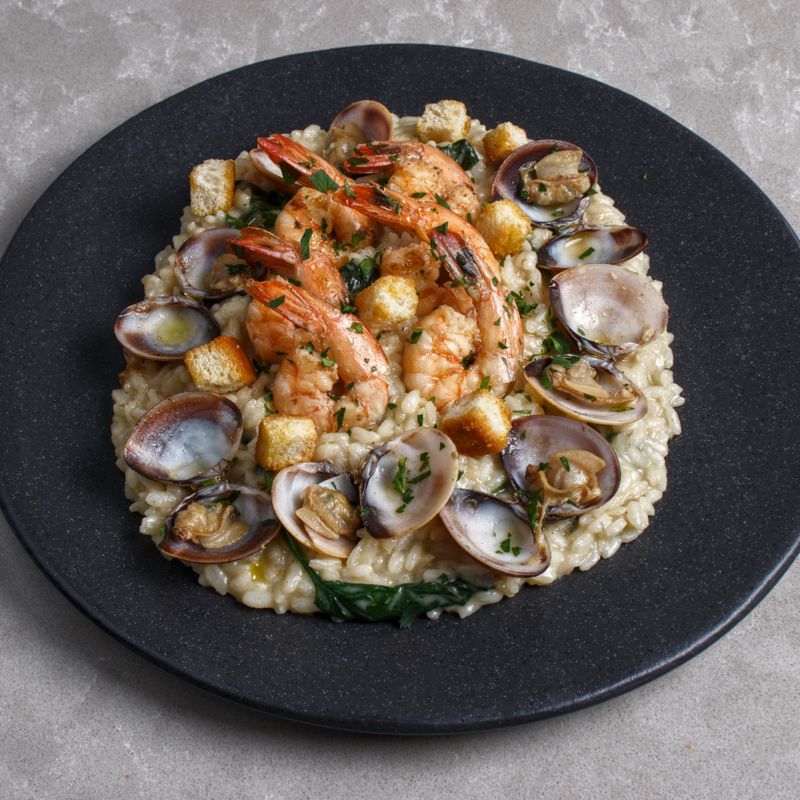
Creamy carnaroli risotto infused with champagne and finished with seared dry scallops, fresh tarragon, and a touch of mascarpone. The champagne adds delicate acidity and complexity, while the scallops provide a luxurious protein. This elegant dish is refined enough for a special dinner party but straightforward enough to execute confidently at the stove.
- Prep
- 15 min
- Cook
- 30 min
- Wait
- 5 min
- Total
- 50 min
- Makes
- 4 servings (about 1¼ cups each)
Steps
Before you start
- Pat scallops dry and bring to room temperature 15 minutes before cooking
- Heat stock in a separate pot and keep it at a gentle simmer throughout the risotto cooking
- Measure out champagne and have all other ingredients prepped and within arm's reach—risotto requires constant attention
Heat stock and begin risotto
- Pour the stock into a medium saucepan and bring to a gentle simmer over medium heat.
- Keep it at a bare simmer throughout the risotto cooking.
- In a large heavy-bottomed saucepan or Dutch oven (3- to 4-quart), heat 1 tablespoon of the olive oil over medium heat.
- Add the minced shallots and cook, stirring frequently, for 2 to 3 minutes until softened and lightly golden, but not brown.
- Add the carnaroli rice and stir constantly for 1 to 2 minutes until the rice is coated with oil and the grains turn translucent at the edges.
+ Show details− Hide details
Ready when: Rice grains translucent at edges; shallots softened and light gold
Tip: Don't skip the toasting step—it helps the rice cook evenly and adds subtle nutty flavor.
Deglaze with champagne
- Pour in the champagne slowly, stirring constantly.
- The rice will hiss and bubble.
- Continue stirring until almost all the liquid has been absorbed and the pan is nearly dry, about 2 minutes.
+ Show details− Hide details
Ready when: Liquid nearly absorbed; rice grains still firm but losing opacity
Tip: Use dry champagne or a crisp white wine—sweeter wines will make the risotto cloying.
Begin adding stock, stirring constantly
- Add the hot stock one ladleful (about ¾ cup or 180 ml) at a time, stirring frequently and allowing each addition to be almost completely absorbed before adding the next.
- Continue this process for 16 to 18 minutes, maintaining a gentle simmer.
- The risotto should always look creamy but not soupy.
- Taste a grain of rice around the 16-minute mark—it should be tender with a slight firmness in the center (al dente), not mushy or chalky.
+ Show details− Hide details
Ready when: Rice grains tender with slight resistance in center; creamy, not soupy or stiff
Tip: Stir regularly to release the rice's starches and create the signature creamy texture. Don't leave the pot unattended.
Sear scallops while risotto finishes
- About 5 minutes before the risotto is done, heat the remaining 1 tablespoon of olive oil in a 12-inch skillet over medium-high heat until shimmering and just beginning to smoke.
- Season the patted-dry scallops generously on both sides with sea salt and white pepper.
- Working in batches if necessary, carefully place scallops in the hot oil in a single layer.
- Do not move them for 2 to 3 minutes—they need this time to develop a golden crust.
- Flip each scallop once and cook for an additional 2 minutes on the second side, until opaque throughout and firm to the touch (they should register 120–125°F / 49–52°C on an instant-read thermometer).
- Transfer to a warm plate.
+ Show details− Hide details
Ready when: Scallops golden brown on both sides, opaque throughout, 120–125°F internal temperature
Tip: Dry scallops are critical for browning. If they release liquid, they were not dry enough. Don't crowd the pan, or they'll steam instead of sear.
Finish risotto with butter and cheese
- When the rice is al dente and the risotto is creamy, remove the pot from heat.
- Stir in the cold butter pieces and mascarpone cheese, breaking them up and stirring until completely incorporated and the risotto becomes glossy and flows slightly on the plate when spooned.
- Fold in the grated Parmigiano-Reggiano and fresh tarragon.
- Taste and adjust seasoning with sea salt and white pepper.
+ Show details− Hide details
Ready when: Risotto glossy and flows slightly; cheese and herbs fully incorporated
Tip: This 'mantecatura' (finishing step) is what makes risotto luxurious. Cold butter and mascarpone create the creamy consistency—don't skip them.
Plate and serve immediately
- Divide the risotto among four warm shallow bowls, spooning it into a small mound in the center of each.
- Top each portion with three seared scallops.
- Drizzle lightly with additional olive oil if desired, and garnish with a few extra fresh tarragon leaves or a light grating of Parmigiano-Reggiano.
- Serve at once.
+ Show details− Hide details
Ready when: Risotto warm and creamy in center; scallops warm throughout
Tip: Risotto is best eaten immediately. Warm your serving bowls under hot water to keep the dish at the right temperature.
Good to know
Tips
- Carnaroli rice holds its shape better than arborio during the long stirring process and absorbs more liquid, creating a silkier texture. Don't substitute arborio if you can find carnaroli—it's worth seeking out.
- Pat scallops completely dry and bring them to room temperature before searing. Cold, wet scallops will stick to the pan and steam rather than develop a golden crust.
- Stir the risotto regularly but not manically. Constant motion will break down the rice and make it mushy. Gentle, steady stirring is ideal.
- Keep the stock at a bare simmer, not a rolling boil. Stock that's too hot cooks the rice unevenly and boils off moisture.
Make ahead
You can prepare components ahead: dice shallots and measure rice up to 4 hours ahead. Pat scallops dry and refrigerate them uncovered for up to 2 hours. Warm the stock fresh just before cooking. Do not make the risotto ahead—it must be cooked to order and served immediately for the best texture.
Storage & reheating
Risotto is best served fresh, but leftovers can be refrigerated in an airtight container for up to 2 days. Reheat gently over low heat with a splash of warm stock, stirring frequently. The texture will be slightly thicker. Scallops do not freeze well after cooking; discard leftovers. Raw scallops can be frozen for up to 3 months in an airtight container—thaw overnight in the refrigerator before cooking.
Substitutions
- champagne or dry white wine → dry white wine (Sauvignon Blanc or Pinot Grigio) or dry vermouth. Use the same quantity. The acidity and subtle fruit are key; avoid sweet wines.
- mascarpone cheese, room temperature → heavy cream or crème fraîche. Use the same quantity. The risotto will be slightly lighter but still creamy. Whisk in off heat.
- fresh tarragon leaves → fresh chervil or a mix of fresh dill and parsley. Tarragon's anise-like flavor is signature here, but chervil offers similar delicacy. Use the same quantity.
- large dry sea scallops (U10 or U15 size, about 1.5 oz each) → large shrimp (U10 or U12 size, about 1 oz each), peeled and deveined, or asparagus spears seared until tender-crisp. Shrimp cook in the same time and temperature. Asparagus (vegetarian option) requires 3–4 minutes per side over medium-high heat.