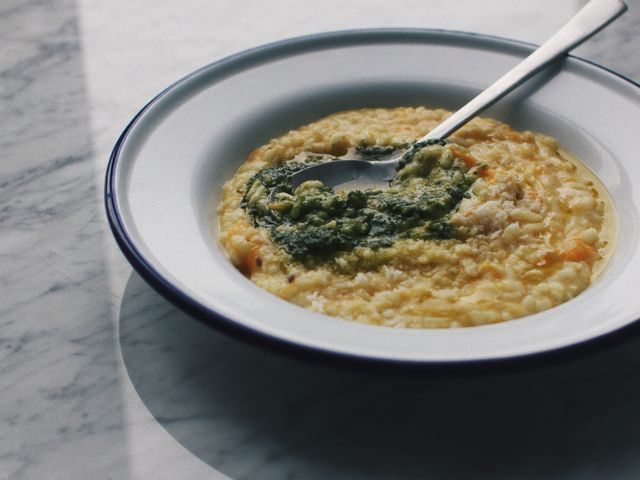
Italian Scallop and White Wine Risotto
A classic Northern Italian risotto with tender sea scallops, bright white wine, and creamy arborio rice finished with butter and Parmigiano-Reggiano. The scallops are seared separately and added at the end to preserve their delicate texture, while the risotto develops its signature creamy consistency through constant stirring and gradual stock addition.
- Prep
- 15 min
- Cook
- 30 min
- Wait
- 5 min
- Total
- 50 min
- Makes
- 4 servings (about 1½ cups each)
Steps
Before you start
- Bring seafood or chicken stock to a gentle simmer in a separate pot and keep it warm on the stovetop throughout cooking
- Pat the scallops completely dry with paper towels before searing—moisture prevents browning
- Have all ingredients measured and within arm's reach; risotto requires constant attention and cannot be left unattended
Sauté shallots and garlic
- Heat 1 tablespoon (15 ml) of olive oil in a large heavy-bottomed saucepan over medium heat.
- Add minced shallots and garlic, stirring frequently, until softened and fragrant, about 2–3 minutes.
- Do not brown.
+ Show details− Hide details
Ready when: Shallots are translucent and garlic is fragrant
Tip: Keep heat at medium to avoid browning the aromatics, which would make the risotto bitter
Toast rice grains
- Add the arborio rice to the pan and stir constantly for 1–2 minutes.
- You should hear the grains clicking against the pan and smell a toasty aroma.
- This blooms the starches and helps the rice maintain its shape while cooking.
+ Show details− Hide details
Ready when: Rice grains are opaque with a slight golden tint and make an audible clicking sound
Tip: Toasting the rice is key to proper risotto texture; don't skip this step
Deglaze with wine
- Pour the white wine into the pan, stirring constantly.
- Let the wine simmer and mostly absorb into the rice, about 2–3 minutes, stirring occasionally.
- The rice will smell fragrant and alcoholic aroma will dissipate.
+ Show details− Hide details
Ready when: Most of the wine is absorbed and rice is mostly dry looking again
Tip: Let the wine fully absorb to develop flavor and prevent a watery risotto
Add stock and stir
- Using a ladle, add 1 cup (240 ml) of warm seafood stock to the rice.
- Stir frequently but not constantly—every 30 seconds or so—to release the starches gradually.
- Once most of the stock has been absorbed (after 3–4 minutes), add another ladle of stock.
- Repeat this process, adding stock one ladle at a time and letting each addition absorb mostly before adding the next, for about 18–20 minutes total.
- The rice should always be creamy and flow slightly on the plate, never stiff or mushy.
+ Show details− Hide details
Ready when: Rice grains are tender with a slight firmness in the center (al dente) and the mixture flows slowly when tilted
Tip: Stir frequently but not constantly—constant stirring releases too many starches and makes the risotto gluey. Keep stock warm so it doesn't cool the rice and interrupt cooking
Sear the scallops
- While the risotto cooks, heat 2 tablespoons (30 ml) of olive oil in a 12-inch (30 cm) skillet over medium-high heat until shimmering.
- Pat the scallops dry one more time if needed.
- Once the oil is hot, carefully place scallops in the skillet in a single layer without crowding (work in batches if necessary).
- Sear without moving them for 2 minutes until golden brown on the first side, then flip and sear for 1–2 minutes on the second side until opaque throughout.
- Season with a pinch of kosher salt and pepper.
- Transfer to a plate and keep warm.
+ Show details− Hide details
Ready when: Scallops are opaque throughout with a golden crust on both sides
Tip: Do not move scallops while they cook—this prevents a good crust from forming. Overcrowding the pan will cause them to steam instead of sear
Finish risotto with butter and cheese
- When the rice is al dente and the mixture is creamy, remove the pan from heat.
- Stir in the cold butter cubes and grated Parmigiano-Reggiano cheese until fully incorporated and the risotto becomes silky and smooth.
- Season with additional kosher salt and freshly ground black pepper to taste.
- This final step, called 'mantecatura,' transforms the risotto from good to exceptional.
+ Show details− Hide details
Ready when: Risotto is glossy, flows slightly on the plate, and tastes creamy and rich
Tip: Cold butter emulsifies with the starch and cream to create a silky texture—do not use warm butter or reheat after adding it
Plate and serve
- Divide the risotto among four shallow bowls, creating a small well in the center of each portion.
- Arrange 3 seared scallops on top of each serving.
- Drizzle with any pan juices from the scallops.
- Garnish with fresh parsley and a pinch of lemon zest if desired.
- Serve immediately.
+ Show details− Hide details
Tip: Risotto must be served immediately in warmed bowls—it continues to firm up as it cools
Good to know
Tips
- Mise en place is essential for risotto—have all ingredients measured and ready before you start cooking, because the process moves quickly and requires constant attention
- The 'creamy' consistency comes from starch released by the rice and emulsified by butter, not from cream. Never use cream in traditional risotto, as it masks the delicate flavor of the rice
- If your risotto becomes too thick before the rice is cooked, add warm stock a little at a time. If it's too loose at the end, let it simmer for 1–2 minutes while stirring, or stir in a spoonful of grated cheese to help bind it
- Scallops are delicate and cook quickly; avoid overcooking by using a high heat for a quick sear and removing them from the pan as soon as the second side is opaque
Storage & reheating
Risotto is best served fresh. Leftovers can be stored in an airtight container in the refrigerator for up to 2 days. Reheat gently on the stovetop over medium-low heat with a splash of warm stock or water, stirring occasionally, until creamy again (3–5 minutes). Do not reheat in the microwave, as it can make the rice tough.
Substitutions
- arborio rice → Carnaroli rice. Carnaroli has a slightly smaller starch granule and holds its shape well; cook time may be 1–2 minutes longer. Vialone Nano is another excellent choice.
- seafood or light chicken stock → Good-quality chicken stock or a 50/50 mix of chicken stock and clam juice. Seafood stock provides the best flavor, but chicken stock works well if you add a splash of clam juice. Vegetable stock will work but produces a lighter flavor.
- large sea scallops (about ½ pound), patted dry → Large shrimp (16–20 per pound) or halibut chunks. Shrimp cook in 2–3 minutes total; halibut should be cut into 1½-inch (4 cm) pieces and seared 2 minutes per side. Do not substitute bay scallops—they are too small and will overcook.
- dry white wine (such as Pinot Grigio or Sauvignon Blanc) → Dry vermouth or additional seafood stock. Dry vermouth adds herbal notes; if using extra stock, reduce the total stock by ¾ cup (180 ml) and add it with the wine so the risotto doesn't become too liquid.