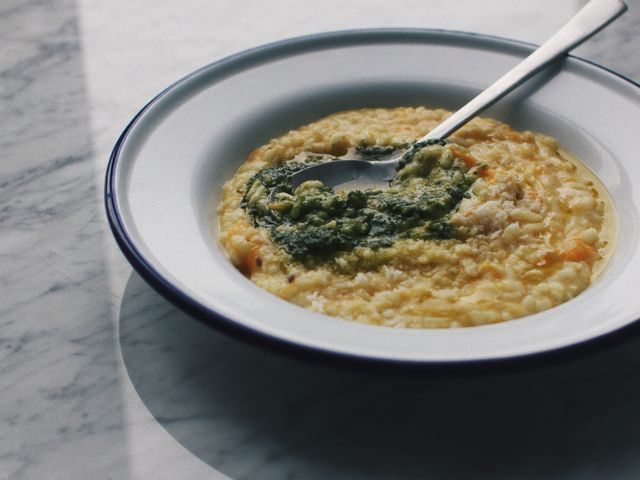
Roasted Porcini Mushroom and Barolo Wine Risotto
A luxurious stovetop risotto featuring earthy roasted porcini mushrooms and full-bodied Barolo wine. Arborio rice is slowly stirred with warm stock and wine, releasing its starches to create a creamy, flowing risotto without cream. Fresh parmesan and a touch of butter finish the dish with richness. This elegant side pairs beautifully with roasted meats or can stand alone as a showstopper vegetarian main.
- Prep
- 15 min
- Cook
- 35 min
- Wait
- 10 min
- Total
- 1 hr
- Makes
- 4 servings (about 1.5 cups per person)
Steps
Before you start
- Heat beef stock to a gentle simmer in a separate pot and keep it warm throughout cooking—cold stock will shock the rice and interrupt the cooking process.
- Have all ingredients prepped and measured before you start cooking; risotto requires constant attention and you won't have time to chop mid-stir.
- Use a good-quality, dry Barolo wine you would drink—cheap cooking wine will make the risotto taste off.
- Preheat oven to 425°F (220°C) to roast mushrooms before beginning the risotto.
Rehydrate dried porcini
- Place dried porcini mushrooms in a small heatproof bowl and pour 1 cup (240 ml) of hot water over them.
- Let soak for 10 minutes until softened and darkened.
- Carefully pour the liquid through a fine-mesh strainer into another bowl, leaving any grit at the bottom undisturbed.
- Chop the rehydrated porcini into bite-sized pieces (about ½ inch).
- Reserve both the mushrooms and their soaking liquid.
+ Show details− Hide details
Ready when: Porcini are dark, plump, and easily torn with a fork
Tip: The soaking liquid is liquid gold—it contains concentrated mushroom flavor and will be added to the risotto for depth.
Roast fresh mushroomsOven 425°F / 220°C
- Preheat oven to 425°F (220°C).
- On a medium rimmed baking sheet, toss halved or quartered fresh mushrooms with 2 tablespoons olive oil, ½ teaspoon salt, ¼ teaspoon black pepper, and 3 thyme sprigs.
- Spread in a single layer.
- Roast for 15–18 minutes, stirring halfway through, until mushrooms are golden brown, their edges are crispy, and they've released their moisture.
- The mushrooms should smell deeply savory.
+ Show details− Hide details
Ready when: Mushrooms are deep golden brown with crispy edges and smell rich and savory
Tip: Don't stir more than once—allow them to sit undisturbed so they caramelize rather than steam. Roasting concentrates their flavor far more than pan-sautéing.
Begin the risotto base
- While mushrooms roast, bring beef stock and the reserved porcini soaking liquid to a gentle simmer in a separate pot.
- Keep it on very low heat.
- In a large heavy-bottomed saucepan over medium heat, add 2 tablespoons of the cold butter.
- Once melted, add minced shallots and garlic.
- Cook, stirring often with a wooden spoon, for 2–3 minutes until softened and fragrant but not browned.
- The mixture should smell sweet and lightly pungent.
+ Show details− Hide details
Ready when: Shallots and garlic are translucent and smell fragrant; no brown color
Tip: Do not let the garlic and shallots brown or they will taste bitter. Medium heat allows them to cook gently without coloring.
Toast the rice
- Add 1.5 cups Arborio rice to the pan with the shallots and garlic.
- Stir constantly with the wooden spoon for 1–2 minutes until each grain is coated in butter and the rice smells slightly nutty.
- You'll hear a faint clicking sound as the grains move against the pan.
- Do not let the rice brown.
+ Show details− Hide details
Ready when: Every grain is glossy and coated; smell is lightly toasted and nutty
Tip: Toasting the rice before adding liquid seals the outer layer slightly, helping it release starch more evenly and creating a better texture.
Deglaze with wine
- Pour in 1 cup of Barolo wine.
- Stir constantly for 1–2 minutes, scraping the bottom of the pan, until the wine is mostly absorbed and the rice no longer looks wet.
- The pan should smell rich with wine and toasted grain.
+ Show details− Hide details
Ready when: Rice is no longer standing in liquid; wine aroma fills the pan
Tip: Barolo's tannins and complexity add sophistication to the risotto. If you add stock all at once, the wine flavor gets diluted—adding it separately lets it fully integrate first.
Add warm stock gradually
- Using a ladle, add about 1 cup (240 ml) of the warm stock and porcini soaking liquid mixture to the rice.
- Stir frequently—not constantly, but every 20–30 seconds—over medium heat.
- When the rice has absorbed most of the liquid (it should look almost dry but the grains shouldn't be hard), add another ladle of stock.
- Continue this process for 18–22 minutes total, stirring and adding stock in stages, until the rice is creamy, flows slightly on the plate, and each grain is tender but still has a very slight firmness at its center (al dente).
- You may not need all 4.5 cups of stock.
+ Show details− Hide details
Ready when: Rice is creamy and flows on the plate; grains are tender with a slight firm center; no chalky or hard bits remain
Tip: The key to creamy risotto without cream is patience and stirring—as the rice absorbs stock, it releases starch that creates the sauce. If you rush by adding all stock at once, the texture suffers. Taste a grain around the 20-minute mark to judge doneness.
Finish with mushrooms and butter
- When the rice is creamy and al dente, gently fold in the roasted fresh mushrooms and their pan juices, along with the chopped rehydrated porcini.
- Remove from heat.
- Add the remaining 1 tablespoon of cold butter in small cubes and stir gently but thoroughly for 30 seconds to incorporate—this creates a silky finish.
- Stir in ¾ cup of finely grated Parmigiano-Reggiano until melted and fully combined.
+ Show details− Hide details
Ready when: Mushrooms are evenly distributed; butter and cheese are fully melted and creamy
Tip: Add cold butter off the heat—it emulsifies better with the hot rice when the pan isn't actively cooking. This is called 'mantecatura' and is essential for authentic risotto creaminess.
Season and serve
- Taste and adjust seasoning with kosher salt and freshly ground black pepper.
- Remember the cheese and mushrooms both carry salt, so add carefully.
- Divide among four warm bowls.
- If desired, sprinkle each bowl with a small handful of fresh flat-leaf parsley.
- Serve immediately—risotto must be eaten right away while creamy.
+ Show details− Hide details
Ready when: Risotto flows on the plate and each bowl is piping hot
Tip: Warm your serving bowls by rinsing them with hot water and drying just before serving—warm bowls keep the risotto creamy longer.
Good to know
Tips
- Do not walk away from risotto. It requires steady, attentive stirring for 18–22 minutes. This is where the magic happens—as the rice absorbs the warm stock, it gradually releases its starch, creating the signature creamy sauce without any cream.
- Invest in good Arborio or Carnaroli rice. Short-grain Italian rices have a starchy, almost creamy center and a firm exterior that resists mushy texture. Long-grain or jasmine rice will never achieve the proper consistency.
- Keep your stock simmering in a separate pot, not cooling on the counter. Cold stock added to hot rice causes the cooking process to stall and creates lumpy, unevenly cooked grains.
- Taste the rice constantly in the final 2–3 minutes. The line between perfectly al dente and overcooked is just a minute or two. You want a rice grain that bites back slightly when chewed.
Make ahead
Dried porcini can be rehydrated 1 day ahead and refrigerated in their soaking liquid, covered. Fresh mushrooms can be roasted 4 hours ahead and left at room temperature; gently warm them in a low oven (300°F / 150°C) for 5 minutes before adding to the risotto. Arborio rice should be cooked fresh and served immediately for the best creamy texture—risotto does not reheat well.
Storage & reheating
Store any leftovers in an airtight container in the refrigerator for up to 2 days. To reheat, place in a saucepan over medium-low heat with 2–3 tablespoons of warm stock or water per serving, stirring gently until creamy and heated through (about 3–4 minutes). The texture will not be quite as silky as freshly made risotto. Freezing is not recommended for risotto as the texture becomes grainy and loses its creaminess upon thawing.
Substitutions
- dry Barolo wine → other full-bodied dry red wine such as Brunello di Montalcino, Barbaresco, or a premium Cabernet Sauvignon. Barolo is ideal for its earthy, complex notes, but any dry red wine with good tannin structure and body will work. Avoid very light wines like Pinot Noir—they lack the depth needed here.
- warm beef stock (homemade or low-sodium) → vegetable stock or mushroom stock (made by simmering dried porcini, mushrooms, and aromatics). Use vegetable or mushroom stock to make the risotto fully vegetarian. Mushroom stock will deepen the earthy flavor even further.
- mixed fresh mushrooms (cremini, shiitake, oyster), cleaned → cremini or button mushrooms only (use 14 oz / 400 g for similar yield) or a mix of portobello and cremini. Any firm, meaty mushroom works. Avoid delicate mushrooms like chanterelles, which will fall apart under roasting.
- Parmigiano-Reggiano, finely grated → Grana Padano or aged Pecorino Romano (use 60 g if using Pecorino, as it is sharper). Both provide the same nutty, umami richness. Pecorino is saltier, so reduce additional salt in the finishing step.