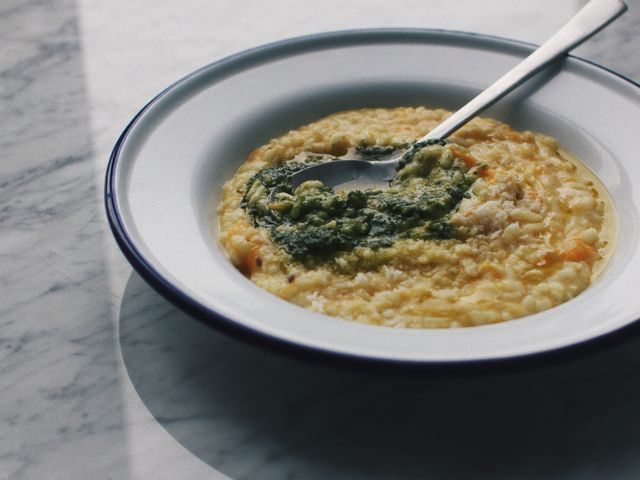
Italian Carnaroli Asparagus and Mint Spring Rice
A silky risotto made with Carnaroli rice, tender asparagus, and bright mint. The grains stay firm and separate while creating a creamy sauce, built layer by layer with white wine and warm vegetable stock. Fresh mint stirred in at the end brings springtime freshness to this elegant side dish.
- Prep
- 15 min
- Cook
- 22 min
- Wait
- 5 min
- Total
- 42 min
- Makes
- 4 servings (about 1¼ cups each)
Steps
Before you start
- Bring vegetable stock to a gentle simmer in a pot and keep it hot throughout cooking
- Trim asparagus (cut off the woody bottom third) and cut into 2-inch pieces
- Chop fresh mint leaves just before cooking to preserve color and flavor
- Have all ingredients within arm's reach of the stove—risotto demands constant attention once you start
Toast the rice
- Heat olive oil in a large heavy-bottomed saucepan over medium heat.
- Add the diced onion and stir frequently until soft and translucent, about 2–3 minutes.
- Add the Carnaroli rice and stir constantly for 1–2 minutes.
- The rice grains should look slightly glossy and make a gentle clicking sound against the pan, but do not brown them.
- This toasting step seals the grain and helps it maintain its shape during cooking.
+ Show details− Hide details
Ready when: Rice grains look glossy, onion is soft and translucent
Tip: Do not let the rice brown; it will turn bitter and compromise the delicate flavor of the final dish.
Deglaze with wine
- Pour in the white wine all at once and stir continuously.
- The wine will bubble and steam.
- Keep stirring until the liquid is almost completely absorbed by the rice, about 1–2 minutes.
- The wine adds acidity and depth to the risotto.
+ Show details− Hide details
Ready when: Wine is nearly absorbed; rice looks barely wet
Tip: Stir constantly to prevent the rice from sticking to the bottom of the pan.
Begin adding stock
- Add 1 ladle of warm stock (about 1 cup / 240 ml) and stir frequently.
- When the liquid is mostly absorbed, add another ladle.
- Continue this process over the next 18–20 minutes, adding stock one ladle at a time and stirring often.
- The rice should always look creamy and moist but never soupy or dry.
- Adjust the heat as needed to maintain a gentle, steady bubble.
+ Show details− Hide details
Ready when: Rice grains are tender but still have a slight firmness in the center, and the mixture is creamy
Tip: The constant stirring is essential—it releases the rice's natural starches, which create the characteristic creamy texture without any cream.
Add asparagus
- When the rice has been cooking for about 12–15 minutes and is halfway tender, add the asparagus pieces along with the next ladle of stock.
- Stir gently to distribute the asparagus evenly.
- Continue adding stock and stirring as before.
- The asparagus will soften and flavor the risotto over the remaining cooking time.
+ Show details− Hide details
Ready when: Asparagus pieces are tender and bright green
Tip: Add the asparagus at the halfway mark so it stays tender but doesn't disintegrate by the time the risotto is done.
Test for doneness
- After 18–20 minutes total of stock-adding, taste a grain of rice.
- It should be creamy and tender on the outside but still have a very slight firmness in the center (a tiny al dente core, not crunchy).
- The rice grains should no longer taste floury.
- If the rice is still too firm, add another ladle of stock and continue stirring for 1–2 minutes.
- The risotto should flow slightly on a plate, not stand in a stiff mound.
+ Show details− Hide details
Ready when: Rice is creamy and just tender with a tiny al dente core; risotto flows on the plate
Tip: Carnaroli rice holds its shape better than Arborio, so aim for a very slight firmness in the center. Do not let it become mushy.
Finish the risotto
- Remove the pan from the heat.
- Stir in the butter cubes, finely grated Parmigiano-Reggiano, and the freshly chopped mint.
- Stir vigorously for about 30 seconds until the butter and cheese are fully incorporated and the risotto is smooth and glossy.
- Season with a pinch of fine sea salt and freshly ground black pepper to taste.
- The risotto should look creamy and flow gently across the plate.
+ Show details− Hide details
Ready when: Risotto is smooth, glossy, and fragrant with mint
Tip: This final vigorous stirring, called 'mantecatura,' creates the silky, flowing texture. Do not skip this step. Add butter and cheese off the heat to prevent them from becoming greasy.
Rest and serve
- Let the risotto rest off the heat for 2–3 minutes.
- This allows the flavors to meld and the consistency to set slightly.
- Divide the risotto evenly among four warm bowls.
- Serve immediately with an extra scattering of grated Parmigiano-Reggiano and a few fresh mint leaves if desired.
+ Show details− Hide details
Ready when: Risotto has relaxed consistency and is warm throughout
Tip: Warm the bowls before serving to keep the risotto at the perfect temperature. Serve immediately; risotto does not hold well.
Good to know
Tips
- Keep the stock at a steady simmer throughout cooking. Cold or room-temperature stock will drop the temperature of the rice and disrupt the cooking process, resulting in a gummy texture.
- Resist the urge to add all the stock at once. The gradual addition and constant stirring are what build the creamy consistency. Patience is essential.
- Use true Parmigiano-Reggiano, not pre-grated 'Parmesan,' which contains cellulose and will not melt smoothly. Grate it fresh just before serving.
- The risotto is forgiving within a narrow window: if it's too thick, stir in a little more warm stock; if too loose, let it cook 30 seconds longer without adding stock. Trust your instincts and taste.
Make ahead
Prep all ingredients up to 2 hours ahead: dice the onion, cut and trim the asparagus, grate the cheese, and chop the mint just before cooking. The risotto itself must be made fresh and served immediately—it does not improve with waiting.
Storage & reheating
Risotto is best served immediately, but any leftover may be refrigerated in an airtight container for up to 2 days. Reheat gently on the stovetop over low heat with a splash of warm stock or water, stirring constantly, until creamy again (do not use the microwave, which will dry it out). Freezing is not recommended, as the texture becomes grainy upon thawing.
Substitutions
- Carnaroli rice → Arborio rice. Arborio has a slightly higher starch content and may feel creamier but can become mushy more easily. Reduce the final cooking time by 1–2 minutes if using Arborio.
- fresh asparagus spears, medium-thickness → fresh peas (spring or English peas) or a mix of peas and thin green beans. Add peas at the same point (halfway through cooking). Green beans should be trimmed and cut into ¾-inch pieces; they may need an extra minute of cooking time.
- fresh mint leaves → fresh basil or flat-leaf parsley. Both provide a fresh herb finish. Basil has a slightly sweeter flavor; parsley is more neutral. Chop just before adding to preserve color.
- dry white wine (such as Pinot Grigio or Vermentino) → dry sherry or an additional ½ cup vegetable stock. If using stock instead, skip the deglazing step and add the extra stock as your first ladle-full. The wine's acidity will be missed, so add an extra squeeze of fresh lemon juice (½ teaspoon) at the very end.