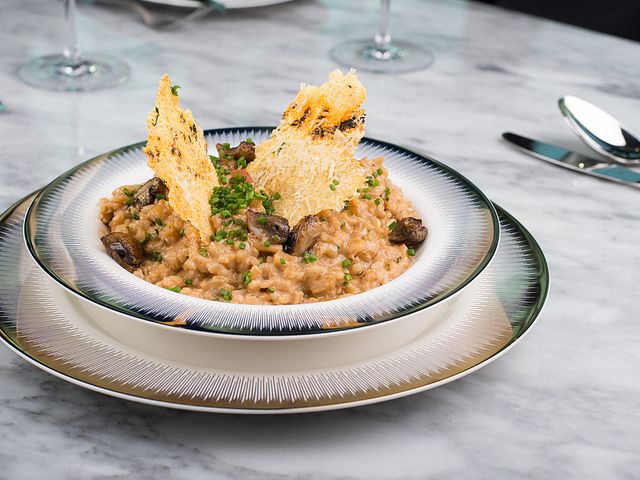
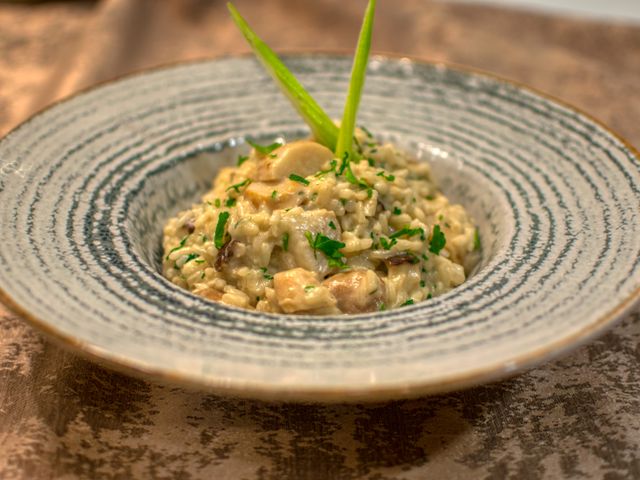
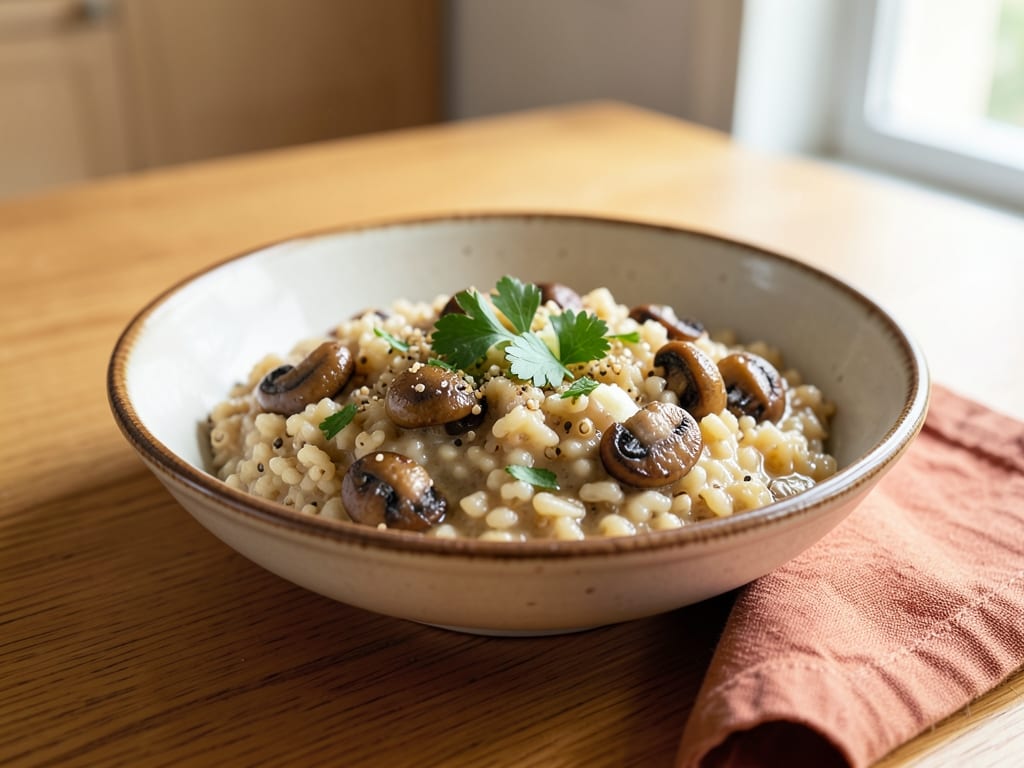
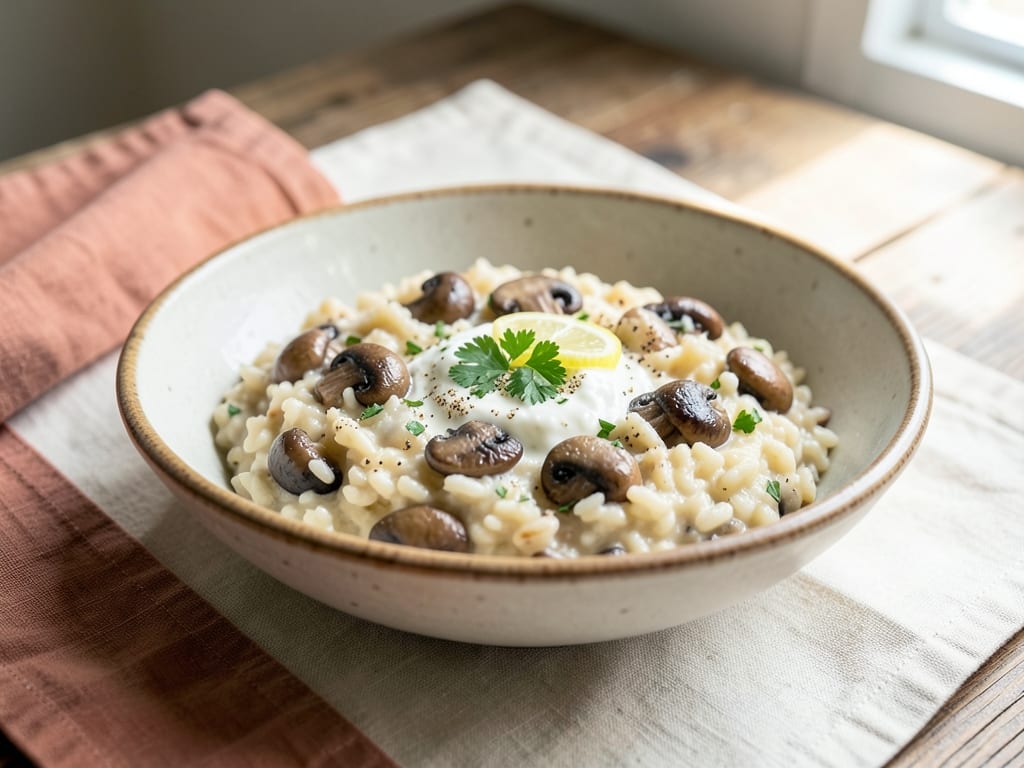
Dinner Party Truffle Oil Porcini Risotto
A luxurious, creamy risotto showcasing earthy porcini mushrooms and the fragrant depth of black truffle oil. This stovetop risotto demands attention and patience—constant stirring coaxes starch from the Arborio rice, creating a silky, flowing sauce that clings to each grain. Perfect as a sophisticated side or elegant vegetarian main course.
- Prep
- 15 min
- Cook
- 25 min
- Wait
- 5 min
- Total
- 45 min
- Makes
- 4 servings (1¼ cups each)
Steps
Before you start
- Bring 4 cups (1 liter) of vegetable or chicken stock to a gentle simmer in a separate pot and keep it hot throughout cooking—cold stock will interrupt the cooking process and make the rice sticky.
- Rehydrate the dried porcini mushrooms 10 minutes before starting so you have both the softened mushrooms and their soaking liquid ready.
- Have all ingredients measured and within arm's reach; risotto requires continuous attention and you cannot step away mid-cook.
Rehydrate the porcini
- Place the chopped dried porcini mushrooms in a small bowl and cover with ½ cup (120 ml) of hot water.
- Let steep for 10 minutes until the mushrooms are soft and plump.
- Strain through a fine-mesh sieve, reserving both the mushrooms and the soaking liquid separately.
- The soaking liquid will be added to the stock.
+ Show details− Hide details
Ready when: Mushrooms are tender and liquid is deeply colored
Tip: This soaking liquid is liquid gold for flavor—never discard it. Strain it carefully to remove grit that may have settled.
Prepare the stock
- Pour the reserved porcini soaking liquid into your pot of simmering stock.
- Keep the combined liquid at a gentle, steady simmer on medium or medium-low heat.
- The stock must stay hot throughout cooking; cold stock will shock the rice and cause it to release starch unevenly, making the risotto gummy.
+ Show details− Hide details
Ready when: Liquid is steaming gently; small bubbles form at the edges
Tip: Keep the pot uncovered so you can easily ladle stock as needed.
Toast the shallots and garlic
- In your 4-quart saucepan, melt 1 tablespoon (14 g) of the cold butter over medium heat.
- Once foaming, add the minced shallots and cook, stirring frequently, for 2–3 minutes until softened and beginning to turn translucent.
- Add the minced garlic and stir constantly for 30 seconds until fragrant.
- Do not let the shallots or garlic brown—this creates bitterness.
+ Show details− Hide details
Ready when: Shallots are soft and translucent; garlic is fragrant but pale
Tip: Use medium heat, not high—this gentle start sets up the creaminess to come.
Add rice and toast briefly
- Pour in the 1½ cups (300 g) of Arborio rice and stir constantly with a wooden spoon for 1 minute.
- You'll hear a slight clicking sound as the grains tumble together.
- This toasting coats each grain with fat and helps it hold its structure during cooking.
- The rice should look glossy but still opaque.
+ Show details− Hide details
Ready when: Rice grains are coated and glossy; faint clicking sound is heard
Tip: Do not let the rice brown—you want to toast it, not roast it. This is a crucial step for a creamy risotto with bite.
Deglaze with wine
- Pour in the ¾ cup (180 ml) of dry white wine.
- Stir constantly as the liquid sizzles and steams.
- The wine will absorb into the rice relatively quickly—this takes about 1 minute.
- Scrape the bottom of the pan to incorporate any browned bits.
- When the rice looks mostly dry again (not wet, but not bone-dry), move to the next step.
+ Show details− Hide details
Ready when: Wine is mostly absorbed; rice surface looks nearly dry
Tip: Use a good-quality, dry white wine (Pinot Grigio, Sauvignon Blanc, or Vermentino work beautifully). Cheap wine will make the risotto taste sharp.
Begin the risotto rhythm
- Ladle in approximately 1 cup (240 ml) of the hot stock.
- Stir constantly for about 2 minutes until the liquid is mostly absorbed into the rice.
- This is the rhythm you'll maintain for the rest of the cooking: add stock, stir, wait for absorption, repeat.
- Each addition should be fully absorbed (the rice should look creamy, not soupy, but with no visible liquid at the bottom of the pan) before adding more.
- Continue adding stock in ½-cup (120 ml) increments, stirring frequently, for the next 18–20 minutes.
+ Show details− Hide details
Ready when: Rice grains are tender but still have a slight firmness at the center (al dente); mixture is creamy and flows slightly on the plate
Tip: Constant stirring is not a myth—it helps release starch from the rice into the cooking liquid, creating that luxurious, silky sauce. Neglecting to stir results in dense, mushy risotto.
Add the porcini and adjust seasoning
- When the rice is nearly tender (about 18–20 minutes into cooking), add the rehydrated porcini mushrooms and a final ladle of hot stock if the risotto looks thick.
- Stir for another 1–2 minutes, then taste the rice.
- A grain should be tender throughout with just a tiny hint of firmness in the very center.
- Season with ¼ teaspoon of fine sea salt and a pinch of freshly ground black pepper.
- Taste again and adjust.
+ Show details− Hide details
Ready when: Rice is al dente; flavor is balanced with earthy umami from mushrooms
Tip: Taste the rice, not the liquid. If you wait until it feels completely soft in your mouth, the risotto will be overcooked. The porcini's deep, savory flavor should shine without overpowering the delicate rice.
Finish with butter and cheese
- Remove the pan from heat.
- Using a wooden spoon, stir in the remaining 2 tablespoons (29 g) of cold butter and the ½ cup (50 g) of grated Parmigiano-Reggiano cheese.
- Stir vigorously for 30 seconds—this vigorous stirring, called 'mantecatura,' incorporates the fat and cheese into the risotto, making it glossy and silky.
- Do not skip this step; it is the final secret to restaurant-quality risotto.
+ Show details− Hide details
Ready when: Risotto is creamy, glossy, and flows slightly when plated; no lumps are visible
Tip: The risotto should flow like lava, not sit in a stiff mound. If it's too thick, stir in a splash of hot stock; if too loose, stir over low heat for a few seconds to evaporate excess liquid.
Add truffle oil and rest
- Drizzle the 1½ teaspoons (7 ml) of black truffle oil over the risotto and fold it in gently with a few strokes of the wooden spoon.
- Do not overmix—you want visible flecks of truffle oil for visual appeal.
- If using fresh thyme, remove the leaves from the sprigs and scatter them on top.
- Cover the pan loosely and let the risotto rest for 2 minutes off the heat before serving.
+ Show details− Hide details
Ready when: Risotto is fragrant with truffle; surface is smooth and glossy
Tip: Add the truffle oil at the very end—heat diminishes its delicate, complex flavor. Truffle oil is potent, so don't be tempted to add extra; a little goes a long way.
Good to know
Tips
- Arborio rice is essential—its high starch content creates the signature creamy texture. Do not substitute with regular long-grain white rice, jasmine, or basmati; they will not yield the same luxurious sauce.
- The constant stirring is not optional and not a myth. It coaxes starch out of each grain, which thickens the cooking liquid into a silky beurre blanc-like sauce. Lazy stirring results in thick, gummy risotto.
- Truffle oil is potent and can overpower if you're not careful. Start with 1 teaspoon (5 ml) and taste; add the remaining ½ teaspoon (2.5 ml) if desired. Remember, the goal is to enhance the porcini, not mask it.
- Plate and serve immediately. Risotto waits for no one—it continues to absorb liquid as it sits, becoming thick and stodgy within a few minutes. For dinner parties, have your plates warming and guests seated before you finish the last step.
Storage & reheating
Risotto is best served immediately. Leftovers can be refrigerated in an airtight container for up to 2 days. To reheat, place in a saucepan over medium-low heat, add a splash of stock or water (2–3 tablespoons per cup), and stir gently and frequently until creamy again, about 3–4 minutes. Do not overheat or the texture will become grainy. Risotto does not freeze well due to its delicate, creamy texture.
Substitutions
- dried porcini mushrooms → 1 oz (28 g) fresh cremini or portobello mushrooms, finely chopped (sauté in 1 teaspoon butter for 2 minutes, then use their liquid in place of half the porcini soaking liquid). Fresh mushrooms lack the concentrated umami of dried porcini, so the earthiness will be more subtle. You will lose some of the deeply savory character that makes this dish special for entertaining.
- dry white wine → ½ cup (120 ml) dry white vermouth or 3 tablespoons (45 ml) dry white wine mixed with 3 tablespoons (45 ml) vegetable stock. Vermouth adds herbal notes; the stock mixture dilutes the wine flavor slightly. Either works in a pinch, but the wine provides brightness that lifts the richness of the porcini and truffle.
- black truffle oil → 1 tablespoon (15 ml) finely grated fresh black truffle mixed in at the end, or 1 teaspoon (5 g) truffle butter whisked in with the final butter addition. Fresh truffle is more potent and refined but much more expensive. Truffle butter offers better flavor than oil and won't separate. Neither option is readily available; if unavailable, the risotto is still excellent with just the porcini for umami.
- Parmigiano-Reggiano cheese → ¼ cup (25 g) finely grated Parmigiano-Reggiano plus ¼ cup (25 g) finely grated Pecorino Romano. Pecorino Romano is sharper and more peppery than Parmigiano-Reggiano. This blend adds complexity but changes the flavor profile slightly. Use only high-quality aged cheeses.