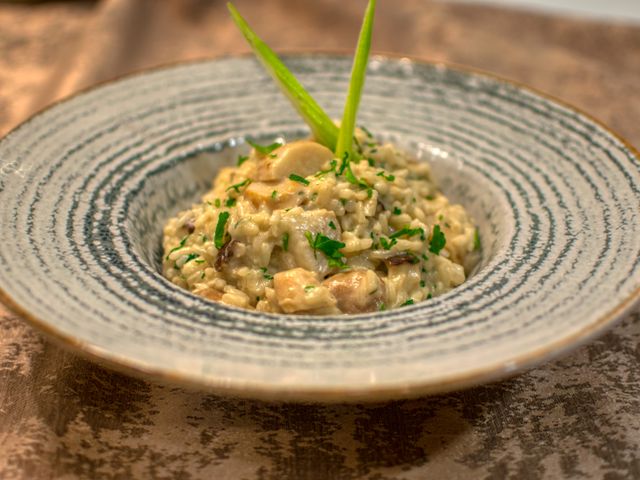
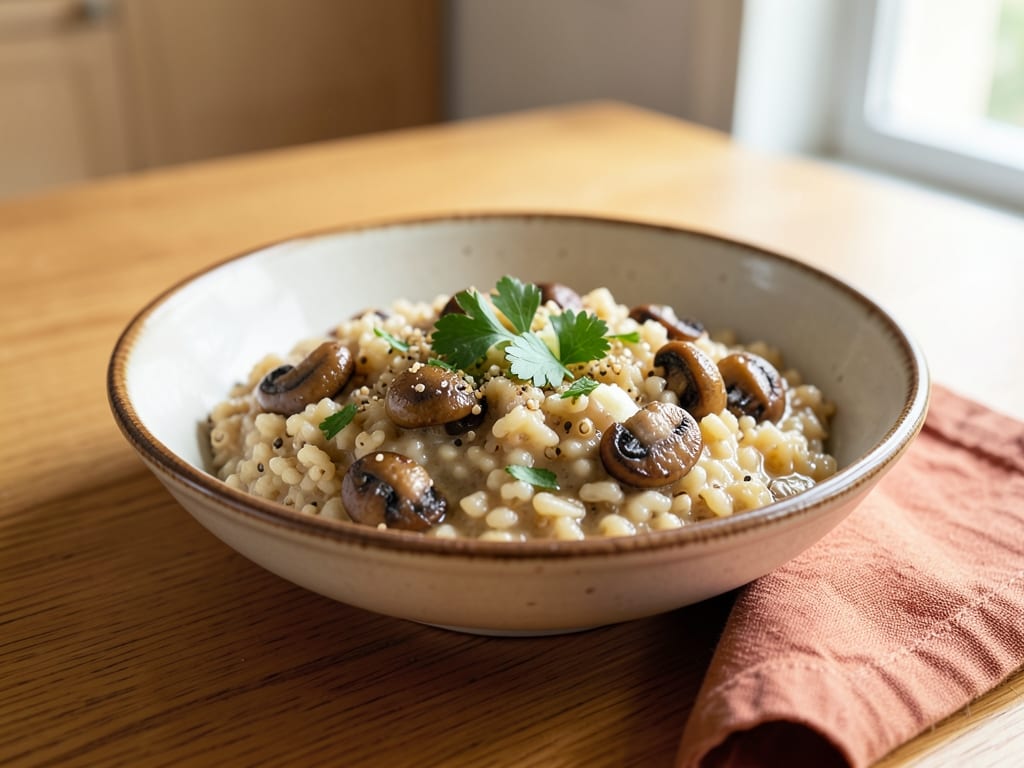
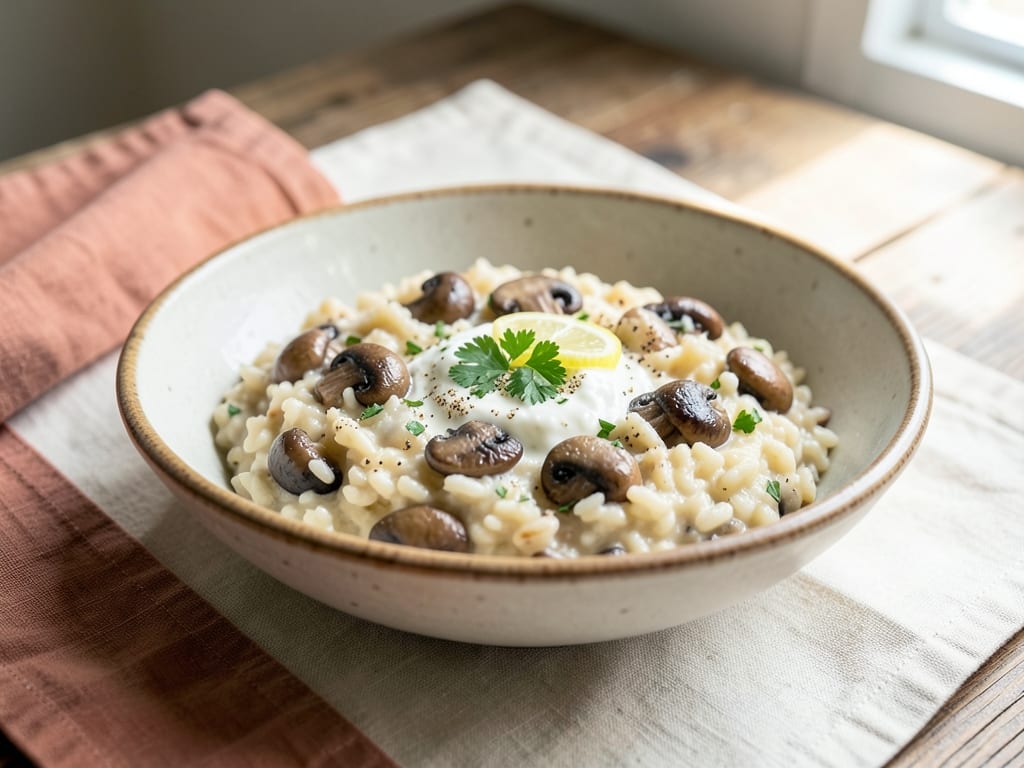
Italian Porcini Mushroom and Thyme Barley Risotto
A creamy, earthy barley risotto enriched with umami-deep porcini mushrooms, fresh thyme, and aged Parmigiano-Reggiano. Pearl barley releases starch slowly, creating a luxurious sauce without cream. The porcini soaking liquid adds depth, while fresh mushrooms provide texture and a subtle woodland flavor.
- Prep
- 15 min
- Cook
- 35 min
- Wait
- 10 min
- Total
- 1 hr
- Makes
- 4 servings (about 1½ cups per serving)
Steps
Before you start
- Have your vegetable broth hot in a pot or kettle before you begin.
- Soak the porcini mushrooms in hot water 10 minutes ahead to rehydrate them and create a flavorful soaking liquid.
- Measure out all ingredients so you can work quickly once the barley hits the pan.
Rehydrate the porcini
- Pour 1½ cups (360 ml) of hot water over the dried porcini mushrooms in a medium bowl.
- Let them soak for 10 minutes until tender and the liquid becomes dark and fragrant.
- Using a fine-mesh strainer set over a measuring cup, drain the mushrooms, reserving the soaking liquid.
- Roughly chop the rehydrated porcini and set aside.
- You should have about 1¼ cups (300 ml) of porcini liquid; if you have less, top it up with hot water.
+ Show details− Hide details
Ready when: Mushrooms are tender and liquid is dark brown
Tip: Strain carefully to leave any grit behind; the liquid is liquid gold for flavor.
Heat the liquid
- In a separate pot, combine the reserved porcini soaking liquid (about 1¼ cup / 300 ml) with the vegetable broth (4 cups / 960 ml).
- Heat over medium heat until it reaches a gentle simmer, then keep it at a very low simmer throughout the cooking process.
- This warm broth will be added gradually to the barley.
+ Show details− Hide details
Ready when: Small bubbles break the surface continuously
Tip: Keeping broth hot ensures the barley cooks evenly without shocking the grains.
Sauté aromatics and mushrooms
- Heat 3 tablespoons (45 ml) of olive oil in a large heavy-bottomed pot over medium heat.
- Add the minced shallots and sauté for 2–3 minutes, stirring frequently, until softened and fragrant but not browned.
- Add the minced garlic and cook for another 30 seconds.
- Stir in the fresh mushrooms (cremini or button), increase heat to medium-high, and cook for 5–6 minutes, stirring occasionally, until the mushrooms release their moisture and begin to brown.
- The liquid will mostly evaporate, leaving behind caramelized, earthy flavor.
+ Show details− Hide details
Ready when: Mushrooms are golden-brown and any liquid has mostly evaporated
Tip: Don't crowd the pan or stir too frequently—let the mushrooms caramelize for deeper flavor.
Toast the barley
- Add the rinsed pearl barley to the pot and stir constantly for 2 minutes.
- The barley grains should look slightly translucent at the edges and smell nutty.
- This toasting step brings out the grain's natural sweetness and helps it maintain its shape during cooking.
+ Show details− Hide details
Ready when: Barley grains are pale gold and fragrant
Tip: Constant stirring prevents burning. If the barley smells acrid, reduce heat slightly.
Deglaze with wine
- Pour in the dry white wine (¾ cup / 180 ml), stirring frequently, and let the barley absorb it over 2–3 minutes.
- You'll hear a gentle sizzle as the wine reduces.
- Scrape the bottom of the pot to release any browned bits.
- The wine adds acidity and brightens the earthy mushroom flavors.
+ Show details− Hide details
Ready when: Wine is mostly absorbed and the pot smells fragrant
Tip: Don't skip deglazing—those browned bits contain concentrated flavor.
Begin gradual broth addition
- Add the thyme sprigs to the pot.
- Reduce heat to medium.
- Ladle about 1 cup (240 ml) of the hot broth mixture into the barley and stir well.
- Let the barley absorb the liquid, stirring frequently (every 30 seconds or so), for about 4–5 minutes.
- The barley will begin to soften and the liquid will reduce significantly.
- Once most of the liquid is absorbed, add another ladle of broth (about ¾ cup / 180 ml).
- Continue this process: stir often, add broth when the previous addition is mostly absorbed, and keep the heat at medium so the barley cooks steadily without scorching.
+ Show details− Hide details
Ready when: Barley grains are tender but still slightly firm, and the mixture is creamy
Tip: This is the most important step—constant stirring releases the barley's starch and creates the silky sauce. Don't walk away.
Add rehydrated porcini
- After about 20 minutes of cooking, when the barley has softened slightly but still has texture, stir in the chopped rehydrated porcini mushrooms.
- Continue adding broth in the same manner—ladle by ladle—until the barley is tender, creamy, and has absorbed most of the liquid.
- The total cooking time for the barley from the first broth addition should be about 30–35 minutes.
+ Show details− Hide details
Ready when: Barley is tender and creamy, individual grains are soft but not mushy
Tip: Taste the barley at 30 minutes—it should have a soft center with just a hint of firmness in the very core.
Finish the risotto
- Remove the pot from heat and discard the thyme sprigs.
- Stir in the grated Parmigiano-Reggiano and the cold butter, one piece at a time, stirring gently until melted and fully incorporated.
- The risotto should be flowing and creamy, not stiff.
- If it seems too thick, add a splash more warm broth.
- Season generously with sea salt and freshly ground black pepper to taste.
+ Show details− Hide details
Ready when: Cheese and butter are fully melted and incorporated; risotto flows slightly on the plate
Tip: Add butter and cheese off the heat to keep them from breaking. The risotto will continue to firm up slightly as it cools, so it should be a touch looser than your target consistency.
Rest and serve
- Let the risotto rest in the pot for 2 minutes, then spoon into shallow bowls.
- Garnish each serving with a pinch of freshly grated Parmigiano-Reggiano and a small sprig of fresh thyme.
- Drizzle with a touch of extra-virgin olive oil if desired.
+ Show details− Hide details
Tip: Serve immediately—risotto waits for no one and stiffens as it cools.
Good to know
Tips
- Barley risotto is less finicky than rice risotto—the grains hold their shape better and forgive slight timing variations. Still, frequent stirring and gradual broth addition are essential for creaminess.
- The porcini soaking liquid is umami gold. Don't discard it; combine it with the vegetable broth for maximum depth. If your porcini are very large, you may end up with less soaking liquid—top it up with hot water.
- For a lighter version, skip the final butter and use only the cheese for enrichment. The risotto will still be creamy from the barley's starch, though less rich.
- Serve in shallow, warmed bowls. Risotto is best enjoyed piping hot, so chill the bowls just before serving if needed.
Make ahead
You can prepare the porcini soaking liquid, chop the aromatics and mushrooms, and measure out the barley and broth up to 4 hours ahead. Store covered in the refrigerator. The risotto itself must be cooked just before serving for the best creamy texture.
Storage & reheating
Leftover risotto keeps in an airtight container in the refrigerator for up to 3 days. Reheat gently on the stovetop over medium-low heat with a splash of vegetable broth, stirring frequently, until heated through and creamy again (5–7 minutes). Barley risotto does not freeze well due to texture changes.
Substitutions
- cremini or button mushrooms → mixed mushrooms (cremini, shiitake, oyster), sliced. Mix your fungi for deeper, more complex flavor. Adjust quantities if using very meaty varieties like portobello.
- dry white wine → dry vermouth or additional vegetable broth. Use the same volume. Vermouth adds herbal notes; broth gives a milder, more neutral result.
- Parmigiano-Reggiano cheese → Grana Padano or aged Pecorino Romano. Pecorino will add saltiness and sharpness—use slightly less and adjust salt. Both are authentic Italian choices.
- pearl barley → Arborio or Carnaroli rice. This becomes a traditional mushroom risotto. The cooking method and timing remain the same; the result is silkier and more delicate than barley.