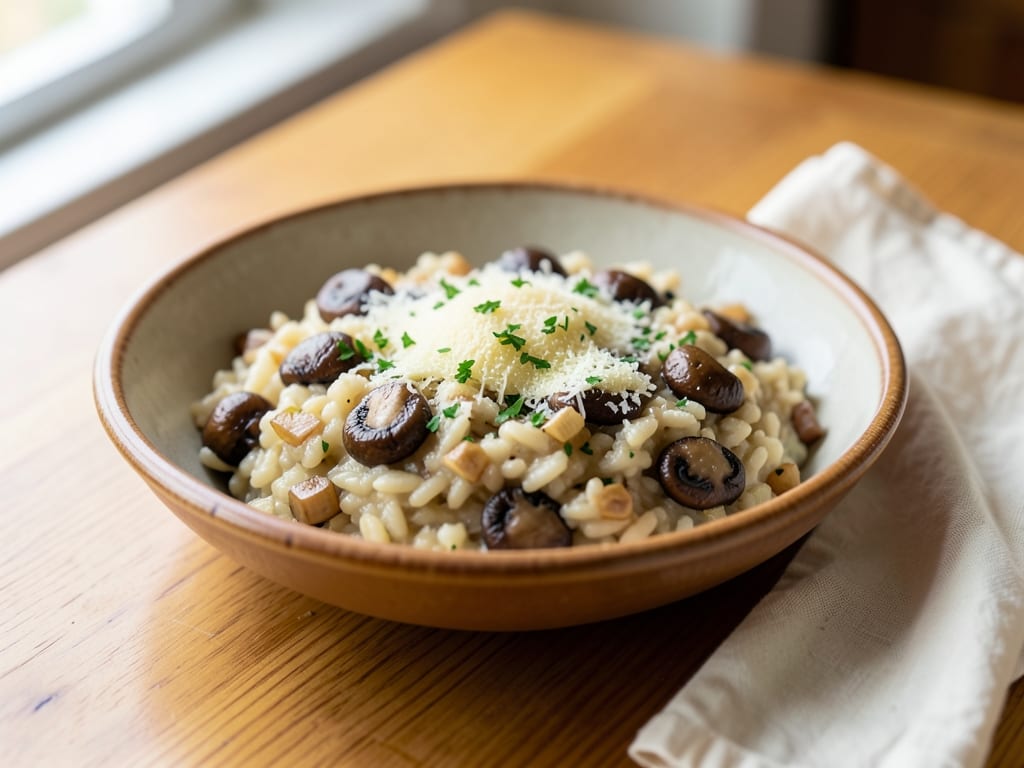
Risotto Porcini
A luxurious, creamy risotto perfumed with earthy dried porcini mushrooms. The slow, patient stirring releases the rice's starches to create a naturally silky sauce, finished with butter and Parmesan for rich depth. This is comfort food that tastes like you spent hours at the stove, but requires only about 30 minutes of active attention.
- Prep
- 15 min
- Cook
- 25 min
- Wait
- 5 min
- Total
- 45 min
- Makes
- 4 servings (about 1.5 cups each)
Steps
Before you start
- Have 4 cups (960 ml) of warm broth ready in a separate pot on low heat—risotto requires constant, gradual additions.
- Measure out all ingredients before you begin; the cooking process moves quickly once the rice hits the pan.
- Use Arborio or Carnaroli rice; these starchy short-grain varieties are essential for proper creaminess.
Steep porcini mushrooms
- In a small bowl, pour the 0.75 cup (180 ml) of hot (not boiling) water over the dried porcini mushrooms.
- Let steep for 10 minutes until they soften and the liquid turns dark amber.
- Strain through a fine-mesh strainer, pressing gently on the mushrooms to extract all liquid.
- Finely chop the rehydrated mushrooms and set aside.
- Reserve the soaking liquid and add it to your warm broth.
+ Show details− Hide details
Ready when: Porcini are soft and liquid is dark amber
Tip: Don't skip straining—grit from the mushrooms can remain in the liquid.
Heat broth
- Pour the broth and reserved porcini soaking liquid into a separate saucepan and keep it at a bare simmer on low heat throughout cooking.
- The rice needs gradual additions of warm liquid to release its starches evenly.
+ Show details− Hide details
Tip: Warm broth dissolves into the rice more readily than cold liquid, which would shock the cooking process.
Sauté aromatics
- In your large heavy-bottomed saucepan, melt 1 tablespoon (14 g) of butter over medium heat.
- Add the minced shallots and cook for 2–3 minutes, stirring occasionally, until translucent and fragrant.
- Add the minced garlic and cook for another 30 seconds, stirring constantly.
- The mixture should smell sweet and aromatic, not browned.
+ Show details− Hide details
Ready when: Shallots are translucent, garlic is fragrant and light golden
Tip: Don't let the garlic brown—burnt garlic tastes bitter. Keep the heat at medium and stir frequently.
Toast the rice
- Add the 1.5 cups (300 g) of Arborio rice to the pan and stir constantly for 1–2 minutes.
- The rice grains should look slightly translucent at the edges and smell nutty.
- This brief toasting develops the rice's flavor and helps each grain stay distinct.
+ Show details− Hide details
Ready when: Rice grains are partly translucent and smell toasted
Tip: This step is quick—don't walk away. The rice will scorch if left unattended.
Deglaze with wine
- Pour in the 0.5 cup (120 ml) of white wine and stir constantly until the liquid is almost completely absorbed by the rice, about 1–2 minutes.
- The wine adds acidity and depth to the final dish.
+ Show details− Hide details
Ready when: Rice has absorbed the wine; bottom of pan is almost dry
Tip: Stir and watch closely. You'll feel resistance from the rice when the liquid is gone.
Add broth and stir
- Add 1 cup (240 ml) of warm broth (with the reserved porcini liquid included) and stir gently but frequently.
- The rice will begin to soften and release its starch, creating a creamy suspension.
- Continue stirring every 15–20 seconds to prevent sticking on the bottom.
- As the liquid is absorbed (you'll see the rice surface begin to dry, about 3–4 minutes), add another 1 cup (240 ml) of broth.
- Repeat this process for 18–20 minutes total, stirring frequently and adding broth in 1-cup (240 ml) increments as it's absorbed.
+ Show details− Hide details
Ready when: Rice is creamy and grains are just tender but still have a slight bite in the center
Tip: Frequent stirring is essential—it releases the rice's starch. Don't add all the broth at once. Taste a grain at 18 minutes; it should have a tiny firm core.
Fold in porcini and finish with butter
- When the rice is nearly tender (with just a slight al dente bite), stir in the chopped rehydrated porcini mushrooms.
- Then, one piece at a time, add the 3 tablespoons (43 g) of cold butter cubes, stirring gently after each addition until fully incorporated.
- This technique, called 'mantecatura,' creates an emulsion that makes the risotto silky and luxurious.
+ Show details− Hide details
Ready when: Butter is fully incorporated, porcini are distributed evenly, and the mixture looks creamy
Tip: Cold butter creates the emulsion that makes risotto creamy—don't melt it separately or you'll lose the effect.
Finish with cheese and season
- Remove the pan from heat.
- Add the 0.75 cup (75 g) of grated Parmigiano-Reggiano cheese and fold it in gently.
- Taste and season with kosher salt and freshly ground black pepper to your preference.
- The risotto should flow gently on the plate, not pile up stiffly.
+ Show details− Hide details
Ready when: Cheese is fully incorporated, risotto is creamy and flows slowly across the plate
Tip: Taste before adding salt—Parmigiano and broth are already salty. Less is often more.
Rest and serve
- Cover the pan loosely and let the risotto rest for 1–2 minutes off heat.
- This allows the starches to relax and the risotto to reach its creamiest state.
- Divide among warm bowls and serve immediately.
- Risotto waits for no one.
+ Show details− Hide details
Ready when: Risotto is uniform in color and flows gently
Tip: Have warm bowls ready before you start the dish. Cold bowls will cool the risotto and thicken it.
Good to know
Tips
- Patience and frequent stirring are non-negotiable. Risotto is a forgiving dish only if you stay present—don't multitask. Set a timer for each broth addition to keep you on track.
- If you run out of broth before the rice is tender, use boiling water (it heats up faster than cold liquid). The flavor will be slightly less rich, but the texture will be correct.
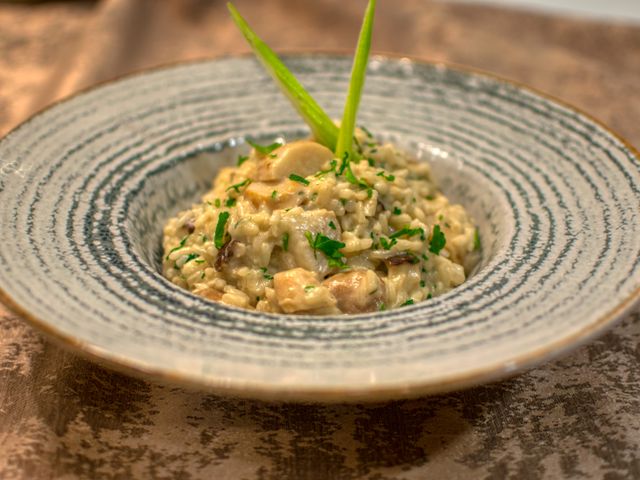
- For deeper porcini flavor, save a few whole mushroom pieces to garnish the finished risotto. They'll be tender and aromatic after soaking.
- Risotto is a teaching dish that rewards technique. The more you make it, the better your instinct for when the rice is done and when the consistency is right. Trust your senses.
Storage & reheating
Risotto is best enjoyed immediately, but leftovers can be refrigerated in an airtight container for up to 2 days. To reheat, place in a saucepan over medium heat with a splash of broth or water, stirring gently until creamy again. Risotto does not freeze well, as the texture becomes grainy when thawed.
Substitutions
- dried porcini mushrooms → Other dried mushrooms (cremini, shiitake, or a mixed mushroom blend). Use the same weight. Shiitake will give a deeper, earthier flavor; cremini is milder. The soaking liquid will be less dark but equally flavorful.
- dry white wine → Dry vermouth or additional broth (vegetable or chicken). Vermouth adds herbal notes; using broth makes the risotto richer but less bright. Reduce broth additions slightly to avoid excess liquid.
- Parmigiano-Reggiano cheese → Grana Padano or Pecorino Romano. Grana Padano is similar and slightly less sharp. Pecorino Romano is saltier and more pungent—reduce added salt if substituting.
- Arborio rice → Carnaroli or Vialone Nano rice. Both are short-grain varieties with similar starch content. Carnaroli grains stay slightly firmer; Vialone Nano is equally creamy.