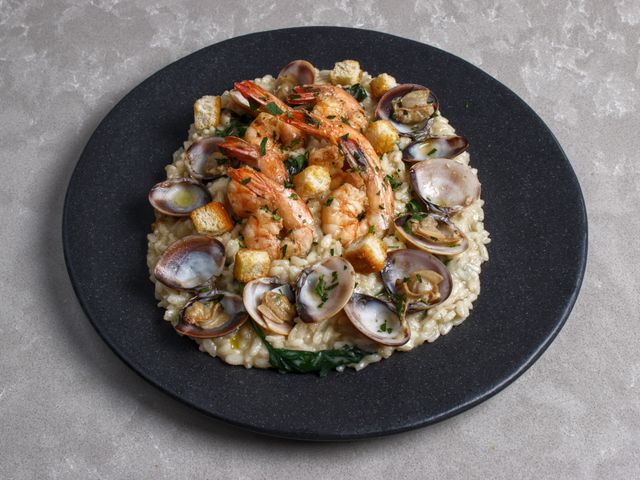
Italian Lombard Risotto with Roasted Butternut Squash and Sage
A creamy, luxurious Carnaroli risotto from Lombardy's tradition, crowned with caramelized roasted butternut squash, crispy sage leaves, and aged Parmigiano-Reggiano. The sweetness of the squash balances the earthiness of sage and the tender rice, finished with a silky mantecatura (butter-and-cheese emulsion) that makes each spoonful rich and velvety.
- Prep
- 20 min
- Cook
- 35 min
- Wait
- 15 min
- Total
- 1 hr 10 min
- Makes
- 4 servings (about 1¼ cups each)
Steps
Before you start
- Have vegetable broth simmering in a separate pot before you begin—risotto waits for no one and cold broth will shock the rice
- Cut and roast the squash first so it's ready to fold in at the end
- Have all ingredients measured and within arm's reach of the stovetop
- Read through the entire recipe—the constant stirring is essential to coax out the rice's starch and create the signature creamy texture
Roast the butternut squashOven 425°F / 220°C
- Preheat your oven to 425°F (220°C).
- Toss the cubed butternut squash with 2 tbsp (30 ml) olive oil, and season generously with sea salt and black pepper.
- Spread on a baking sheet in a single layer.
- Roast for 15–18 minutes, stirring halfway through, until the edges are deeply caramelized and the flesh is fork-tender.
- The squash should look golden brown and slightly crusty.
- Set aside to cool slightly.
+ Show details− Hide details
Ready when: Squash is deeply golden, edges are caramelized, and flesh yields easily to a fork
Tip: Don't skip the halfway stir—it ensures even caramelization and prevents burning on one side
Heat broth and crisp sage
- While the squash roasts, bring the 4.5 cups (1080 ml) vegetable broth to a gentle simmer in a separate pot and keep it there.
- In a small skillet over medium-high heat, melt 1 tbsp (15 g) butter.
- Add 8 of the torn sage halves and let them cook for 2–3 minutes, stirring gently, until the leaves are crispy and fragrant and the butter smells nutty.
- Transfer the crispy sage to a paper towel to drain.
- Reserve the sage butter in the pan.
+ Show details− Hide details
Ready when: Sage leaves are crispy and fragrant, butter is golden and nutty-smelling
Tip: Watch the sage carefully—it can go from fragrant to burnt in seconds. The butter should smell nutty, not dark brown
Build the risotto base
- In your large heavy-bottomed pot, melt 2 tbsp (30 g) butter over medium heat.
- Add the minced shallots and sauté for 2–3 minutes, stirring often, until softened and just beginning to turn golden.
- The shallots should smell sweet and fragrant but not browned.
- This is your aromatic foundation.
+ Show details− Hide details
Ready when: Shallots are soft, translucent, and fragrant, just beginning to turn golden
Tip: Don't brown the shallots—you want them sweet, not caramelized. If they're browning too fast, lower the heat
Toast the rice
- Add the 1.5 cups (300 g) Carnaroli rice to the pot with the shallots.
- Stir constantly for 2 minutes.
- You'll hear the rice grains click gently against the pot, and they'll become slightly opaque and smell faintly toasted.
- This toasting develops nutty flavors in the finished risotto.
+ Show details− Hide details
Ready when: Rice grains are slightly opaque, fragrant, and clicking softly in the pot
Tip: Toasting the rice is the key to superior risotto—don't skip it or rush it
Deglaze with wine
- Pour the 0.5 cup (120 ml) white wine into the pot and stir constantly until the wine is almost completely absorbed, about 1–2 minutes.
- The rice should no longer have a wet appearance, though it won't be dry.
- This step adds acidity and flavor that brightens the whole dish.
+ Show details− Hide details
Ready when: Wine is almost completely absorbed; rice looks dry but not crusty
Tip: If the wine evaporates too quickly, your heat is too high—lower it slightly
Begin the risotto dance
- Add the first ladle of hot vegetable broth (about ¾ cup / 180 ml) to the rice.
- Stir frequently, but not constantly—every 30 seconds or so is ideal.
- When the broth is almost completely absorbed (the rice should look creamy but you should see the bottom of the pot when you stir), add the next ladle.
- Continue this rhythm for 18–20 minutes total, tasting the rice at the 18-minute mark.
- The rice is done when it has a tender bite with a slight firmness in the very center (al dente), and the overall texture is creamy and flows slightly on the plate.
+ Show details− Hide details
Ready when: Rice is creamy, tender with a slight bite in the center, and flows on the plate without being mushy
Tip: The risotto should move like lava on the plate, not sit in a stiff mound. If you're not getting creaminess, you're not stirring enough or your broth isn't hot enough
Mantecatura—finish with butter and cheese
- Once the rice is al dente and creamy, remove the pot from heat.
- Immediately add the remaining cold butter pieces and all the grated Parmigiano-Reggiano.
- Stir vigorously for 30–45 seconds—this is the mantecatura, the classic Lombard technique that creates an emulsion of starch, butter, and cheese.
- The risotto should loosen, become glossy, and flow like lava when spooned onto a plate.
- Do not stir too gently here—vigorous stirring is essential.
+ Show details− Hide details
Ready when: Risotto is glossy, creamy, flows on the plate, and tastes rich with no graininess
Tip: The mantecatura transforms good risotto into silk. Vigorous stirring off heat is the secret—don't hold back
Fold in squash and serve
- Gently fold the roasted butternut squash into the risotto with a wooden spoon.
- Divide the risotto among four warm bowls, spooning some of the creamy sauce into each bowl.
- Top each with the crispy sage leaves and a light drizzle of the sage butter.
- Serve immediately, while the risotto is still flowing and warm.
+ Show details− Hide details
Ready when: Risotto is served immediately while still creamy and warm, with squash distributed throughout
Tip: Risotto does not hold—serve it immediately. Warm the bowls first so the heat stays longer
Good to know
Tips
- Keep your broth at a gentle, steady simmer throughout—cold broth will shock the rice and halt the cooking process
- The constant stirring during cooking is not optional; it coaxes starch out of the rice kernels, which is what makes risotto creamy, not the cream
- Always use room-temperature or cold butter and cheese for the mantecatura—cold ingredients emulsify better than warm ones
- Taste the rice frequently in the last 2 minutes of cooking; risotto's ideal texture is achieved in a small window, and overcooked rice becomes mushy
Make ahead
You can roast the squash up to 2 hours ahead and keep it at room temperature. You can also have the broth simmering and the mise en place (shallots minced, sage torn, rice measured, cheese grated) ready. However, the risotto itself must be cooked just before serving—it does not hold.
Storage & reheating
Leftover risotto will keep in an airtight container in the refrigerator for up to 2 days. To reheat, place it in a saucepan with a splash of vegetable broth or water and stir over medium heat until creamy again (it will thicken as it cools). You can also gently reheat it in the microwave in 1-minute intervals, stirring between them. Freezing is not recommended—risotto's delicate, creamy texture breaks down upon thawing.
Substitutions
- Carnaroli rice → Arborio rice. Arborio is the more common risotto rice and will work well, though Carnaroli holds its shape slightly better and has a marginally creamier result
- Parmigiano-Reggiano, finely grated → Grana Padano. Nearly identical to Parmigiano-Reggiano in flavor and function, though slightly sharper; use the same amount
- dry white wine (Pinot Grigio or Vermentino) → Dry vermouth or dry sherry. Either will add acidity and depth; use the same amount. Avoid sweet wines, which will make the risotto cloying
- butternut squash, peeled, seeded, and cut into ½-inch (1.3 cm) cubes → Delicata squash or kabocha squash. Both are slightly sweeter than butternut but will give a similar caramelized result; use the same weight