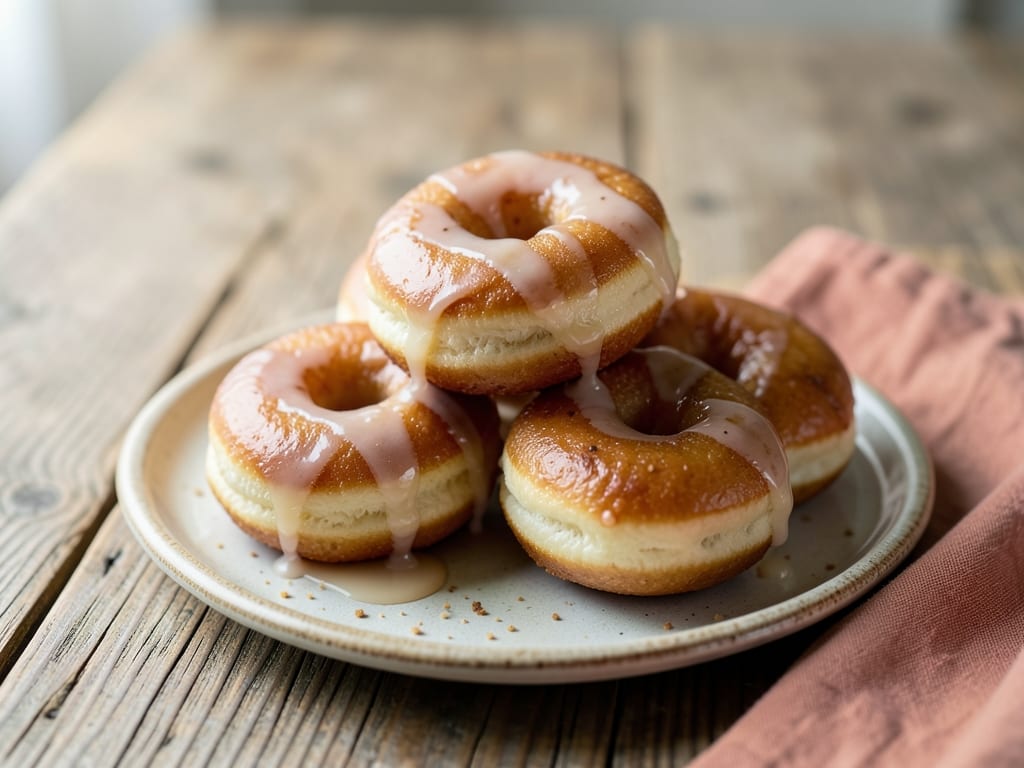
Classic Glazed Yeast Donuts
Pillowy, airy yeast donuts fried until golden with a pale ring around the middle, then dipped in a thin vanilla glaze that sets into a delicate shell. A shop-style classic you can make at home with pantry staples.
- Prep
- 53 min
- Cook
- 15 min
- Wait
- 2 hr 13 min
- Total
- 3 hr 21 min
- Makes
- 12 donuts plus 12 donut holes
Steps
Before you start
- Plan on about 3½ hours start to finish. Most of that is hands-off rising time.
- Let the eggs sit out for 30 minutes so they reach room temperature. Melt the butter and let it cool until just warm, not hot.
- Cut twelve 4-inch (10 cm) squares of parchment paper. Each donut rises on its own square, and you can lower it straight into the oil on the paper.
- Use a deep-fry or candy thermometer. Oil that is too cool makes greasy donuts, and oil that is too hot browns the outside before the inside cooks.
- Set up a cooling rack over a rimmed baking sheet before you start frying.
Activate the yeast
- Pour the warm milk (105–110°F / 40–43°C) into the bowl of a stand mixer.
- Sprinkle in the yeast and 1 tablespoon of the granulated sugar from the dough sugar.
- Stir once and let it stand for 8 minutes.
+ Show details− Hide details
Ready when: The surface is covered with a thick, creamy foam about ¼ inch (6 mm) deep and smells yeasty. If there is no foam, the yeast is dead, so start over with fresh yeast.
Tip: Milk hotter than 120°F (49°C) can kill the yeast. Test it on your wrist. It should feel warm, not hot.
Mix the dough
- Add the remaining sugar, the beaten eggs, cooled melted butter, 1 teaspoon vanilla and the salt to the foamy milk.
- Whisk briefly to combine.
- Add 440 g (3½ cups) flour.
- Fit the dough hook and mix on low speed for 1 to 2 minutes, until no dry flour remains and a shaggy, sticky dough forms.
+ Show details− Hide details
Ready when: The dough looks shaggy and sticky, with no dry flour streaks at the bottom of the bowl.
Tip: Make sure the butter has cooled. Hot butter can scramble the eggs and harm the yeast.
Knead until smooth
- Knead on medium-low speed for 8 minutes, scraping down the hook once or twice.
- The dough should be soft and slightly tacky.
- If it sticks heavily to the bowl sides after 3 minutes, add 1 tablespoon of flour from the dusting flour.
- To knead by hand, work the dough on a lightly floured counter for 10 to 12 minutes.
+ Show details− Hide details
Ready when: The dough is smooth and elastic, and it springs back slowly when poked with a floured finger. It clears most of the bowl sides but still feels slightly tacky.
Tip: Resist adding lots of extra flour. A slightly sticky dough gives the lightest donuts.
First rise
- Shape the dough into a ball and place it in a large bowl greased lightly with oil.
- Turn it once to coat.
- Cover the bowl with plastic wrap or a damp towel.
- Let it rise in a warm spot (75–80°F / 24–27°C) for 60 to 75 minutes.
+ Show details− Hide details
Ready when: The dough has doubled in volume and a fingertip pressed in leaves an indentation that fills back in slowly.
Tip: If your kitchen is cool, set the covered bowl in the microwave (turned off) next to a cup of just-boiled water to create a warm, draft-free spot.
Roll and cut
- Turn the dough onto a lightly floured counter and gently press out the large air bubbles.
- Roll it to an even ½-inch (1.25 cm) thickness.
- Dip the 3-inch (7.5 cm) cutter in flour and cut out donuts as close together as possible.
- Cut a hole in each with the 1-inch (2.5 cm) cutter.
- Set each donut on its own parchment square on a baking sheet, with the holes on a second sheet.
- Gather the scraps, rest them for 5 minutes, then re-roll once and cut again.
- You should get 12 donuts and 12 holes.
+ Show details− Hide details
Ready when: The dough is an even ½ inch thick, and the cutouts have clean edges.
Tip: Press the cutter straight down and do not twist it. Twisting seals the edges and stops the donuts from puffing evenly.
Second rise
- Cover the baking sheets loosely with greased plastic wrap or a clean towel.
- Let the donuts rise at room temperature for 30 to 40 minutes.
- Start heating the oil (next step) during the last 15 minutes of this rise.
+ Show details− Hide details
Ready when: The donuts look visibly puffy, about 1½ times their original size. A gentle fingertip poke leaves a dent that springs back only slowly.
Tip: An over-proofed donut collapses and fries up flat. If the dent doesn't spring back at all, fry right away.
Heat the oil
- Pour the frying oil into a 5½-quart (5 L) Dutch oven so it is about 2 inches (5 cm) deep.
- Clip on the thermometer.
- Heat over medium heat until the oil reaches 365°F (185°C).
- Adjust the burner as you fry to keep it between 360 and 370°F (182–188°C).
- Set a cooling rack over a rimmed baking sheet nearby.
+ Show details− Hide details
Ready when: The thermometer reads a steady 365°F (185°C).
Tip: Never leave hot oil unattended, and keep the oil at least 3 inches below the rim of the pot to prevent boil-overs.
Fry the donuts
- Lift 2 or 3 donuts by their parchment squares and gently lower them into the oil, peeling off the parchment once they float.
- Fry for 1 to 1½ minutes on the first side, until deep golden.
- Flip with a spider skimmer or chopsticks and fry for 1 more minute.
- Lift out, let the oil drip back, and move to the rack.
- Fry the holes in a batch for about 45 seconds per side.
- Let the oil return to 365°F (185°C) between batches.
+ Show details− Hide details
Ready when: Both sides are deep golden brown with a pale ring around the middle. A donut cut open should read about 190°F (88°C) at the center and look cooked through and fluffy.
Tip: If the donuts brown in under 1 minute, the oil is too hot. Lower the heat and wait a few minutes before frying more.
Make the glaze
- While the donuts cool for about 5 minutes, whisk the powdered sugar, 3 tablespoons milk, corn syrup (if using) and 1 teaspoon vanilla in a medium shallow bowl until smooth.
- It should be thick but pourable, like thin white paint.
- Whisk in up to 1 more tablespoon of milk if too thick.
+ Show details− Hide details
Ready when: The glaze is smooth, and a ribbon lifted on the whisk disappears back into the bowl after about 5 seconds.
Tip: Corn syrup gives the glaze a shiny finish and keeps it from cracking, but the recipe works without it.
Glaze and set
- While the donuts are still warm (not hot), dip the top of each into the glaze.
- Hold for a second, lift, and let the excess drip off.
- Set on the rack glaze-side up.
- Dip the holes the same way.
- Let the glaze set for 15 minutes before serving.
+ Show details− Hide details
Ready when: The glaze is translucent, shiny and no longer wet when lightly touched.
Tip: For a thicker, more opaque coating, dip a second time after the first coat has set for 5 minutes.
Good to know
Tips
- Keep the oil at 365°F (185°C). A thermometer is the easiest way to avoid greasy or raw-centered donuts.
- Fry in small batches of 2 or 3. Overcrowding drops the oil temperature quickly.
- Handle risen donuts gently. Lifting them by the parchment squares keeps them from deflating.
- To dispose of the oil, cool it completely, strain it, and pour it into a sealed container. Do not pour it down the drain.
Make ahead
After kneading, you can refrigerate the covered dough overnight (up to 12 hours) in place of the first rise. The next day, roll and cut it straight from the fridge, then let the cut donuts rise at room temperature for 45 to 60 minutes before frying.
Storage & reheating
Best eaten the day they are made. Store glazed donuts in a single layer in an airtight container at room temperature for up to 1 day. Unglazed donuts can be frozen in a zip-top bag for up to 1 month. Thaw at room temperature for 1 hour, warm in a 300°F (150°C) oven for 5 minutes, then glaze. Refrigerating makes them stale faster, so avoid it. To refresh a day-old glazed donut, microwave for 8 to 10 seconds.
Substitutions
- active dry yeast → instant yeast, same amount (2¼ tsp / 7 g). Instant yeast does not need blooming, but the milk method still works. Rise times may be slightly shorter.
- whole milk → 2% milk or unsweetened oat milk. Donuts will be slightly less rich. Skip skim milk for the best tenderness.
- neutral oil such as canola, vegetable or peanut oil → refined peanut oil or vegetable shortening. Any neutral oil with a high smoke point works. Do not use olive oil.
- light corn syrup → 1 tbsp (15 ml) extra milk or honey. The glaze will be a little less shiny but still tastes good.
More pastries
See all →
Find more like this
- Meal
- Breakfast
- Cuisine
- American
- Diet
- VegetarianHalal
- Method
- Stovetop
- Quick & Easy
- Make AheadBudget