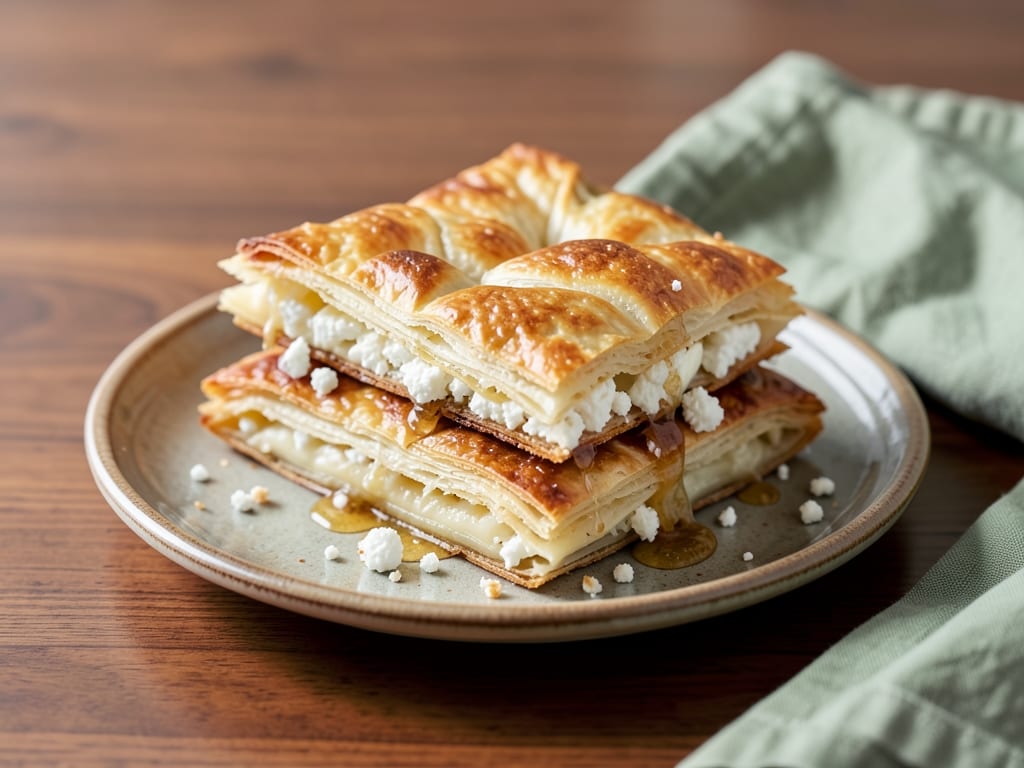
Egyptian Feteer Meshaltet (Flaky Layered Cheese-Filled Pastry with Honey)
Paper-thin, ghee-brushed dough is stretched by hand, folded around melty cheese into a tidy square, then griddled until shatteringly crisp outside and flaky within. Drizzle with honey for the classic sweet-and-salty finish.
- Prep
- 56 min
- Cook
- 30 min
- Wait
- 1 hr
- Total
- 2 hr 26 min
- Makes
- 6 feteer (each about 5½-inch / 14 cm square)
Steps
Before you start
- Plan on about 2½ hours total, including a 60-minute dough rest that can't be skipped. Without it, the dough tears instead of stretching.
- Melt all the ghee and let it cool until warm, not hot, so it doesn't cook the dough or burn your hands.
- Clear a large smooth counter, about 2×2 feet (60×60 cm). Granite, stainless steel and laminate all work. Unsealed wood doesn't.
- Shred the mozzarella and crumble the feta before you start stretching, so your hands stay clean while you work.
- Remove rings and wash your hands. You'll be working with plenty of ghee, and rings can tear the thin dough.
Mix the dough
- In a large bowl, whisk the flour and salt.
- Make a well in the center and pour in the lukewarm water and the 2 tbsp (30 g) ghee for the dough.
- Stir with your hand or a wooden spoon until no dry flour remains and a shaggy, sticky dough forms.
+ Show details− Hide details
Ready when: No dry flour remains in the bowl and the dough holds together in a rough, shaggy mass.
Tip: Don't add extra flour. This dough is meant to be soft, and a soft dough stretches paper-thin.
Knead until elastic
- Turn the dough onto the counter and knead firmly for about 10 minutes, pushing it away with the heel of your hand and folding it back.
- It is sticky at first but gradually becomes smooth.
- Stop when it is soft and springy.
+ Show details− Hide details
Ready when: The dough is smooth, soft and elastic, and it springs back slowly when you press it with a fingertip.
Tip: If it's too sticky to handle, rub a little of the shaping ghee on your hands rather than adding flour.
Divide and coat in ghee
- Divide the dough into 6 equal pieces of about 137 g each (use the scale).
- Roll each into a smooth ball.
- Pour about half of the shaping ghee into a large rimmed tray, set the balls in it and turn each to coat completely.
- Keep the remaining ghee for stretching and folding.
+ Show details− Hide details
Ready when: Each ball is smooth and fully glossy with ghee, with no dry patches.
Tip: Pinch the seam closed on the bottom of each ball so the surface is smooth and won't tear later.
Rest the dough
- Cover the tray tightly with plastic wrap and let the balls rest at room temperature for 60 minutes.
- The gluten relaxes and the dough becomes very soft and slack, which is what lets it stretch without snapping.
+ Show details− Hide details
Ready when: The balls feel very soft and spread slightly when poked.
Tip: You can rest the covered tray in the fridge for up to 12 hours. Bring it to room temperature for 30 minutes before stretching.
Prepare the cheese
- Toss the shredded mozzarella and crumbled feta together in a bowl.
- Divide into 6 equal portions of about 60 g each (roughly ½ cup loosely packed) and set them close to your work area.
+ Show details− Hide details
Tip: Pat the feta dry first. Excess moisture can make the thin dough soggy or tear it.
Stretch the dough thin
- Generously brush the counter with ghee over a 2×2-foot (60×60 cm) area.
- Take one ball, set it on the counter and flatten it with your palm into a round disk.
- Using oiled palms and fingertips, press and push the dough outward from the center.
- Then lift the edges and gently pull and slap it outward until it forms a very thin, near-translucent rectangle about 18×18 inches (45×45 cm).
- Don't worry about small holes, since the folds will hide them.
+ Show details− Hide details
Ready when: You can see the counter or the lines of your hand through the dough, and it is an even, thin sheet.
Tip: If the dough springs back and resists, cover it and wait 5 minutes. Rested dough stretches, while tense dough tears.
Fill and fold
- Brush the stretched sheet lightly with ghee.
- Scatter one portion of cheese (about 60 g) in a rectangle over the center third of the sheet.
- Fold the left third over the cheese, brush with ghee, then fold the right third over to make a long strip.
- Brush again, then fold the ends in toward the center to form a neat square of about 5½ inches (14 cm).
- Brush the top with ghee and set it aside on the tray.
- Repeat with the remaining dough balls, stacking the finished squares with a thin film of ghee between them.
+ Show details− Hide details
Ready when: Each square is neatly sealed with the cheese fully enclosed and no filling showing at the edges.
Tip: Keep the cheese away from the very edges of the folds so it doesn't leak out and burn on the pan.
Griddle until golden
- Heat a large griddle or two 10-inch skillets over medium-low heat for about 3 minutes.
- Brush with a little of the cooking ghee.
- Place 2 folded squares on the griddle (one per skillet if using two) and cook for 4 to 5 minutes per side.
- Press gently with a spatula as they cook, brushing the pan with more ghee before flipping.
- Cook in 3 batches, keeping finished feteer loosely covered with foil.
+ Show details− Hide details
Ready when: Both sides are deep golden brown and crisp, and the feteer feel light and spring back when pressed. The cheese inside is melted.
Tip: If the surface browns before the middle feels warm and soft, lower the heat. Medium-low gives the layers time to cook through.
Crush and serve
- Move each hot feteer to a plate.
- Squeeze the edges gently between your palms or tap the sides to loosen the layers so they puff up and flake.
- Drizzle each with about 1 tbsp (20 g) of honey and serve right away while the cheese is still molten.
+ Show details− Hide details
Ready when: The layers separate visibly and the honey pools in the flaky crevices.
Tip: Serve immediately. Feteer is at its crispest in the first 10 minutes.
Good to know
Tips
- Work on a well-greased counter and keep your hands oiled. The ghee is what stops the layers sticking together and gives you a flaky texture.
- Stretch gently with your fingertips, not your fingernails, and use the weight of the dough to pull it outward. Rushing causes tears.
- Cook over medium-low heat so the layers bake through before the outside darkens.
- For a savory-only version, skip the honey and serve with olives, tomato slices and fresh herbs.
Make ahead
"The dough balls can be coated in ghee and refrigerated, covered, for up to 12 hours. Alternatively, fill and fold the squares, stack them with parchment between, and refrigerate for up to 1 day, or freeze them uncooked. Cook straight from the fridge, or from frozen over low heat, allowing a few extra minutes per side."
Storage & reheating
"Room temperature: best eaten fresh, but leftovers keep covered for up to 4 hours. Fridge: up to 3 days in an airtight container. Freezer: cooked or uncooked for up to 2 months, with parchment between each. Reheat in a dry skillet over medium-low heat for 3 to 4 minutes per side, or in a 350°F (175°C) oven for 10 to 12 minutes, until crisp and the cheese is hot. Add honey after reheating."
Substitutions
- ghee → clarified butter or neutral oil such as sunflower. Oil gives a lighter flavor and works well for stretching, but ghee gives the classic nutty richness and flakiness.
- low-moisture mozzarella → Egyptian gebna rumi, Romano or halloumi. Use the same weight, grated. Halloumi adds extra saltiness, so you may want to reduce the feta.
- feta cheese → extra mozzarella or fresh white cheese like domiati. Use the same weight. If using extra mozzarella, the filling will be milder and stretchier.
- honey → date syrup, maple syrup or powdered sugar. Any of these gives the sweet contrast. Powdered sugar is the traditional alternative.
More pastries
See all →

Find more like this
- Meal
- Breakfast
- Main ingredient
- MozzarellaFeta
- Diet
- VegetarianHalal
- Method
- Stovetop