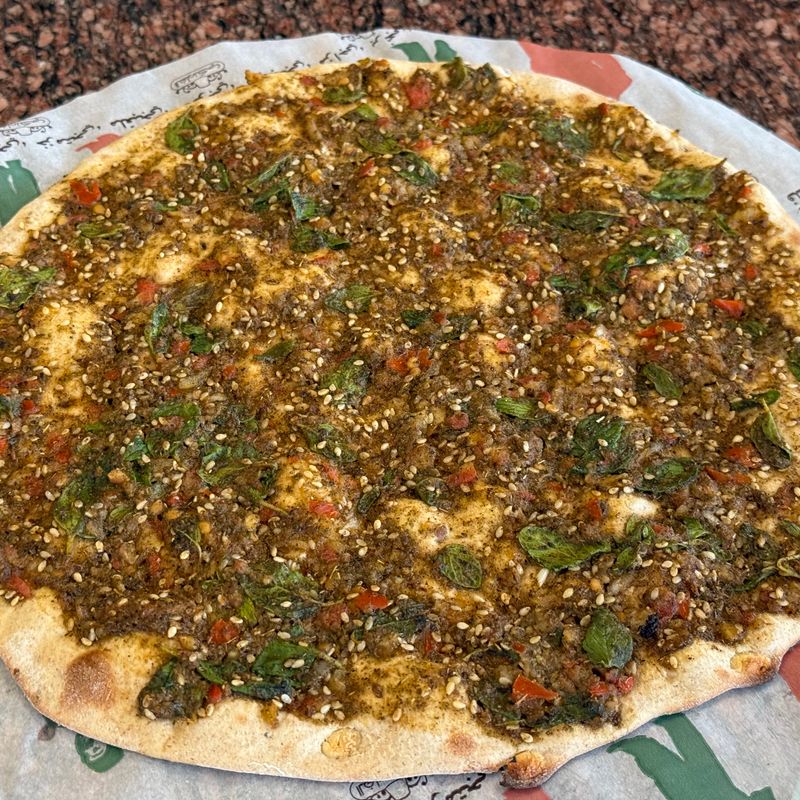
Lebanese Spinach and Sumac Fatayer
Soft olive-oil dough folded into little triangles around a bright, lemony filling of spinach, onion and tart sumac. Serve warm for breakfast, packed in lunchboxes, or on a mezze table.
- Prep
- 1 hr 10 min
- Cook
- 17 min
- Wait
- 1 hr 25 min
- Total
- 2 hr 52 min
- Makes
- 16 triangular hand pies (2 per serving)
Steps
Before you start
- Plan on about 3 hours start to finish, most of it hands-off while the dough rises.
- Use instant (rapid-rise) yeast. If you only have active dry yeast, use the same amount and let it foam for 10 minutes in step 1.
- Wash and thoroughly dry the spinach. Wet leaves make a watery filling and soggy pastry.
- Line two large baking sheets with parchment paper before you start shaping.
Proof the yeast
- Pour the warm water (105–110°F / 40–43°C) into a large bowl or the bowl of a stand mixer.
- Stir in the sugar and instant yeast.
- Let it stand 5 minutes.
+ Show details− Hide details
Ready when: The surface looks creamy and foamy with small bubbles.
Tip: If the water feels hot on your wrist it is too hot and can kill the yeast. It should feel just warm.
Mix and knead dough
- Add the flour, 1½ tsp salt and ¼ cup (60 ml) olive oil to the yeast mixture.
- Stir with a wooden spoon until a shaggy dough forms.
- Knead with the dough hook on medium-low for 6 minutes, or by hand on a lightly floured surface for 8–10 minutes.
+ Show details− Hide details
Ready when: The dough is smooth, soft and slightly tacky but not sticky. It springs back slowly when you poke it.
Tip: If it sticks stubbornly to your hands, knead in flour 1 tablespoon at a time. Too much flour makes tough pastry.
Let dough rise
- Shape the dough into a ball and place it in a lightly oiled bowl, turning once to coat.
- Cover with plastic wrap or a damp towel.
- Leave in a warm spot for 1 hour.
+ Show details− Hide details
Ready when: The dough has doubled and a floured fingertip pressed in leaves a dent that fills back in slowly.
Tip: Make the filling while the dough rises so it is ready when you are.
Salt and squeeze spinach
- Put the finely chopped spinach in a large bowl, sprinkle with 1 tsp salt, and massage with your hands for 2 minutes until it wilts and releases liquid.
- Add the diced onion and toss.
- Let sit 5 minutes.
- Gather the mixture into a clean kitchen towel in two batches, twist tightly over the sink, and squeeze out as much liquid as you can.
- Return it to the bowl.
+ Show details− Hide details
Ready when: The squeezed spinach and onion feel damp but not dripping. A handful squeezed in your fist releases no more than a few drops.
Tip: Squeeze hard. This is the most important step for crisp, non-soggy bottoms.
Season the filling
- Add the sumac, lemon juice, 2 tbsp olive oil and black pepper to the spinach mixture.
- Toss well with a fork to separate the clumps.
- Fold in the toasted pine nuts if using.
- Taste and add a pinch more salt or sumac if you like it tarter.
+ Show details− Hide details
Ready when: The filling is loose, glossy, bright red-green and distinctly tangy.
Tip: Do not season and then wait long. Salt and lemon continue to draw out liquid, so fill the pastries soon after mixing.
Preheat and divideOven 425°F / 220°C
- Place oven racks in the upper and lower thirds and preheat to 425°F (220°C).
- Line two baking sheets with parchment.
- Turn the risen dough out onto a lightly floured surface and gently press out the large bubbles.
- Cut into 16 equal pieces (about 48 g each) and roll each into a smooth ball.
+ Show details− Hide details
Ready when: Sixteen smooth, even balls with no seams on top.
Tip: Weigh the first couple of pieces on a scale to keep the sizes uniform.
Roll out circles
- Cover the dough balls with a towel and let them rest 10 minutes so they roll easily.
- On a lightly floured surface, roll each ball into a circle about 4 inches (10 cm) across and ⅛ inch (3 mm) thick.
- Keep the rest covered while you work.
+ Show details− Hide details
Ready when: Circles are thin but not translucent and do not shrink back when rolled.
Tip: If a circle keeps shrinking, cover it and move on to the next, then return to it.
Fill and pinch
- Place about 1½ tablespoons (25 g) of filling in the center of a circle.
- Lift the edges from three sides toward the center to form a triangle, leaving a small opening at the top.
- Pinch the three seams firmly together from the corners inward, then pinch again to seal.
- Arrange on the lined sheets 1 inch (2.5 cm) apart, 8 per sheet.
+ Show details− Hide details
Ready when: Each triangle is sealed tightly at all three seams with filling just visible at the very center.
Tip: Do not overfill. Overstuffed fatayer burst open in the oven. Dampen your fingertips with water if a seam will not stick.
Bake until goldenOven 425°F / 220°C
- Brush the tops and sides of the triangles lightly with 1 tbsp olive oil.
- Bake at 425°F (220°C) for 15–17 minutes, swapping and rotating the sheets halfway through.
+ Show details− Hide details
Ready when: The tops and bottoms are deep golden brown and the pastry feels firm and sounds hollow when tapped underneath.
Tip: Check the bottoms by lifting one with a spatula. Pale bottoms mean it needs a few more minutes.
Cool and serve
- Slide the parchment with the fatayer onto a wire rack, or transfer the pastries directly to the rack.
- Let them cool 10 minutes.
- Serve warm or at room temperature, with yogurt or labneh and olives alongside.
+ Show details− Hide details
Ready when: The pastries are warm, not steaming hot, and the crust is set.
Tip: Be careful with the first bite. The filling stays hot longer than the crust.
Good to know
Tips
- Squeeze the spinach until it is almost dry. Excess moisture is the number one cause of soggy or leaking fatayer.
- Pinch the seams twice, once to join and once to seal. A firm seal keeps the juices inside.
- Bake on the lowest and highest racks and swap them halfway so both trays brown evenly.
- For a richer shine and soft crust, brush the hot pastries once more with olive oil as they come out of the oven.
Make ahead
Make the dough up to 24 hours ahead: after kneading, refrigerate in an oiled, covered bowl, then bring to room temperature for 45 minutes before dividing. The unbaked, shaped fatayer can be frozen on a tray until solid, then bagged for up to 2 months and baked from frozen at 400°F (200°C) for 22–25 minutes. The seasoned filling is best made fresh.
Storage & reheating
Room temperature: up to 8 hours, loosely covered. Refrigerator: up to 4 days in an airtight container. Freezer: up to 3 months, wrapped well. Reheat from fridge or frozen on a baking sheet at 350°F (175°C) for 8–10 minutes (12–15 minutes from frozen) until hot and the crust is crisp. Avoid the microwave, which makes the dough soft.
Substitutions
- fresh spinach → Swiss chard leaves (stems removed) or 300 g thawed frozen chopped spinach. Squeeze frozen spinach very dry in a towel. Skip the salting and massaging step but still add the salt to the onion.
- ground sumac → Extra 1 tbsp lemon juice plus 1 tsp lemon zest. You will lose the distinctive deep red color and fruity tartness, but the filling will still be tangy.
- pine nuts → Chopped toasted walnuts. Use the same quantity. Walnuts give a slightly earthier flavor.
- instant yeast → Active dry yeast. Use the same amount and allow 10 minutes of foaming in step 1. The first rise may take about 15 minutes longer.
More stuffed bites
See all →


Find more like this
- Meal
- Breakfast
- Cuisine
- Lebanese
- Main ingredient
- Spinach
- Quick & Easy
- Make Ahead