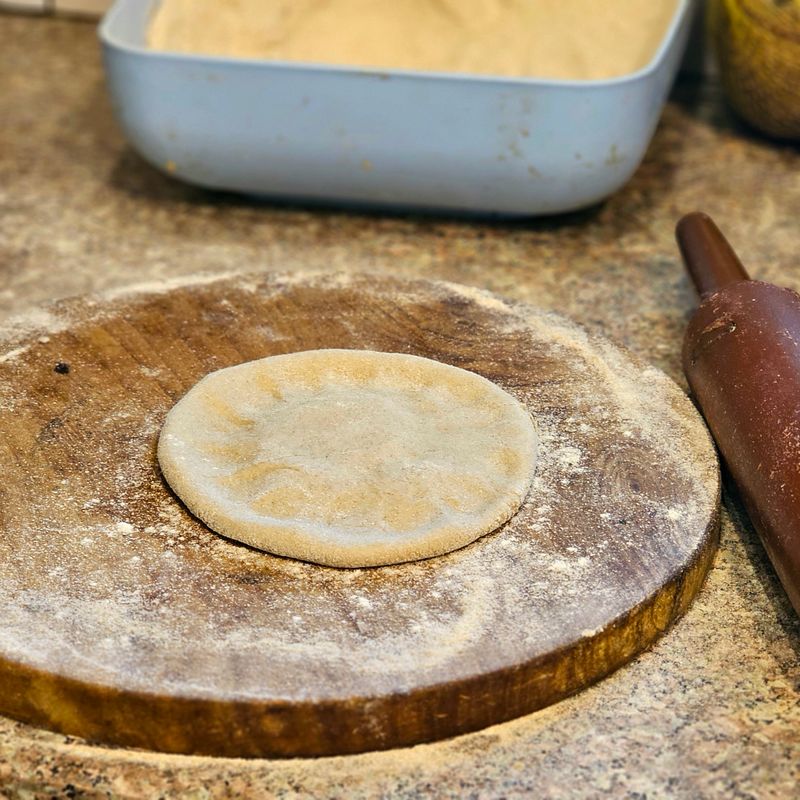
Whole Wheat Flatbread Dough
A simple, reliable dough made from whole wheat flour, water, salt, and olive oil. This versatile base can be divided and shaped, then cooked on a griddle, cast iron skillet, or in the oven. The brief mix-and-rest method produces tender, flavorful flatbreads with a hearty whole wheat character and subtle earthiness.
- Prep
- 18 min
- Cook
- —
- Wait
- 40 min
- Total
- 58 min
- Makes
- 4 flatbreads (about 115g dough each) or 8 smaller pieces
Steps
Before you start
- Use warm water (around 110°F/43°C) to activate the dough properly; test temperature on your wrist—it should feel gently warm, not hot
- Measure flour by weight if possible for the most consistent results across batches
- Your kitchen temperature affects resting time; warmer kitchens (75–80°F/24–27°C) will produce faster rise, cooler ones may need up to 60 minutes
- Have a damp kitchen towel and your cooking surface (griddle, cast iron, or oven) ready for the next step after dividing
Combine dry ingredients
- In a large mixing bowl, whisk together 250g (2 cups) whole wheat flour and 5g (1 teaspoon) salt until evenly distributed.
- Make a shallow well in the center of the flour.
+ Show details− Hide details
Ready when: Flour and salt are evenly combined with no visible streaks
Tip: Whisking prevents clumpy salt and distributes it uniformly throughout, avoiding salty pockets in your final flatbread.
Mix in water and oil
- Pour 180ml (3/4 cup) warm water and 30ml (2 tablespoons) olive oil into the flour well.
- If using the optional honey, stir it into the warm water first.
- Using a wooden spoon or dough whisk, stir in a circular motion, gradually incorporating flour from the sides of the well.
- Continue mixing until all flour is moistened and a shaggy, slightly sticky dough forms with no visible dry flour.
+ Show details− Hide details
Ready when: All flour is incorporated into a sticky, shaggy mass; no dry pockets remain
Tip: Warm water (around 110°F/43°C) activates gluten and improves dough extensibility. If your kitchen is cool, use slightly warmer water, up to 120°F (49°C), but never above 130°F or you'll damage the gluten structure.
Knead until smooth and elastic
- Transfer the dough to an unfloured work surface.
- Knead by pushing the dough away from you with the heel of your hand, folding it back over itself, rotating it 45 degrees, and repeating.
- Continue for 6–7 minutes.
- The dough will gradually become smoother, less sticky, and more elastic as gluten develops.
- You'll feel it transform from rough and craggy to silky and supple under your hands.
+ Show details− Hide details
Ready when: The dough is smooth and elastic; when poked, it springs back slowly within 1–2 seconds
Tip: Whole wheat dough is naturally stickier than white flour dough because the bran absorbs liquid differently. Resist the urge to add flour—if it sticks badly, dampen your hands instead.
Let dough rise
- Return the dough to the same mixing bowl (no need to wash it; the residual oil is enough).
- Cover with a damp kitchen towel.
- Let rest at room temperature (68–72°F/20–22°C is ideal) for 30–40 minutes.
- The dough should become noticeably puffier with a relaxed texture and increase by about 25–30% in volume.
+ Show details− Hide details
Ready when: Dough has increased in volume by about 25–30%; when poked gently, it slowly springs back halfway
Tip: Warmer kitchens (75–80°F/24–27°C) will rise faster (25–30 minutes); cooler ones may need up to 60 minutes. For deeper flavor and better digestibility, cover and refrigerate for 8–12 hours (or even up to 1 day) before dividing.
Divide and shape into balls
- Turn the dough out onto a lightly floured work surface.
- Divide into 4 equal pieces (about 115–120g each if you have a scale, or roughly equal by eye) or 8 pieces for smaller flatbreads.
- Gently shape each piece into a smooth ball by pulling the edges toward the center and rolling it gently on the work surface.
- At this point, the dough portions are ready to rest for 10–15 minutes before flattening and cooking, or you can proceed directly to cooking if time is tight.
+ Show details− Hide details
Ready when: Dough is divided into smooth, even balls with taut surfaces
Tip: Use a kitchen scale for equal portions that cook evenly. If dividing by hand, do your best to make them roughly the same size so baking time is consistent.
Good to know
Tips
- Whole wheat dough is naturally stickier than white flour dough because the bran absorbs liquid differently. Embrace the slight stickiness—don't over-flour your work surface. If your hands get sticky, dampen them with water instead of adding more flour.
- The longer you let the dough rest, the more flavorful it becomes. For deeper complexity, cover and refrigerate for 8–12 hours (or even up to 1 day) before dividing and cooking. The slow fermentation develops subtle tanginess and improves digestibility.
- Water temperature is crucial: if your water is too hot (above 130°F/54°C), it can damage gluten development; too cold (below 90°F/32°C), and the dough rises very slowly. Aim for 110°F (43°C)—test with an instant-read thermometer or your inner wrist (it should feel gently warm, not hot).
- If you plan to flatten these by hand into thin rounds, let each shaped portion rest for 10–15 minutes after Step 5. This relaxes the gluten, making the dough much easier to stretch and less likely to spring back aggressively.
Make ahead
The dough can be made up to 1 day ahead. After the first rise (Step 4), divide into portions, wrap each tightly in plastic wrap or place in a sealed container, and refrigerate. Let come to room temperature (about 30–45 minutes) before flattening and cooking. Cold dough develops even more flavor and is easier to handle.
Storage & reheating
Uncooked dough portions keep in the refrigerator in an airtight container for up to 3 days. Freeze uncooked dough portions (wrapped individually in plastic wrap) for up to 2 months; thaw overnight in the refrigerator and bring to room temperature (about 1 hour) before cooking. Once you cook these dough portions into flatbreads, cooked flatbreads store in an airtight container at room temperature for 2 days, or wrapped in plastic wrap in the refrigerator for up to 5 days. Reheat on a griddle or skillet over medium heat for 1–2 minutes per side until warm and pliable.
Substitutions
- whole wheat flour → Spelt flour or Kamut flour. These ancient grains create dough with a slightly nuttier, more complex flavor. Use the same weight. Spelt may need slightly less water due to higher absorption; reduce water by about 10ml (2 teaspoons) and adjust as needed during mixing.
- whole wheat flour → Half whole wheat flour and half all-purpose flour (125g each). This creates a lighter, more delicate flatbread while keeping some whole grain character. The texture will be less dense. Reduce water by about 15ml (1 tablespoon) as all-purpose flour absorbs less water.
- salt → Kosher salt or coarse sea salt. Adjust to 1.25 teaspoons kosher salt since it's less dense than fine table salt. Taste the dough after mixing and adjust to your preference.
- olive oil → Neutral oil (vegetable, canola, or grapeseed oil). Use the same amount. The flatbread will lack the fruity olive flavor but will be equally delicious. Alternatively, use half olive oil and half neutral oil.
More flatbread doughs
See all →
Find more like this
- Meal
- Dinner
- Quick & Easy
- 5 Ingredients or LessEasyBeginner