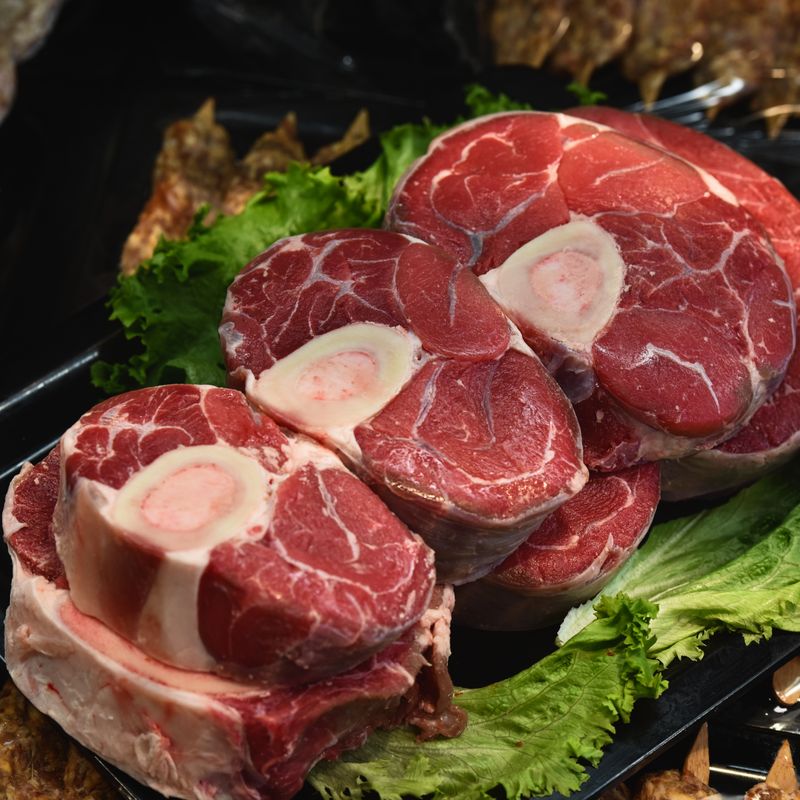
Veal Knuckle Stock
A classic French veal stock made by simmering veal knuckle bones with mirepoix vegetables and aromatics. The bones release gelatin and collagen, creating a silky body and delicate, refined flavor. This pale golden stock is an essential foundation for sauces, soups, and braises. When chilled, it sets into a light jelly—a sign of proper execution and rich body.
- Prep
- 20 min
- Cook
- 50 min
- Wait
- 4 hr
- Total
- 5 hr 10 min
- Makes
- 2–3 quarts veal stock
Steps
Before you start
- Have a 12-quart (or larger) stockpot, fine-mesh strainer, and cheesecloth ready before starting.
- Plan for 5+ hours total time, with only about 50 minutes of active work; most time is unattended simmering.
- Read through the optional blanching step (step 2) and decide in advance if you want extra clarity in your finished stock.
- If charring vegetables, preheat the oven so it's ready when needed.
- Gather fresh thyme and bay leaves—dried aromatics won't give the same delicate flavor.
Char the vegetablesOven 400°F / 205°C
- Preheat oven to 400°F (200°C).
- Cut onions in half (leave papery skin on), cut carrots into rough 2-inch chunks (no need to peel), and cut celery into 2-inch chunks.
- Spread on a baking sheet in a single layer and roast until deeply browned and charred at edges, about 25 minutes, stirring once halfway through.
- (Skip this step if you prefer a lighter, more delicate stock—just halve the onions raw and rough-chop the vegetables instead; the whole process will take about 30 minutes less.)
+ Show details− Hide details
Ready when: Vegetables are deep mahogany brown with charred, blackened edges
Tip: Charring adds sweetness and color to the stock; skipping this saves 30 minutes but produces a lighter, less developed flavor.
Prepare the veal bones
- Rinse veal knuckle bones thoroughly under cold running water, rubbing gently to remove any bone dust or debris.
- For the clearest stock (optional but traditional), bring a large pot of water to boil, add bones, simmer for 5 minutes, then drain and rinse very well under cold water until no gray foam remains.
- This blanching step removes coagulated proteins and impurities from the bones, resulting in a more refined, clear stock.
+ Show details− Hide details
Ready when: Bones are pale and clean, rinsed of gray foam and discoloration
Tip: Blanching creates noticeably clearer final stock; if you skip it, compensate with extra-thorough skimming in step 4.
Build the stock base
- Place the prepared (or blanched) bones and charred vegetables into a 12-quart (11.4 L) stockpot or larger.
- Pour in 4 quarts (3.8 L) of cold water, making sure bones are covered.
- Set the pot over high heat and slowly bring to a simmer—watch carefully and do not allow it to come to a rolling boil.
- A rolling boil breaks down proteins into tiny particles and clouds the stock.
+ Show details− Hide details
Ready when: Small, gentle bubbles break the surface regularly; liquid is steaming but not boiling
Tip: Starting with cold water allows impurities to rise to the surface slowly so they can be skimmed easily and completely.
Skim impurities from surface
- Once the stock reaches a gentle simmer, reduce heat to medium-low and maintain a bare, steady simmer.
- Using a shallow skimmer or slotted spoon, begin removing any gray, white, or beige foam and particles that have risen to the surface.
- Make repeated passes over the surface, working methodically for 10–15 minutes.
- You'll notice the surface becomes progressively clearer with each pass.
- Stop when minimal foam rises and the surface is mostly clear and glossy.
+ Show details− Hide details
Ready when: Surface is mostly clear and glossy, with little or no foam rising
Tip: Never rush this step—thorough skimming is what transforms a stock from cloudy to crystal-clear and refined. This is where technique matters.
Add aromatics and simmer
- Add 1 teaspoon whole black peppercorns, 1 dried bay leaf, and 2–3 fresh thyme sprigs to the pot.
- Reduce heat to low and adjust it so the stock maintains a very gentle, barely-visible simmer—the surface should show only faint wisps of steam, never any bubbles breaking the surface.
- Simmer gently and undisturbed for 3 to 4 hours.
- (Longer simmering, toward 4 hours, extracts more collagen and gelatin, creating deeper body and more concentrated flavor; 3 hours gives a lighter, more delicate stock.)
+ Show details− Hide details
Ready when: Stock is pale golden and aromatic; bones are soft and fall apart easily; vegetables have released all their color and flavor
Tip: This gentle simmer is critical for clarity—if the stock boils, it immediately clouds as proteins break into tiny particles. Check it every 30 minutes and reduce heat further if needed.
Strain the finished stock
- Remove the pot from heat and let cool for 5 minutes.
- Carefully position a fine-mesh strainer over a large heatproof container (at least 8-quart / 7.6 L), and line the strainer with cheesecloth.
- Slowly and carefully pour the stock through the strainer, letting liquid drain naturally by gravity alone.
- Do not press, squeeze, stir, or force the solids—this would cloud the stock and extract bitter flavors.
- Let it drain completely (about 10 minutes), then discard the bones and vegetables.
- Allow the strained stock to cool to room temperature uncovered, then refrigerate or freeze.
- Once chilled, you can skim off any solidified fat from the surface if desired (or leave it for additional flavor and nutrition).
+ Show details− Hide details
Ready when: Stock is strained, clear, and free of solids; when chilled overnight, it will set into a light gel
Tip: Never squeeze the solids through cheesecloth—patience with gravity creates the clearest, most beautiful stock possible.
Good to know
Tips
- Keep the simmer as gentle as possible. A rolling boil is the enemy of clear stock—it breaks down proteins into tiny particles that cloud the liquid. A proper stock simmer shows faint wisps of steam with no bubbles breaking the surface. Check it every 30 minutes and reduce heat if needed.
- Skim thoroughly and repeatedly during the first 15 minutes. This is where you remove coagulated proteins and impurities that would otherwise cloud your finished stock. Don't rush this step; it's the single biggest factor in achieving professional clarity.
- Never press the solids when straining. The most common mistake is squeezing or forcing the vegetables and bones through cheesecloth. This extracts cloudiness, bitterness, and off-flavors. Let gravity do all the work; the liquid will drain naturally in 10–15 minutes.
- When chilled, a good veal stock should set into a light gel or aspic. This is a sign you've successfully extracted collagen and gelatin—the hallmarks of high-quality stock. If your stock doesn't gel slightly, you either simmered too hard (and degraded the proteins) or didn't use enough bone.
Make ahead
Veal stock is excellent for advance preparation. Make it up to 2 days before using, or freeze for up to 3 months. Consider portioning into ice cube trays (1-ounce cubes for sauces) or smaller containers (1–2 cups for soups and braises) for easy thawing and use. To use frozen stock, thaw overnight in the refrigerator or warm gently on the stovetop over low heat, stirring occasionally.
Storage & reheating
Room temperature: Cool quickly to room temperature (within 1–2 hours), then refrigerate immediately; do not leave at room temperature longer than 2 hours. Refrigerator: Store in a sealed container for up to 3 days. A layer of solidified fat on top will protect the stock below and keep it fresh longer. Freezer: Portion into ice cube trays (1–2 oz cubes) or small containers (1–2 cups). Freeze for up to 3 months. Thaw in the refrigerator overnight or warm gently on the stovetop over medium-low heat, stirring occasionally, until fully thawed and warmed through.
Substitutions
- veal knuckle bones → chicken bones or carcasses (use 4 lb / 1800g). This creates a lighter, more delicate stock. Reduce simmering time to 2–2.5 hours and reduce total liquid to 3.5 quarts (3.3 L), as chicken stock is naturally less body-building than veal.
- veal knuckle bones → beef knuckle or marrow bones (use 4–5 lb / 1800–2300g). This creates a richer, darker, more intense stock. Increase simmering time to 4–5 hours. The result works well for gravies and rich sauces but is not suitable for delicate French sauces.
- fresh thyme → dried thyme (use 1 teaspoon). Dried thyme is more concentrated. Add it with the peppercorns and bay leaf. Fresh thyme gives a more delicate, nuanced flavor—use fresh if possible.
- yellow onion → white onion in equal amount. White onions are slightly more delicate and sweet. Use them if you have them; the difference is subtle in stock.
More broths
See all →
Find more like this
- Meal
- Dinner
- Cuisine
- French
- Quick & Easy
- One-PotMake AheadFreezer Friendly