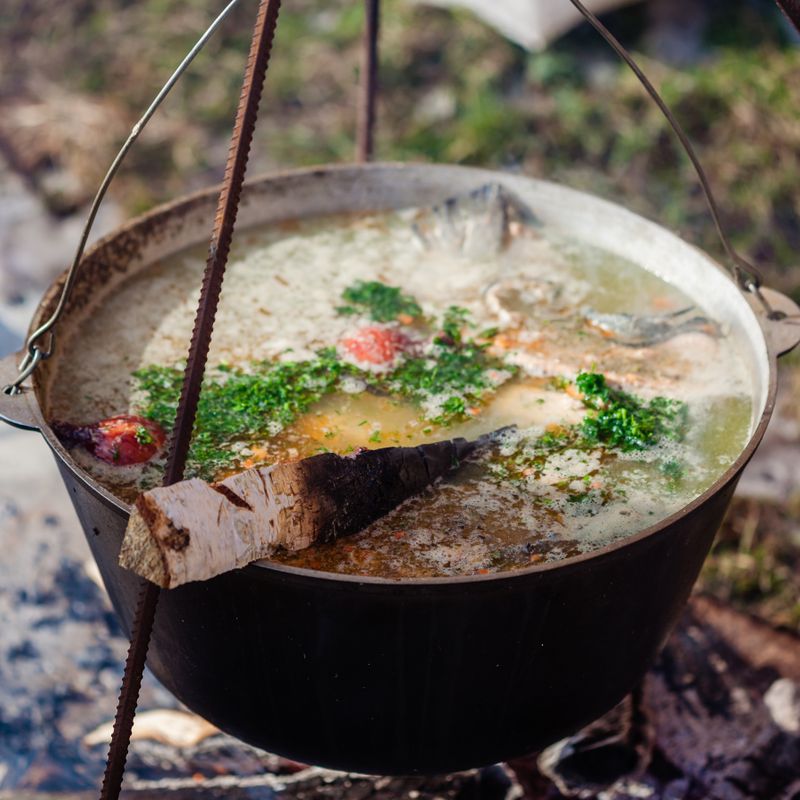
Turkey and Herb Broth
A rich, savory broth made from a roasted turkey carcass simmered with sage, thyme, and aromatic vegetables. This deeply flavorful stock is the foundation for soups, gravies, and sauces, extracting every bit of flavor from the bones. Perfect for post-holiday cooking or any time you have a turkey carcass on hand.
- Prep
- 15 min
- Cook
- 3 hr
- Wait
- 30 min
- Total
- 3 hr 45 min
- Makes
- About 2 quarts (8 cups / 1.9 L) broth
Steps
Before you start
- Break the turkey carcass into 3–4 large pieces so it fits in the pot and releases flavor more efficiently
- Have all vegetables prepped and herbs on hand before starting
- Use cold water directly from the tap—do not bring it to a boil first
- Read through the simmering time so you know to check it occasionally
Combine bones and vegetables
- Place the broken turkey carcass pieces in an 8-quart stockpot.
- Add the halved onions (unpeeled for color and mineral content), celery chunks, carrot chunks, black peppercorns, bay leaves, sage leaves, and thyme sprigs.
- Pour the 3 quarts of cold water over everything, covering the solids by about 1 inch.
+ Show details− Hide details
Tip: Do not rinse the carcass beforehand; a little coloring from the roasting adds depth to the broth.
Bring to a boil
- Set the pot over high heat and bring the water to a rolling boil, about 8–10 minutes.
- As soon as it boils, you'll see a gray foam rise to the surface.
- Skim this foam off with a spoon and discard it.
- This removes impurities and gives you a clearer, cleaner-tasting broth.
+ Show details− Hide details
Ready when: Water reaches a rolling boil and foam forms on the surface
Tip: Skim for about 1 minute or until foam mostly subsides. The first skim makes the biggest difference in clarity.
Reduce heat and simmer
- Once you've skimmed the surface, reduce the heat to low and bring the broth to a gentle simmer—just a few slow bubbles breaking the surface at a time.
- Never let it boil hard again or the broth will become cloudy and the vegetables will break apart.
- Maintain this gentle simmer for the next 3 hours.
+ Show details− Hide details
Ready when: Gentle bubbles rise slowly; broth is golden and fragrant
Tip: Resist the urge to stir. Let the bones release their flavor undisturbed. If the broth is boiling too vigorously, adjust the burner down further.
Strain the broth
- After 3 hours, the broth will be golden brown and smell rich and savory.
- Line a fine-mesh strainer or colander with cheesecloth.
- Carefully pour the entire contents of the pot through the strainer into a large bowl or clean pot, allowing the liquid to drip through.
- Discard all solids (bones, vegetables, and herbs).
- Let any remaining liquid in the cloth drip for 1–2 minutes without squeezing.
+ Show details− Hide details
Ready when: All liquid has passed through the strainer into the bowl; solids remain in cloth
Tip: Do not squeeze the cloth or press on the solids—this forces fine particles into the broth and clouds it.
Cool and skim fat
- Let the strained broth cool at room temperature for 20–30 minutes.
- As it cools, fat will rise to the surface and solidify slightly.
- Use a spoon or a defatting ladle to skim off as much fat as you like (for a richer broth, leave a thin layer; for a cleaner taste, remove most of it).
- You should have about 2 quarts (8 cups / 1.9 L) of finished broth.
+ Show details− Hide details
Ready when: Broth is warm to the touch; a layer of fat has accumulated on top
Tip: If you refrigerate the broth first, the fat will be very easy to lift off in a solid layer once it hardens completely.
Taste and season
- Taste the broth.
- Because you didn't add salt during cooking, you have full control now.
- Season gently with salt and a pinch of black pepper if desired.
- The broth is now ready to use or to store.
+ Show details− Hide details
Ready when: Broth tastes savory and balanced
Tip: Hold back on salt if you plan to reduce this broth further for gravy; you can always add more later.
Good to know
Tips
- Never let the broth boil hard during the long simmer; a gentle rolling simmer extracts flavor without clouding the liquid.
- Save turkey broth in ice cube trays (about 2 tablespoons per cube) for easy portioning and adding to sauces and gravies throughout the year.
- If your broth gels when cold, that's a sign of excellent collagen extraction—a sign of a truly good broth. Simply reheat to use.
- Add a splash of dry white wine or apple cider vinegar (about ¼ cup / 60 ml) to the pot before simmering to help extract minerals and brighten the flavor.
Make ahead
This broth is best made the day after roasting a turkey. Prepare it up to 4 days ahead and refrigerate in an airtight container, or freeze for up to 3 months for use in soups, gravies, and sauces. Thaw overnight in the refrigerator before reheating.
Storage & reheating
Room temperature: cool completely, then transfer to airtight containers and refrigerate within 2 hours (do not leave at room temperature for more than 2 hours). Refrigerator: up to 4 days in an airtight container; reheat gently in a saucepan over medium heat until steaming. Freezer: up to 3 months in airtight freezer containers or freezer bags; thaw overnight in the refrigerator before using.
Substitutions
- fresh sage leaves → 1 teaspoon (3 g) dried sage. Use half the amount of dried herbs as fresh. Add dried sage with the other seasonings at the start.
- fresh thyme sprigs → 1.5 teaspoons (2 g) dried thyme. Use half the amount of dried herbs as fresh. Add dried thyme with the other seasonings at the start.
- carrots → 1 parsnip, cut into chunks (about 150 g). Parsnips add a subtle sweetness and earthiness. Carrots contribute sweetness, so the broth may taste slightly different, but still delicious.
- cold water → Vegetable or chicken broth. Use in place of cold water for extra body and flavor, but reduce the final simmer time to 2 hours since broth is already flavorful.
More broths
See all →

Find more like this
- Meal
- Dinner
- Main ingredient
- Leftover Turkey
- Method
- Stovetop
- Quick & Easy
- EasyBeginnerMake AheadFreezer Friendly