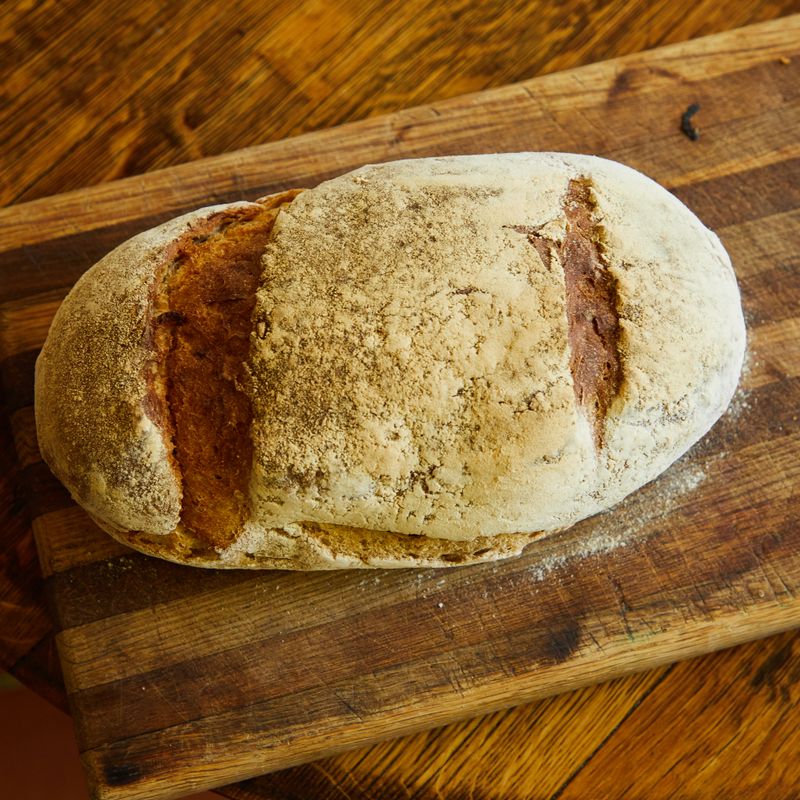
Sourdough Whole Wheat Batton
A French-inspired sourdough batton made with a blend of whole wheat and bread flour, developed through a long cold fermentation for complex flavor and an open crumb. The dough is shaped into an elegant oblong loaf and baked on a hot baking stone to achieve a crackling crust and tender interior. This recipe yields a rustic, naturally leavened loaf perfect for slicing and serving alongside soups, cheeses, or charcuterie.
- Prep
- 30 min
- Cook
- 35 min
- Wait
- 9 hr
- Total
- 10 hr 5 min
- Makes
- 1 loaf (about 14 slices)
Steps
Before you start
- Ensure your sourdough starter is active and bubbly (fed within the past 4–8 hours)
- Place a baking stone on the middle oven rack and preheat for at least 45 minutes at 500°F (260°C)
- Have a spray bottle of water ready for steaming the oven
- Read through the fermentation timeline; cold retard takes 12–16 hours overnight
Mix dough
- In a stand mixer fitted with the dough hook, combine the active starter (150 g), room-temperature water (280 ml), bread flour (300 g), and whole wheat flour (100 g).
- Mix on low speed for 3 minutes until all flour is hydrated and a shaggy dough forms.
- Let the dough rest for 20 minutes at room temperature (autolyse) to allow the flours to fully absorb the water.
+ Show details− Hide details
Ready when: All flour is moistened; dough is rough but holds together
Tip: The autolyse develops gluten naturally, reducing mixing time and improving dough extensibility.
Add salt and mix
- Add the sea salt (9 g) to the rested dough.
- Mix on medium-low speed for 5 minutes until the dough is smooth, elastic, and slightly tacky.
- The dough should pull away cleanly from the sides of the bowl but stick slightly to the bottom.
+ Show details− Hide details
Ready when: Dough is smooth, elastic, and passes the windowpane test (a small piece stretches thin without tearing)
Tip: Adding salt after the autolyse strengthens the dough without inhibiting gluten development during the initial rest.
Bulk ferment with folds
- Transfer the dough to a lightly oiled large bowl.
- Cover loosely and let it rest at room temperature (68–72°F / 20–22°C) for 4 hours, performing a set of stretch-and-folds every 30 minutes for the first 2 hours.
- To stretch and fold: wet your hand, grab one side of the dough, pull it up and fold it over the center; rotate the bowl 90 degrees and repeat until you've folded all four sides.
- The dough should increase in volume by roughly 50% and feel pillowy.
+ Show details− Hide details
Ready when: Dough is 50% larger, airy, and jiggles slightly when the bowl is gently shaken
Tip: Stretch-and-folds build strength without intensive kneading and create an open, aerated crumb structure.
Pre-shape the dough
- Turn the dough onto a lightly floured work surface.
- Using a bench scraper, gently pre-shape it into a loose rectangle by folding the edges toward the center without degassing it completely.
- Let it rest uncovered for 20 minutes to relax the gluten.
+ Show details− Hide details
Ready when: Dough relaxes visibly and no longer springs back when poked
Tip: Pre-shaping prevents the final shape from being too tight, which would trap steam and prevent oven spring.
Shape into batton
- Flour your work surface lightly.
- Place the pre-shaped dough seam-side down.
- Fold the top third of the dough down toward you, pressing gently to seal.
- Then fold the upper third down again and seal.
- Roll the dough away from you into a tight cylinder about 10 inches (25 cm) long and 4 inches (10 cm) wide, using the heel of your hand to create tension along the length.
- Place the shaped batton seam-side up in a floured banneton basket or linen-lined bowl.
+ Show details− Hide details
Ready when: Batton is uniform in shape, seams are sealed, and it fits snugly in the banneton
Tip: Proper shaping tension creates surface tension that helps the loaf expand upward rather than sideways during baking.
Cold retard overnight
- Cover the banneton with a plastic bag or shower cap.
- Place it in the refrigerator at 38°F (3°C) for 12–16 hours.
- This long, cold fermentation develops complex sour flavor and makes the dough easier to score.
+ Show details− Hide details
Ready when: Dough has risen slightly and jiggles when the banneton is gently shaken; a poke leaves a slow-to-spring impression
Tip: Cold fermentation is forgiving—anywhere from 12 to 36 hours works, depending on your schedule and preferred sourness level.
Score the loaf
- Remove the banneton from the refrigerator about 10 minutes before baking.
- Invert the cold batton onto a piece of parchment paper (seam-side down).
- Using a lame or sharp serrated knife, make a single confident cut along the length of the loaf at a 30–40° angle, about ¼ inch (6 mm) deep.
- This will create an ear and direct oven spring upward.
+ Show details− Hide details
Ready when: Single score runs along the length of the batton with a clean, decisive cut
Tip: A sharp blade and a single confident stroke prevent the dough from tearing raggedly. Score a cold dough straight from the fridge—warm dough will deflate.
Bake with steamOven 480°F / 250°C
- Place a Dutch oven or covered baking vessel on the preheated baking stone at 500°F (260°C).
- (If you don't have a Dutch oven, preheat an empty 9×13-inch baking pan on the lower rack to trap steam.) Carefully slide the parchment and scored batton onto the hot stone inside the Dutch oven.
- Reduce the oven temperature to 480°F (250°C), cover the Dutch oven, and bake for 20 minutes.
- After 20 minutes, remove the lid and continue baking for 12–15 minutes until the crust is deep chestnut brown and the loaf sounds hollow when tapped on the bottom.
+ Show details− Hide details
Ready when: Crust is deep brown, not pale or golden; bottom sounds hollow when tapped; internal temperature reaches 205–210°F (96–99°C)
Tip: Steam in the first 20 minutes keeps the crust flexible so the dough can expand fully before the surface sets. Don't skip this step—it's crucial for an open crumb and crispy crust.
Cool before slicing
- Transfer the batton to a wire cooling rack.
- Let it cool for at least 1 hour at room temperature before slicing.
- The interior continues to set as it cools, and the crust develops maximum crispness.
+ Show details− Hide details
Ready when: Loaf is warm to the touch but no longer hot; internal temperature drops below 100°F (38°C)
Tip: Cutting a hot loaf will compress the crumb and make it gummy. Patience here ensures a light, open texture.
Good to know
Tips
- Temperature matters: a dough temperature of 75–78°F (24–26°C) at the end of mixing yields a 4-hour bulk fermentation. If your kitchen is cooler, the process will take longer; warmer, faster. Use the windowpane test and visual cues (size, jiggle) rather than strict times.
- Whole wheat flour absorbs more water than bread flour and bakes faster, which is why the ratio here is about 1:3 whole wheat to bread flour. This balance delivers nutty flavor without dense crumb.
- If you notice the dough smelling very sour or looking overfermenting (large bubbles breaking through the surface) during bulk, move it to a cooler spot or shorten the bulk phase by 30 minutes.
- A baking stone preheated for 45+ minutes is key to crust development. If you don't have a stone, a flipped baking sheet works but will produce slightly less crust color.
Make ahead
Dough can be cold-retarded in the refrigerator for up to 36 hours, giving you flexibility in baking time. Bake straight from the fridge for best results.
Storage & reheating
Store the cooled loaf at room temperature in a paper bag or bread box for up to 3 days; wrap cut-side down on a cutting board to maintain crust crispness. For longer storage, slice the loaf, wrap slices individually in plastic wrap, place in a freezer bag, and freeze for up to 1 month. Thaw at room temperature for 30 minutes, or toast from frozen for instant gratification. Refresh a stale crust by misting the loaf lightly with water and warming it in a 350°F (175°C) oven for 5–10 minutes.
Substitutions
- bread flour → all-purpose flour (use 315 g total for the same hydration). All-purpose flour has slightly lower protein, so reduce the amount by 15 g to maintain dough structure. The crumb will be slightly less open.
- whole wheat flour → spelt flour or einkorn flour (use 100 g). Both ancient grains add nutty flavor. Spelt may hydrate slightly differently; start with the same water amount and adjust by adding 10–15 ml if the dough seems too stiff.
- active sourdough starter → 100 g active starter + ¼ tsp instant yeast (pinch, about 0.5 g). If your starter is less vigorous, a tiny amount of commercial yeast ensures reliable rise. This shortens cold retard to 8–10 hours if desired.
- water → 280 ml cool water (50°F / 10°C) for slower fermentation. In warmer kitchens, use cooler water to slow the bulk fermentation and extend flavor development. Expect bulk fermentation to take 5–6 hours instead of 4.
More sourdough
See all →


Find more like this
- Meal
- Dinner
- Method
- Oven
- Quick & Easy
- 5 Ingredients or LessMake Ahead