
Sourdough Artisan Boule
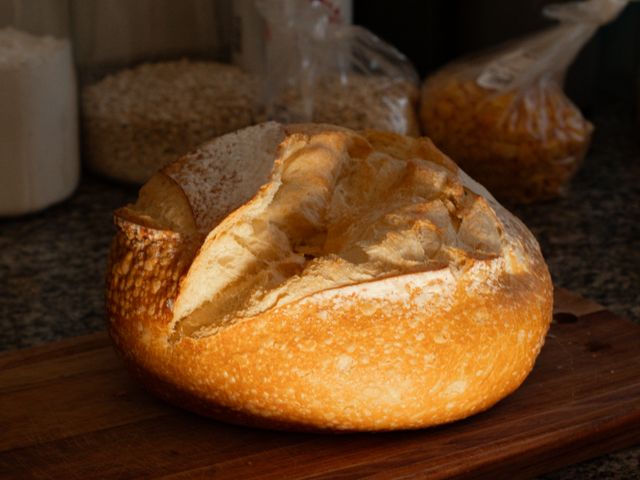
A rustic French-style round sourdough loaf made with a long, cool fermentation that develops complex flavor and an open crumb structure. The dough requires minimal hands-on time, with most of the work happening passively over 24-48 hours. The result is a loaf with a dark, crackling crust and a tender, airy interior with excellent flavor depth.
- Prep
- 20 min
- Cook
- 40 min
- Wait
- 1 days
- Total
- 1 days
- Makes
- 1 loaf (8-10 slices)
Steps
Before you start
- Ensure your sourdough starter is active and bubbly; feed it 4-8 hours before using so it is at peak strength
- Have a Dutch oven or covered bread baker ready
- Plan ahead: this recipe spans 24-48 hours from mixing to baking
- Weigh your ingredients for accuracy; volume measurements are less reliable for sourdough
Mix the dough
- In a large 3-quart mixing bowl, combine 500g bread flour, 350ml water at room temperature, and 100g active sourdough starter.
- Stir with a wooden spoon or your hand until all the flour is hydrated and no dry bits remain.
- The dough will be shaggy and slack.
- Cover the bowl loosely with a damp kitchen towel or plastic wrap and let it rest at room temperature for 30-60 minutes (this autolyse allows the flour to fully absorb water and develop gluten naturally).
+ Show details− Hide details
Ready when: All flour is moistened and incorporated; dough looks shaggy
Tip: Use filtered or unchlorinated water if possible; chlorine can inhibit fermentation
Incorporate salt
- After the autolyse rest, sprinkle 10g fine sea salt over the dough.
- Using wet fingers or a bench scraper, gently fold and squeeze the salt into the dough.
- Work the dough for 3-5 minutes, folding it on itself and rotating the bowl a quarter turn between folds.
- The dough will gradually become smoother and slightly firmer.
- Once the salt is fully incorporated and the dough feels cohesive, cover the bowl again.
+ Show details− Hide details
Ready when: Salt is fully incorporated; dough feels cohesive and smooth
Tip: Adding salt after the autolyse strengthens gluten development without inhibiting fermentation too early
Perform bulk fermentation with stretch and folds
- Over the next 3-4 hours at room temperature (ideally 72-76°F or 22-24°C), perform a total of 4 sets of stretch and folds, spaced 30 minutes apart.
- For each set: wet your hand, grab one side of the dough, stretch it up and fold it over the center.
- Rotate the bowl 90 degrees and repeat 3 more times (one full set takes about 1 minute per side).
- After the first stretch and fold, the dough will start to build strength and rise.
- By the end of the 4th set (around 2-3 hours after salt incorporation), the dough should have increased in volume by about 50% and feel airy and alive.
- Leave the dough covered between sets.
+ Show details− Hide details
Ready when: Dough volume increases by about 50%; surface looks airy with visible bubbles
Tip: Stretch and folds replace traditional kneading and build strength without overworking the dough
Cold retard in the refrigerator
- After the final stretch and fold, cover the bowl with plastic wrap or a damp towel and refrigerate at 38-40°F (3-4°C) for at least 12 hours and up to 48 hours.
- The cold temperature slows fermentation dramatically, allowing complex flavors to develop and making the dough easier to score.
- The dough will continue to rise slowly in the fridge; by 24 hours it should have increased in overall volume by about 30-50%.
+ Show details− Hide details
Ready when: Dough has risen noticeably; poke test shows it springs back slowly (not completely)
Tip: A longer cold fermentation (24-48 hours) produces deeper, more complex sourdough flavor
Preheat the oven and Dutch ovenOven 475°F / 245°C
- Remove the dough from the refrigerator 20-30 minutes before baking.
- Preheat your oven to 475°F (245°C) with a Dutch oven (or covered bread baker) inside for at least 30 minutes.
- This ensures the Dutch oven is very hot and will create steam for a crispy, well-risen loaf.
+ Show details− Hide details
Ready when: Oven reaches 475°F (245°C); Dutch oven is very hot
Tip: A hot Dutch oven traps steam, which prevents the crust from setting too quickly and allows the loaf to rise fully
Shape and score the boule
- Turn the cold dough out onto a lightly floured work surface.
- Gently pre-shape it into a round by pulling the edges toward the center and rotating the dough a quarter turn; repeat 4-5 times to create surface tension.
- Let it rest, uncovered, for 15-20 minutes (bench rest).
- Then, flip the dough seam-side up (so the smooth side faces down).
- With floured hands, fold the top third toward the center, press gently, then fold the bottom third up and press.
- Fold in the sides and roll the dough toward you, creating surface tension.
- Flip seam-side down into your floured banneton or towel-lined bowl, seam facing inward.
- Just before baking, carefully invert the dough onto parchment paper.
- Using a sharp lame or serrated knife, score a single slash at a 30-degree angle about ½ inch (1.25 cm) deep across the top surface.
+ Show details− Hide details
Ready when: Dough is shaped into a tight round; score is clean and decisive
Tip: A cold dough is easier to score without degassing; the slash directs expansion and creates an ear
Bake coveredOven 475°F / 245°C
- Carefully place the parchment paper with the scored dough into the preheated Dutch oven.
- Cover with the lid.
- Bake at 475°F (245°C) for 20 minutes.
- The steam trapped inside will create lift and crust development.
+ Show details− Hide details
Ready when: Steam is visible when you briefly peek; crust begins to set
Tip: Do not open the Dutch oven during this phase; steam is essential for oven spring
Bake uncovered until doneOven 475°F / 245°C
- Remove the lid from the Dutch oven (careful: hot steam will release).
- Continue baking at 475°F (245°C) for another 20-25 minutes, until the crust is deep golden-brown to dark brown and the loaf sounds hollow when tapped on the bottom.
- The internal temperature should reach 205-210°F (96-99°C) when an instant-read thermometer is inserted into the thickest part (not touching the pan).
+ Show details− Hide details
Ready when: Crust is dark golden-brown to nearly black; loaf sounds hollow when tapped; internal temp is 205-210°F (96-99°C)
Tip: A darker crust indicates better caramelization and flavor; if the crust is still pale, bake 2-3 minutes longer
Cool completely
- Transfer the baked loaf to a wire cooling rack (or place it directly on the rack, removing any parchment).
- Let it cool at room temperature for at least 1-2 hours before slicing.
- This resting time allows the crumb to set fully.
- If you cut into the loaf while it is still warm, the interior will be gummy.
+ Show details− Hide details
Ready when: Loaf is cool to the touch; crumb is fully set when you tap it with your knuckle
Tip: Sourdough continues to cook slightly as it cools; resist the urge to slice early or the crumb will be wet
Good to know
Tips
- A healthy, active starter is essential: it should double in size within 4-8 hours of feeding with equal parts starter, flour, and water
- Fermentation speed depends heavily on room temperature; at 70°F (21°C) bulk fermentation takes 3-4 hours, while at 68°F (20°C) it may take 5 hours. Adjust accordingly
- The poke test: gently poke the dough with a floured finger; if it springs back halfway, you are ready to shape; if it springs back completely, ferment longer; if it does not spring back, you may be overfermented
- Stretch and folds are gentler than traditional kneading and work especially well for high-hydration sourdough doughs; they build strength without degassing the dough
Make ahead
You can shape and refrigerate the boule 12-48 hours before baking. You can also freeze the fully baked and cooled loaf wrapped tightly in plastic wrap and foil for up to 3 months; thaw at room temperature, then optionally re-crisp in a 375°F (190°C) oven for 10-15 minutes.
Storage & reheating
Room temperature: wrap the cooled loaf in a linen towel or paper bag and store for up to 3 days (the crust will soften after 1 day; re-crisp briefly in a 375°F/190°C oven for 5-10 minutes). Refrigerator: wrap tightly and store for up to 5 days; reheat as above. Freezer: wrap tightly in plastic wrap, then foil, for up to 3 months; thaw at room temperature and re-crisp if desired.
Substitutions
- bread flour → All-purpose flour (protein content ~10-12% instead of 12-14%). All-purpose flour will work but may produce a slightly less open crumb; increase hydration by 10ml if using it
- filtered or dechlorinated water, at room temperature → Filtered water or bottled water. Chlorinated tap water can slow fermentation; filter or let tap water sit overnight to allow chlorine to dissipate
- active sourdough starter, at room temperature → Liquid sourdough starter (rye or wheat) or a different grain starter. Use the same 100g weight; different starters may ferment at slightly different rates but will work fine
- fine sea salt → Kosher salt (use 13g) or sea salt flakes (use 12g). Finer salts are denser; adjust weight accordingly to maintain sodium content
More sourdough
See all →


Find more like this
- Meal
- Dinner
- Quick & Easy
- 5 Ingredients or LessMake Ahead