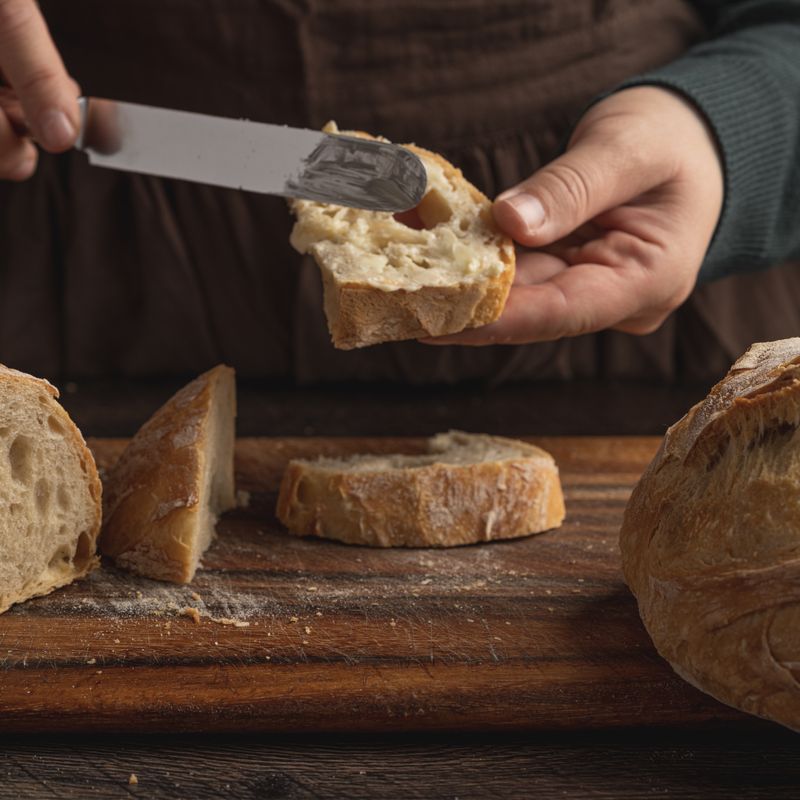
Sourdough Turkish Pide with Lamb and Mint
Hand-shaped Turkish flatbread made with tangy sourdough, filled with spiced ground lamb, fresh mint, and creamy feta. Crispy-bottomed and golden-topped, these individual pides are rich with Middle Eastern flavors and perfect for lunch or dinner.
Steps
Before you start
- Ensure your sourdough starter is fed and active (bubbly and doubled in size) 4–8 hours before mixing dough
- Preheat your oven to 475°F (240°C) 30 minutes before baking
- Have all lamb filling ingredients prepped and at room temperature
- Read through the shaping step before beginning—the characteristic boat shape takes a minute or two to master
Mix the sourdough dough
- In a large mixing bowl, combine the active sourdough starter (120 ml), water (180 ml), and bread flour (330 g).
- Mix with your hand or a wooden spoon until all flour is moistened and you have a shaggy dough with no dry bits.
- Let this autolyse (rest) for 20 minutes without adding salt.
+ Show details− Hide details
Ready when: All flour is fully incorporated
Tip: This autolyse step is essential for sourdough—it builds gluten structure without aggressive kneading.
Add salt and knead
- After the autolyse, sprinkle the salt (9 g) and olive oil (15 ml) over the dough.
- Using wet hands, squeeze and fold the dough onto itself for 8–10 minutes until it becomes smooth, elastic, and slightly sticky.
- The dough should spring back when poked but still show a finger indentation.
+ Show details− Hide details
Ready when: Dough is smooth and elastic with slight stickiness; finger indent springs back halfway
Tip: Keep your hands wet to prevent sticking rather than adding more flour—this keeps the dough hydrated.
First rise (bulk fermentation)
- Shape the dough into a round ball and place it in the same bowl (lightly oiled).
- Cover with a damp towel or plastic wrap.
- Let it rise at room temperature for 90 minutes to 2 hours until it increases by about 50% in volume.
- The dough should be puffy but not necessarily doubled.
+ Show details− Hide details
Ready when: Dough has risen 50% larger; when gently poked, indent slowly springs back halfway
Tip: Sourdough is slower than commercial yeast—avoid rushing this step or the crust will lack flavor.
Prepare the lamb filling
- While the dough rises, make the filling.
- Heat the olive oil (15 ml) in a large skillet over medium heat.
- Add the diced onion (85 g) and cook for 4–5 minutes until soft and translucent.
- Add the minced garlic (10 g) and cook for 1 minute until fragrant.
- Increase heat to medium-high, add the ground lamb (340 g), and cook, breaking it apart with a wooden spoon, for 5–7 minutes until browned and no pink remains.
- Drain off excess fat if needed.
+ Show details− Hide details
Ready when: Lamb is fully cooked through with no pink; internal temperature reaches 160°F (71°C); onion is soft
Tip: Brown the lamb well to develop rich, savory flavor—don't rush this step. Use an instant-read thermometer if unsure.
Season the filling
- Reduce the heat to low.
- Add the ground cumin (2.5 g), Aleppo pepper flakes (0.5 g), and salt (3 g).
- Stir well and cook for 1 minute until the spices bloom and become fragrant.
- Remove from heat and let cool for 5 minutes.
- Stir in the fresh chopped mint (10 g) and crumbled feta cheese (115 g).
- Taste and adjust seasoning with black pepper and salt.
- The filling should be moist but not wet; if there's excess liquid, drain it off.
+ Show details− Hide details
Ready when: Spices are fragrant; feta is mixed through; filling is warm but not hot
Tip: Let the filling cool completely before assembling—hot filling will make the dough sticky and hard to shape.
Shape the pides
- Turn the proofed dough out onto a lightly floured surface.
- Divide it into 4 equal pieces (about 175 g each).
- Round each piece gently and let rest uncovered for 5 minutes.
- Take the first piece and, using your fingertips, gently press it into an oval about 5 inches (13 cm) long and 3 inches (8 cm) wide, leaving the edges slightly thicker than the center.
- Place about 2.5 tablespoons (40 g) of filling down the center, leaving ½ inch (1 cm) border on all sides.
- Fold and pinch the long sides of the oval upward, pinching at the corners to create a boat shape with slightly open ends (traditional pide style).
- Repeat with remaining dough pieces.
+ Show details− Hide details
Ready when: Four boat-shaped pides with crimped edges and open ends
Tip: Keep the filling centered and don't overstuff—about 2.5 tablespoons per pide is ideal. The open ends should stay open for a classic pide presentation.
Final proof and prepare for bakingOven 475°F / 245°C
- Place each shaped pide on parchment paper on your baking sheets, spacing them about 2 inches (5 cm) apart.
- Cover loosely with a towel and let proof at room temperature for 30–40 minutes.
- They should puff slightly and feel light when gently pressed.
- Meanwhile, preheat your oven to 475°F (240°C).
+ Show details− Hide details
Ready when: Pides have risen slightly and feel airy to a light touch
Tip: Don't let them overproof—if they rise too much, they'll collapse in the oven.
Brush and top
- Just before baking, gently brush each pide with the beaten egg wash (about 1 teaspoon per pide), covering the dough but not the filling.
- Sprinkle sesame seeds (about ½ teaspoon per pide, optional) over the egg wash.
- If you like more Aleppo pepper color and flavor, add a tiny pinch to the egg-washed surface.
+ Show details− Hide details
Ready when: Even golden glaze on dough; sesame seeds adhered
Tip: Apply egg wash gently so you don't deflate your final proof.
Bake the pidesOven 475°F / 245°C
- Carefully transfer the baking sheets to the preheated 475°F (240°C) oven (or bake them one sheet at a time if your oven is small).
- Bake for 18–25 minutes until the pide tops and sides are deep golden brown and the bottom crust sounds hollow when tapped.
- Rotate the baking sheets halfway through if your oven bakes unevenly.
- The filling should be hot and the cheese slightly melted.
+ Show details− Hide details
Ready when: Top and sides are deep golden; bottom sounds hollow when tapped; cheese is melted
Tip: Don't overbake—the sourdough can dry out quickly at high heat. Check at 18 minutes and remove as soon as golden.
Cool and serve
- Transfer the baked pides to a wire rack and let rest for 3–5 minutes before serving.
- This resting period lets the crust set slightly so it stays crispy.
- Serve warm, drizzled with a little extra olive oil and a sprinkle of fresh mint if desired.
- They are best eaten within a few hours of baking.
+ Show details− Hide details
Ready when: Pides have cooled slightly; crust is firm and crispy
Tip: A short rest helps the crust crisp up—serve while still warm for the best texture and flavor.
Good to know
Tips
- Sourdough pide relies on an active, bubbly starter. If your starter isn't rising and doubling within 4–8 hours of feeding, it's not ready; feed it again and wait.
- The boat shape is traditional for pide but not mandatory—you can make them round and pinch the edges all the way around, or even make a closed pastry. The boat shape just gives that iconic look and slightly crispy edges.
- Don't skip the autolyse step. Sourdough builds gluten gradually, and the 20-minute rest before salting makes a huge difference in dough texture and extensibility.
- Sourdough bakes best on a preheated baking sheet or stone. If you have a baking stone, place it on your oven rack while preheating and bake the pides directly on it for an even crispier bottom.
Make ahead
Dough can be mixed up to 12 hours ahead, cold-proofed in the refrigerator after the bulk fermentation, then shaped and baked the next day. Bring cold dough to room temperature for 30 minutes before shaping. The lamb filling can be made up to 2 days ahead and refrigerated; let it come to room temperature and check the moisture level before assembling.
Storage & reheating
Store cooled pides at room temperature in an airtight container for up to 1 day. Reheat in a 350°F (175°C) oven for 5–7 minutes until warmed through and the crust recrisps. Pides do not freeze well due to the sourdough texture, but you can freeze the dough after bulk fermentation (up to 2 weeks) or baked pides (up to 1 week) if needed; thaw at room temperature and reheat in the oven.
Substitutions
- ground lamb → ground beef or ground turkey. Beef will be slightly milder; turkey lighter. Both work well. Use the same weight and ensure they reach 160°F (71°C) internal temperature.
- fresh mint leaves → fresh parsley or dill. Parsley is milder and herbaceous; dill adds a bright, fresh note. Either works beautifully with the lamb.
- crumbled feta cheese → crumbled Casio, ricotta salata, or even mild goat cheese. Any crumbly, tangy cheese works. Adjust the salt slightly if your cheese is saltier than feta.
- Aleppo pepper flakes → red pepper flakes or paprika. Red pepper flakes will be spicier; paprika milder and smokier. Start with half the amount of pepper flakes.
More flatbreads
See all →

Find more like this
- Meal
- Lunch
- Cuisine
- Turkish
- Main ingredient
- Ground LambFeta
- Diet
- HalalSugar-Free
- Method
- Oven