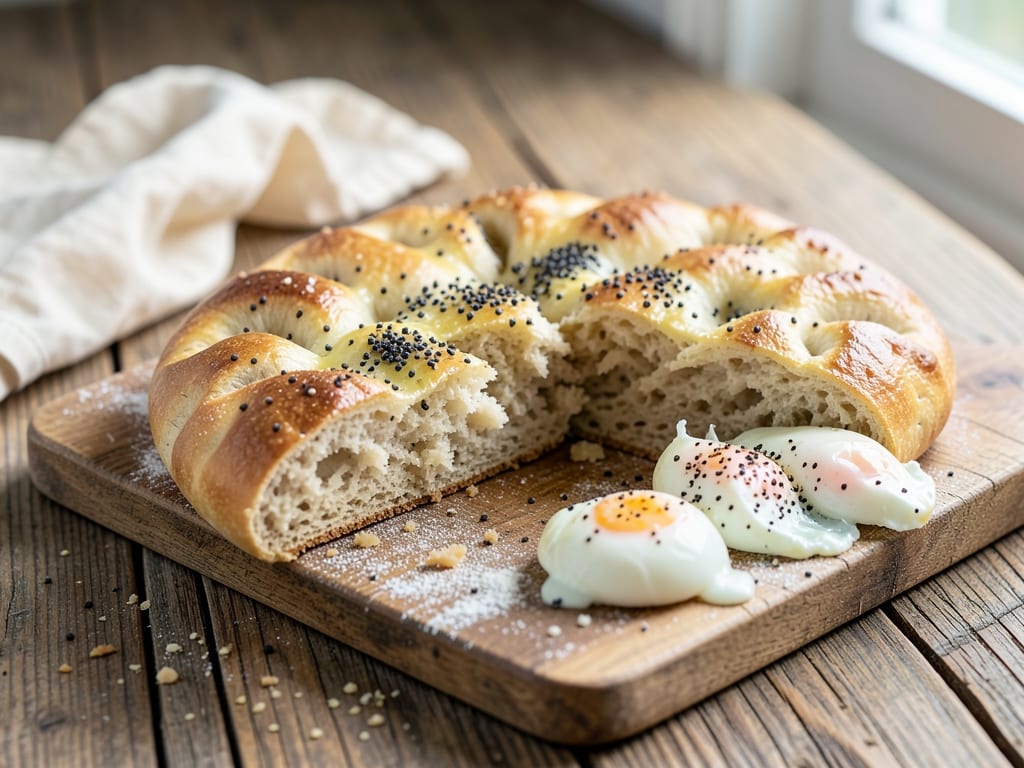
Turkish Pide Bread
Soft, pillowy Turkish flatbread with a shiny golden egg-washed top, a crisp-chewy crust, and a lattice of dimples sprinkled with nigella and sesame seeds. Perfect for tearing and dipping or serving with dips, kebabs, and soups.
- Prep
- 34 min
- Cook
- 16 min
- Wait
- 1 hr 40 min
- Total
- 2 hr 30 min
- Makes
- 2 oval loaves, about 12 inches (30 cm) long (8 servings)
Steps
Before you start
- Plan on about 2½ hours from start to finish, most of it hands-off rising time.
- Measure the flour by weight if you can (500 g). Scooped cups can pack in up to 20% more flour and make the bread dry.
- Check your water with a thermometer: 105–110°F (40–43°C) is warm to the touch but not hot. Hotter water can kill the yeast.
- Set oven racks in the upper and lower thirds before you preheat, and line two baking sheets with parchment paper.
Mix the dough
- In a large bowl, whisk the bread flour, instant yeast, sugar, and fine salt.
- Add the warm water and the 2 tablespoons (30 ml) olive oil.
- Stir with a wooden spoon or your hand until no dry flour remains and a shaggy, sticky dough forms, about 2 minutes.
+ Show details− Hide details
Ready when: No dry flour is left and the dough looks shaggy and sticky.
Tip: Keep the salt and yeast on opposite sides of the bowl when you add the dry ingredients, then whisk well so the salt doesn't slow the yeast.
Knead until smooth
- Turn the dough onto a lightly floured counter and knead for 10 minutes, pushing it away with the heel of your hand, folding it back, and turning it a quarter turn.
- Or knead with a dough hook on medium-low speed for 7 minutes.
- Use as little extra flour as possible.
+ Show details− Hide details
Ready when: The dough is smooth, soft, and slightly tacky. It springs back slowly when poked and stretches into a thin, translucent window without tearing.
Tip: Resist adding lots of flour. A slightly tacky dough bakes into a softer, more open crumb.
First rise
- Grease a large bowl with the 1 tablespoon (15 ml) olive oil, reserving about 1 teaspoon for later.
- Add the dough, turn it once to coat, and cover with a towel or plastic wrap.
- Let it rise in a warm spot (75–80°F / 24–27°C) for 60 minutes.
+ Show details− Hide details
Ready when: The dough has doubled and a floured finger pressed in 1/2 inch leaves a dent that fills back in slowly.
Tip: In a cool kitchen, give it up to 90 minutes. Judge by the dough's size, not the clock.
Divide and shapeOven 450°F / 230°C
- Preheat the oven to 450°F (230°C) with racks in the upper and lower thirds.
- Turn the dough onto the counter and press out the large bubbles.
- Divide it into 2 equal pieces, about 435 g each.
- Shape each into a ball, then stretch and press each into an oval about 12×7 inches (30×18 cm) and 1/2 inch (1.5 cm) thick.
- Place one oval on each parchment-lined baking sheet.
+ Show details− Hide details
Ready when: Each oval is an even thickness with no thin spots or tears.
Tip: If the dough springs back, cover it and let it rest for 5 minutes. It will then stretch more easily.
Second riseOven 450°F / 230°C
- Cover the shaped loaves loosely with a towel and let them rest for 25 minutes while the oven finishes preheating.
- In a small bowl, beat the egg with the milk until smooth.
+ Show details− Hide details
Ready when: The loaves look visibly puffy, and a gentle fingertip press leaves a slight dent.
Dimple and glaze
- Dip your fingertips in the reserved olive oil.
- Press them firmly straight down into each loaf, all the way to the pan, in rows about 1 inch (2.5 cm) apart.
- Then draw your fingers lengthwise to make a diamond lattice pattern.
- Brush the tops generously with the egg wash, letting it pool in the dimples.
- Sprinkle with the nigella seeds and the sesame seeds, if using.
+ Show details− Hide details
Ready when: The surface is covered in deep dimples and glossy with egg wash, with seeds evenly scattered.
Tip: Press firmly. Shallow dimples puff back up in the oven and the pattern disappears.
Bake the pideOven 450°F / 230°C
- Bake both sheets at 450°F (230°C) for 14–16 minutes, swapping their positions and rotating them front to back after 8 minutes.
- Bake until the loaves are deep golden brown on top and the bottoms are golden and sound hollow when tapped.
+ Show details− Hide details
Ready when: Deep golden-brown, glossy top; bottom is golden and sounds hollow when tapped. A thermometer in the center reads 200–210°F (93–99°C).
Tip: If the tops brown before the centers are done, tent loosely with foil for the last few minutes.
Cool and serve
- Slide the loaves, still on parchment, onto a wire rack.
- Cool for 15 minutes so the crumb sets, then tear or slice into wedges and serve warm.
+ Show details− Hide details
Ready when: The loaves are warm, not steaming hot, and the crust feels firm.
Tip: Cutting too early makes the inside gummy. Wait at least 10 minutes.
Good to know
Tips
- Use oiled fingers to dimple deeply. This gives the traditional lattice pattern and stops the loaf from puffing into a dome.
- A hot oven gives the best crust and rise. Make sure it is fully preheated before the loaves go in.
- Brush the egg wash on gently so it doesn't deflate the dough, and let it pool in the dimples for deep color.
- For a crisper bottom crust, preheat the baking sheets and slide the loaves with their parchment onto them. Handle carefully.
Make ahead
"After kneading, put the dough in the oiled bowl, cover tightly, and refrigerate for up to 24 hours. Let it sit at room temperature for 1 hour, then shape, rest 25 minutes, and bake as directed."
Storage & reheating
"Room temperature: wrap tightly or keep in an airtight bag for up to 2 days. Fridge: not recommended, because it dries the bread out. Freezer: wrap whole or sliced loaves well and freeze for up to 3 months. Reheat at 350°F (175°C) for 8–10 minutes, loosely covered with foil if the crust is already dark; thaw frozen loaves first."
Substitutions
- bread flour → all-purpose flour. The crumb will be slightly softer and less chewy. Start with 30 ml less water, then add more if the dough feels dry.
- instant yeast → active dry yeast. Use the same amount. Stir it into the warm water with the sugar and wait 5–10 minutes until foamy before mixing.
- nigella seeds → black sesame seeds. They look similar but taste milder, without nigella's slightly peppery, oniony flavor.
- whole milk → water. The egg wash still browns well but will be slightly less glossy and rich.
More flatbreads
See all →
Find more like this
- Meal
- Breakfast
- Cuisine
- Turkish
- Diet
- VegetarianHalal
- Method
- Oven
- Quick & Easy
- EasyMeal PrepMake Ahead