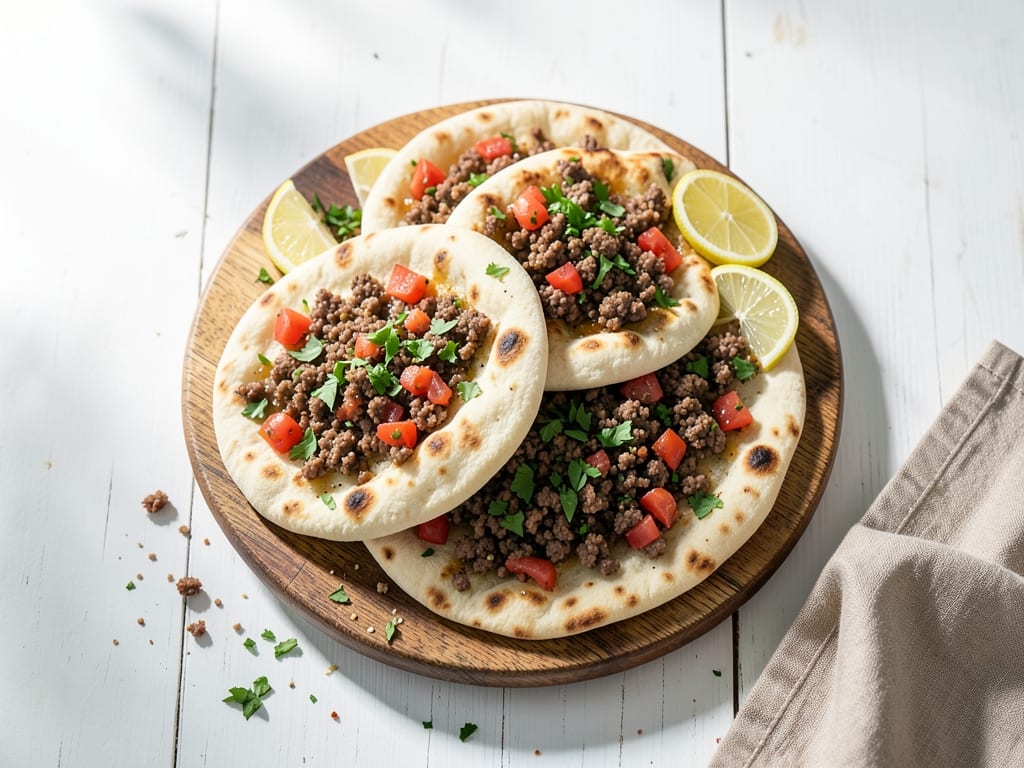
Sourdough Lahmacun (Turkish Lamb Flatbread)
Thin, pliable sourdough rounds topped with a spiced mixture of lamb, tomato, parsley and Turkish pepper paste, baked fast in a very hot oven. The long-fermented crust is tangy, chewy and blistered, and the topping stays juicy under a squeeze of lemon.
- Prep
- 59 min
- Cook
- 20 min
- Wait
- 6 hr 25 min
- Total
- 7 hr 44 min
- Makes
- 8 lahmacun (8-inch / 20 cm rounds), serving 4 as a meal
Steps
Before you start
- Feed your sourdough starter 4–6 hours before mixing so it is bubbly, domed and at its peak. A spoonful should float in water.
- Plan for about 7.5 hours from start to finish, most of it hands-off. The dough ferments at room temperature (about 75°F / 24°C); in a cooler kitchen allow extra time.
- Use a pizza stone or baking steel if you have one. Otherwise, turn two heavy rimless or inverted baking sheets upside down for baking.
- Ask the butcher for ground lamb with some fat (15–20%); lean lamb gives a dry topping. Ground beef works too.
Mix and rest dough
- In a large bowl, stir the lukewarm water and starter with a fork until the starter mostly dissolves and the water looks milky.
- Add the bread flour and mix with wet hands until no dry flour remains and the dough looks shaggy.
- Cover the bowl and let it rest.
+ Show details− Hide details
Ready when: No dry flour patches remain; dough is shaggy and sticky
Tip: Don't add the salt yet. It slows hydration and makes mixing harder.
Add salt and oil
- Sprinkle the 1½ teaspoons salt and drizzle the olive oil over the dough.
- Squeeze and fold the dough with wet hands for about 2 minutes to work them in.
- Then do a set of stretch and folds: grab one edge, stretch it up and fold it over the center, turn the bowl a quarter turn, and repeat 4 times.
- Cover.
+ Show details− Hide details
Ready when: Dough looks smoother and resists slightly when stretched
Tip: Wet your hands to stop the dough sticking.
Two more folds
- After the 30-minute rest, do another set of 4 stretch and folds, then cover.
- Repeat once more after 30 more minutes (3 sets total including step 2).
+ Show details− Hide details
Ready when: Dough is smooth, elastic and slightly domed, and holds its shape when folded
Bulk fermentation
- Leave the covered dough undisturbed at about 75°F (24°C) for about 3½ more hours (about 5 hours since mixing the starter in), until it has grown by 50–75% and shows bubbles on the surface and along the sides of the bowl.
+ Show details− Hide details
Ready when: Dough has grown 50–75%, is jiggly and domed, with bubbles visible; it should smell mildly sour, not boozy
Tip: In a cool kitchen, this can take up to 2 hours longer. Judge by the dough, not the clock.
Make the topping
- Put the grated tomatoes in a fine-mesh sieve over a bowl, sprinkle with a pinch of salt and let drain 10 minutes, pressing gently; discard the liquid.
- Meanwhile, in a large bowl combine the lamb, drained tomatoes, grated onion, parsley, garlic, pepper paste, tomato paste, Aleppo pepper, cumin, paprika, 1 teaspoon salt, black pepper and pomegranate molasses, if using.
- Mix with your hands for about 1 minute until it forms a thick, spreadable paste.
- Cover and refrigerate until needed.
+ Show details− Hide details
Ready when: Topping is a uniform, thick, spreadable paste, not soupy
Tip: Make this during the last hour of bulk fermentation. A watery topping makes the crust soggy.
Divide, shape, preheatOven 500°F / 260°C
- Place a pizza stone or baking steel (or two upside-down baking sheets) on the upper-middle oven rack and preheat to 500°F (260°C).
- Turn the dough onto a lightly floured surface and divide into 8 pieces of about 105 g (3¾ oz) each.
- Shape each into a tight ball by tucking the edges underneath.
- Place on a floured tray, cover with a damp towel and rest 45 minutes (the oven preheats during this time).
+ Show details− Hide details
Ready when: Balls look puffy and spring back slowly when poked
Tip: Don't skip the long preheat. A fully hot stone gives blistered bottoms in minutes.
Roll and top
- Cut 4 pieces of parchment to about 9 inches (23 cm).
- Working with 2 balls at a time, roll each on a lightly floured surface into a very thin 8-inch (20 cm) round, about 2 mm thick, and set on parchment.
- Spread about 3 tablespoons (85 g) of topping in a very thin, even layer over each, leaving a ¼-inch (6 mm) border.
+ Show details− Hide details
Ready when: Dough is thin enough to see your hand faintly through; topping covers it in a thin layer
Tip: Keep the other dough balls covered while you work so they don't dry out. Spread topping with the back of a spoon or damp fingers.
Bake in batchesOven 500°F / 260°C
- Slide 2 topped rounds, parchment and all, onto the hot stone at 500°F (260°C).
- Bake 4–5 minutes.
- The edges should be golden with brown spots, and the topping should be sizzling and set.
- Remove with the peel; the lamb should read 160°F (71°C) on an instant-read thermometer.
- Repeat with remaining rounds in 3 more batches, rolling and topping the next pair while the previous bake.
+ Show details− Hide details
Ready when: Edges golden with dark spots, topping sizzling and no longer pink, lahmacun still bendable at the center
Tip: Don't over-bake; lahmacun should stay pliable enough to roll. If it's browning too fast, move it to a lower rack.
Garnish and serve
- Toss the sliced red onion with the picked parsley and sumac, if using.
- Pile a little on each hot lahmacun, squeeze lemon over, and serve right away, rolled up or folded in half.
+ Show details− Hide details
Tip: Garnish just before eating so the herbs stay fresh and crisp.
Good to know
Tips
- Roll the dough much thinner than you think; it puffs in the oven and thick dough makes the topping slide off.
- Spread the topping thinly and evenly. Too much makes the center soggy and slows cooking.
- To roll up, stack a little salad in the middle, squeeze lemon on it, and roll like a wrap.
- No stone? Preheat inverted baking sheets for the full 45 minutes; cold sheets give pale, soft bottoms.
Make ahead
"Mix the topping up to 1 day ahead and refrigerate covered. For deeper flavor, after step 3 refrigerate the dough in a covered bowl for up to 24 hours instead of the room-temperature bulk rise; bring it to room temperature for 1 hour, then divide and rest as in step 6."
Storage & reheating
Room temperature: up to 2 hours. Refrigerator: wrap cooled lahmacun well and keep up to 3 days. Freezer: stack with parchment between rounds, wrap airtight and freeze up to 2 months. Reheat from fridge or frozen in a dry skillet over medium heat for 1–2 minutes per side, or in a 400°F (200°C) oven for 4–6 minutes, until hot and the edges crisp slightly.
Substitutions
- ground lamb → ground beef (80/20). Milder flavor but works well; keep the same weight and cook to 160°F (71°C).
- Turkish red pepper paste (biber salçası), hot or mild → 1 tablespoon tomato paste plus 1 teaspoon extra paprika and ½ teaspoon chili flakes. Less depth than biber salçası but close in color and heat.
- bread flour → all-purpose flour. The crust will be slightly softer and less chewy; reduce water by 1–2 tablespoons if the dough feels slack.
- Aleppo pepper (pul biber) → ½ teaspoon crushed red pepper flakes plus ½ teaspoon paprika. Aleppo is fruity and mild; this approximates it.
More flatbreads
See all →

Find more like this
- Meal
- Lunch
- Cuisine
- Turkish
- Main ingredient
- Ground LambTomatoes
- Diet
- Dairy-FreeHalal
- Method
- Oven