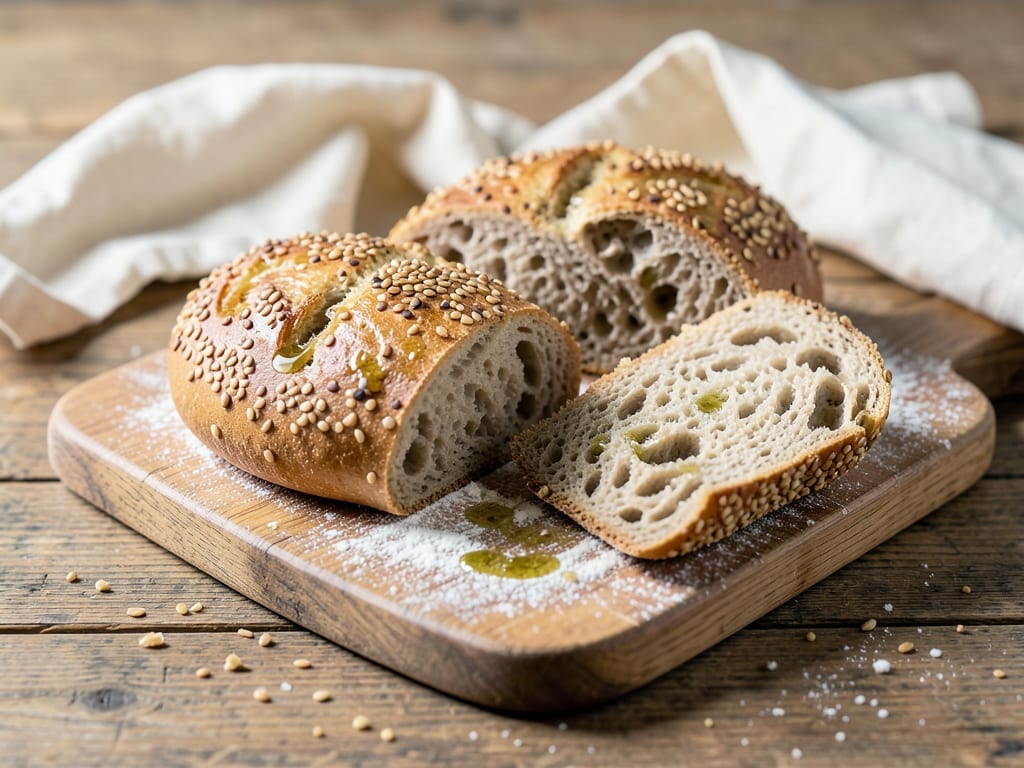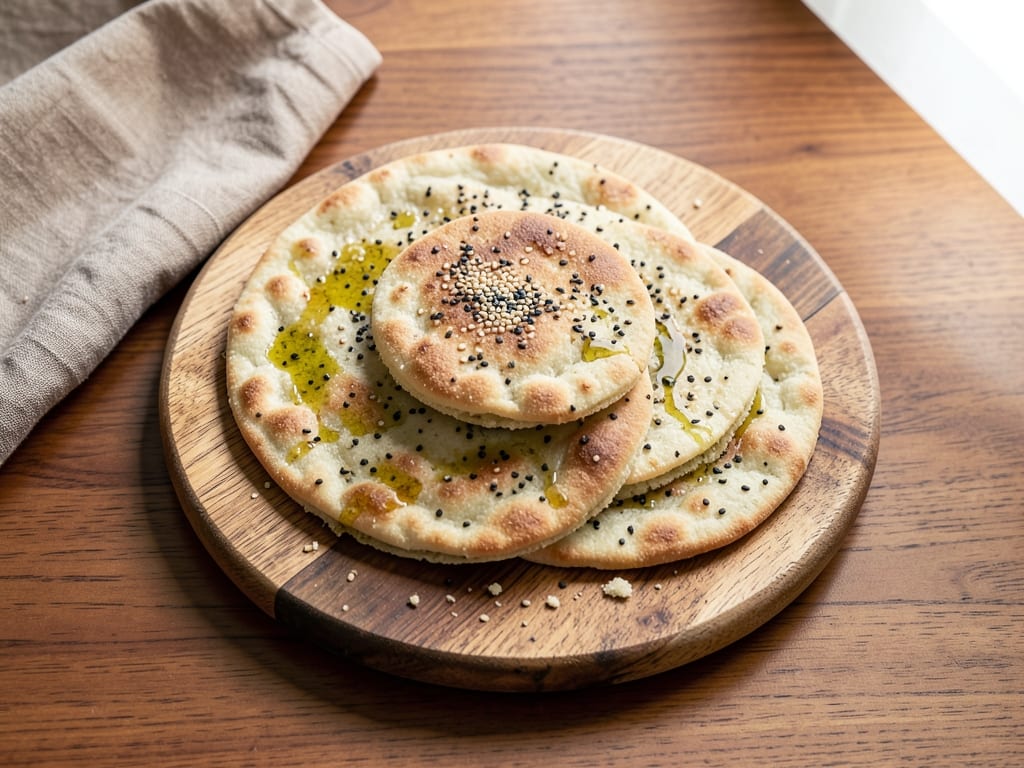
Greek Lagana Flatbread
A soft, olive-oil-rich Greek flatbread with a crisp sesame crust and a tender, chewy crumb. Traditionally baked for Clean Monday, it's also perfect for dipping, sandwiches, or tearing alongside a mezze spread.
- Prep
- 35 min
- Cook
- 22 min
- Wait
- 1 hr 45 min
- Total
- 2 hr 42 min
- Makes
- 1 large oval flatbread (8 pieces)
Steps
Before you start
- Plan on about 2 hours 40 minutes from start to finish, most of it hands-off rising and resting.
- Warm the water to about 105°F (40°C): comfortably warm to the touch, not hot. Water above 120°F (49°C) can kill the yeast.
- Measure the flour by weight if you can. Cup measurements vary and a too-dry dough bakes up dense.
- Use a good extra-virgin olive oil; its flavor is prominent in this bread.
Mix the dough
- In a large bowl, whisk together the flour, instant yeast, sugar and fine sea salt.
- Add the lukewarm water and 3 tablespoons (45 ml) olive oil.
- Stir with a wooden spoon until no dry flour remains and a shaggy, sticky dough forms, about 2 minutes.
+ Show details− Hide details
Ready when: No dry flour pockets remain and the dough looks shaggy and sticky.
Tip: Keep the salt and yeast on opposite sides of the bowl when whisking in the dry ingredients, then mix everything together well before adding liquid.
Knead until smooth
- Turn the dough onto a lightly floured counter and knead for 8 minutes, or use a stand mixer with a dough hook on medium-low for 6 minutes.
- Dust with a little flour only if it sticks stubbornly to your hands.
- The dough should be soft and slightly tacky.
+ Show details− Hide details
Ready when: Dough is smooth, elastic and springs back slowly when poked; a small piece stretches into a thin, translucent window without tearing.
Tip: Resist adding too much flour. A slightly tacky dough gives a softer, more tender bread.
First rise
- Brush a large clean bowl with about 2 teaspoons of the greasing olive oil.
- Shape the dough into a ball, place it in the bowl and turn to coat.
- Cover with a towel or plastic wrap and let rise in a warm spot (75–80°F / 24–27°C) for 60 to 75 minutes.
+ Show details− Hide details
Ready when: Dough has doubled and a floured finger pressed in 1/2 inch leaves an indentation that springs back slowly.
Tip: In a cool kitchen, set the bowl in the oven with only the light on.
Shape the flatbread
- Line an 18×13-inch (46×33 cm) rimmed baking sheet with parchment and brush it with the remaining olive oil from the greasing portion (about 1 teaspoon).
- Turn the dough out and gently press out the large bubbles.
- Stretch and press it into an oval about 14×9 inches (35×23 cm) and roughly 1/2 inch (1.25 cm) thick.
- Transfer to the sheet.
+ Show details− Hide details
Ready when: Dough forms an even oval about 1/2 inch thick with no thin spots.
Tip: If the dough springs back while stretching, cover it and rest 5 minutes, then continue.
Rest and preheatOven 425°F / 220°C
- Cover the shaped dough loosely with a towel and let it rest for 20 minutes until slightly puffy.
- During the last 15 minutes, preheat the oven to 425°F (220°C) with a rack in the center.
+ Show details− Hide details
Ready when: Dough looks puffy and a gentle poke leaves a slight dent.
Dimple and top
- Mix the water and 2 tablespoons (30 ml) olive oil for the topping.
- Dip your fingertips in the mixture and press deep dimples all over the dough, almost to the pan.
- Brush the rest of the mixture over the surface, then sprinkle evenly with sesame seeds and flaky salt, if using.
+ Show details− Hide details
Ready when: Surface is covered in dimples, glossy with oil and evenly coated with seeds.
Tip: Press firmly; shallow dimples disappear in the oven.
BakeOven 425°F / 220°C
- Bake in the center of the 425°F (220°C) oven for 20 to 22 minutes, rotating the pan front to back halfway through, until the top is deep golden and the sesame seeds are toasted.
+ Show details− Hide details
Ready when: Top and edges are deep golden brown, the underside is golden and the bread sounds hollow when tapped.
Tip: If the sesame seeds darken before the bread is done, tent loosely with foil.
Cool and serve
- Slide the bread with its parchment onto a wire rack.
- Cool for at least 15 minutes so the crumb sets, then cut or tear into 8 pieces and serve warm or at room temperature.
+ Show details− Hide details
Ready when: Bread is warm, not hot, to the touch and cuts without squashing.
Good to know
Tips
- Don't skip the deep dimples; they hold the oil and keep the bread from puffing into a dome.
- A sticky dough is fine. Oil your hands rather than adding lots of flour for shaping.
- For a crisper bottom, preheat the baking sheet and slide the parchment with the dough onto it.
- Serve with hummus, tzatziki or taramosalata, or split and fill for sandwiches.
Make ahead
"After kneading, the dough can be placed in the oiled bowl, covered and refrigerated for up to 24 hours. Let it sit at room temperature for 45 minutes, then shape, rest 20 minutes and continue from the dimpling step."
Storage & reheating
"Room temperature: wrap well and keep up to 2 days. Refrigerator: not recommended, as it stales the bread faster. Freezer: wrap tightly and freeze up to 3 months. Reheat at 350°F (175°C) for 8–10 minutes (from frozen, 12–15 minutes) until warm and the crust is crisp."
Substitutions
- bread flour (or all-purpose flour) → all-purpose flour. Gives a slightly softer, less chewy crumb. Use the same weight.
- instant yeast → active dry yeast. Use the same amount, dissolve it in the lukewarm water with the sugar and let it foam for 5–10 minutes before mixing.
- sesame seeds → nigella seeds or a mix of sesame and nigella. Adds a slightly peppery flavor.
- flaky sea salt → dried oregano. Sprinkle 1 teaspoon over the top before baking for a herby version.