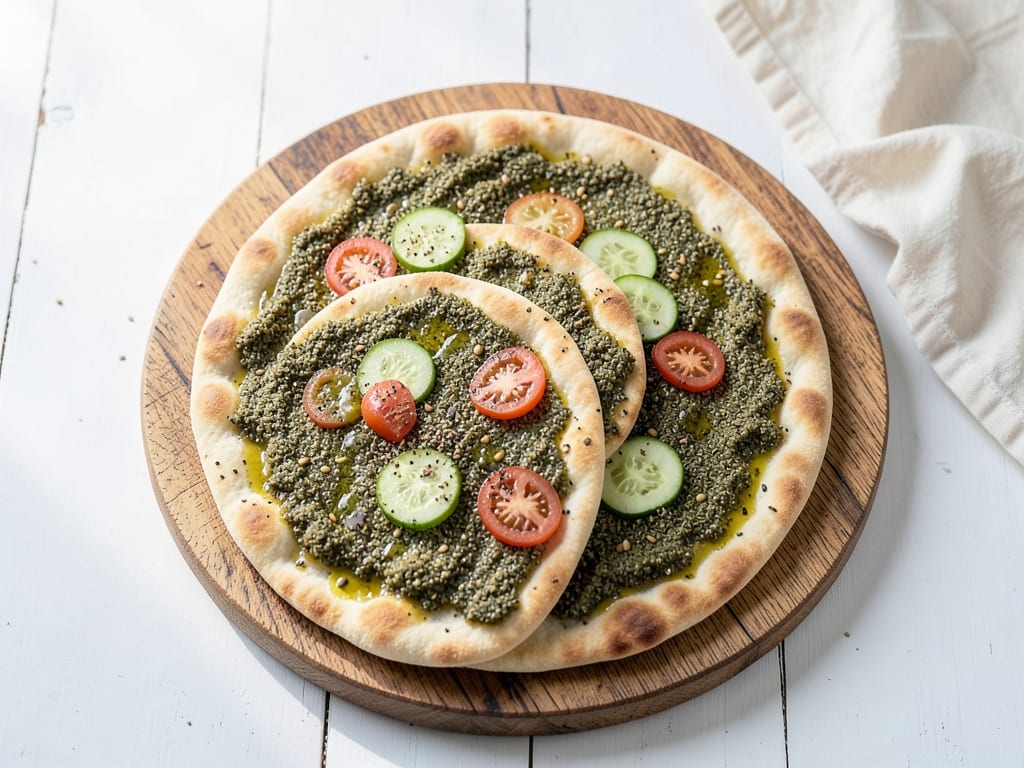
Fattoush-Topped Za'atar Manakish
Soft, chewy flatbreads are baked with a classic za'atar and olive oil spread, then piled with a crisp, lemony fattoush-style salad of cucumber, tomato, radish and herbs, finished with a dusting of tangy sumac. Warm bread and cool salad make a fresh, vegetable-packed lunch.
- Prep
- 58 min
- Cook
- 11 min
- Wait
- 1 hr 23 min
- Total
- 2 hr 32 min
- Makes
- 8 manakish (6-inch/15 cm rounds)
Steps
Before you start
- Read the timing: the dough needs about 1 hour to rise, so start about 2½ hours before you want to eat.
- Check that your yeast is in date, and warm the water to about 105°F (40°C): comfortably warm to the touch, not hot.
- Set oven racks in the upper-middle and lower-third positions before you preheat.
- Don't dress the salad until the manakish are out of the oven. Dressed vegetables turn watery within minutes.
Activate the yeast
- In a large mixing bowl, stir together the warm water, yeast and sugar.
- Let it sit for 5 minutes.
+ Show details− Hide details
Ready when: The surface is covered with a thin layer of foam and smells yeasty. If nothing happens, the yeast is dead; start over with fresh yeast.
Tip: If the water feels hot on your wrist, let it cool first. Water above 120°F (49°C) can kill yeast.
Mix the dough
- Add the flour, salt and 3 tablespoons (45 ml) olive oil to the yeast mixture.
- Stir with a wooden spoon, then your hand, until no dry flour remains and a shaggy, sticky dough forms.
+ Show details− Hide details
Ready when: No dry patches of flour remain and the dough pulls away from the sides of the bowl in a rough mass.
Knead until smooth
- Turn the dough onto a lightly floured counter.
- Knead for 8 minutes, pushing it away with the heel of your hand, folding it back and turning it a quarter turn.
- Add flour 1 tablespoon at a time only if the dough sticks stubbornly to the counter.
+ Show details− Hide details
Ready when: The dough is smooth, soft and elastic, and springs back slowly when poked with a finger.
Tip: Too much added flour makes dry, tough bread. The dough should stay slightly tacky.
Let the dough rise
- Lightly oil the large bowl with a little olive oil, place the dough inside and turn to coat.
- Cover with a damp towel or plastic wrap and leave in a warm spot for 1 hour.
+ Show details− Hide details
Ready when: The dough has doubled in volume and a floured fingertip pressed in leaves a dent that fills back in slowly.
Tip: In a cool kitchen, put the bowl in the oven with only the light switched on.
Prep the fattoush topping
- While the dough rises, combine the lemon juice, 2 tablespoons (30 ml) olive oil, garlic, 1 teaspoon sumac, pomegranate molasses (if using) and salt in a medium bowl and whisk.
- Place the cucumber, tomato, radish, scallion, parsley and mint in a separate bowl or on a plate.
- Do not combine them yet.
- Leave the vegetables undressed in the fridge.
+ Show details− Hide details
Ready when: The dressing is cloudy and well blended, and the vegetables are in even, small pieces.
Tip: Pat the diced tomato and cucumber with a paper towel so extra moisture doesn't dilute the dressing.
Make the za'atar paste
- In a small bowl, stir the za'atar and 6 tablespoons (90 ml) olive oil together to make a loose, spreadable paste.
- Set aside.
+ Show details− Hide details
Ready when: The mixture looks like a thick, glossy, spoonable sauce with no dry za'atar clumps.
Tip: Stir again just before spreading, as the za'atar settles to the bottom.
Divide and shape
- Punch down the risen dough and divide it into 8 equal pieces, about 88 g (3 oz) each.
- Roll each into a ball.
- On a lightly floured counter, roll or press each ball into a round about 6 inches (15 cm) across and ¼ inch (6 mm) thick.
- Place 4 rounds on each of two parchment-lined baking sheets, spaced 1 inch (2.5 cm) apart.
+ Show details− Hide details
Ready when: All 8 rounds are even in thickness and size, and the dough doesn't spring back when rolled.
Tip: If a round keeps shrinking, cover it and let it rest for 5 minutes before rolling again.
Rest and preheatOven 475°F / 245°C
- Cover the shaped dough loosely with a clean towel and let it rest for 15 minutes.
- Meanwhile, preheat the oven to 475°F (245°C) with the racks in the upper-middle and lower-third positions.
+ Show details− Hide details
Ready when: The rounds look slightly puffy and the oven has reached 475°F (245°C).
Tip: Use an oven thermometer if you can; many ovens run cool and the manakish will bake dry before browning.
Top with za'atar
- Press your fingertips into each dough round to make dimples and leave a ½-inch (1 cm) border.
- Stir the za'atar paste, then spoon about 1½ tablespoons onto each round and spread it evenly to the dimpled edge with the back of the spoon.
+ Show details− Hide details
Ready when: Each round is evenly coated with a thin layer of glossy za'atar paste and a clean border.
Tip: Don't spread the paste to the very edge, or it will run off and scorch on the pan.
Bake the manakishOven 475°F / 245°C
- Put one sheet on each rack and bake for 10 to 11 minutes, swapping the sheets between racks and turning them front to back after 5 minutes, until the edges are golden brown and the bottoms are lightly browned.
+ Show details− Hide details
Ready when: The edges are golden brown, the bases are lightly browned when lifted, and the za'atar smells toasty, not burnt.
Tip: Za'atar scorches quickly. If it darkens past deep green-brown before the bread is done, move the tray to a lower rack.
Dress and top
- Let the manakish cool on the pans for 3 minutes.
- Meanwhile, add the vegetables and herbs to the dressing and toss gently to coat.
- Taste and add salt if needed.
- Pile the salad generously on top of the warm manakish, sprinkle with the remaining 1 teaspoon sumac, and serve right away.
+ Show details− Hide details
Ready when: The salad is glossy and bright, and the bread is warm but not piping hot.
Tip: Top the manakish just before serving so the bread stays soft but not soggy.
Good to know
Tips
- Make dimples in the dough before topping: they hold the za'atar paste in place and keep the center from puffing up like a pita.
- Seed the tomatoes and pat the vegetables dry; this is what keeps the fattoush topping crisp rather than watery.
- For a crunchier fattoush feel, add a handful of crushed pita chips or toasted bread pieces to the salad right before serving.
- Roll the dough no thinner than ¼ inch (6 mm) so the bread stays soft and chewy rather than cracker-like.
Make ahead
"The dough can be made through step 4, then refrigerated in a covered, oiled bowl for up to 24 hours. Bring it to room temperature for 30 minutes before shaping. The za'atar paste keeps, covered, at room temperature for 1 day. The undressed chopped vegetables and the dressing can be stored separately in the fridge for up to 4 hours."
Storage & reheating
"Plain baked za'atar manakish (without salad) keep in an airtight container at room temperature for 1 day, in the fridge for up to 3 days, or in the freezer for up to 2 months. Reheat at 350°F (175°C) for 5 to 6 minutes (8 to 10 from frozen), then add fresh salad. Dressed salad does not store well; eat the same day."
Substitutions
- za'atar blend → Mix 3 tbsp dried thyme, 2 tbsp toasted sesame seeds and 1 tbsp sumac. Gives a similar flavor to a store-bought blend; grind it a little for a smoother paste.
- ground sumac → Finely grated zest of 1 lemon plus a little extra lemon juice. Gives a similar bright tang, but lacks sumac's deep red color.
- all-purpose flour → Half whole wheat flour (200 g) and half all-purpose (200 g). The bread will be nuttier and denser; add 1 to 2 tbsp extra water if the dough feels stiff.
- pomegranate molasses → 1 tsp honey plus ½ tsp extra lemon juice. Gives a sweet-tart balance in the dressing.