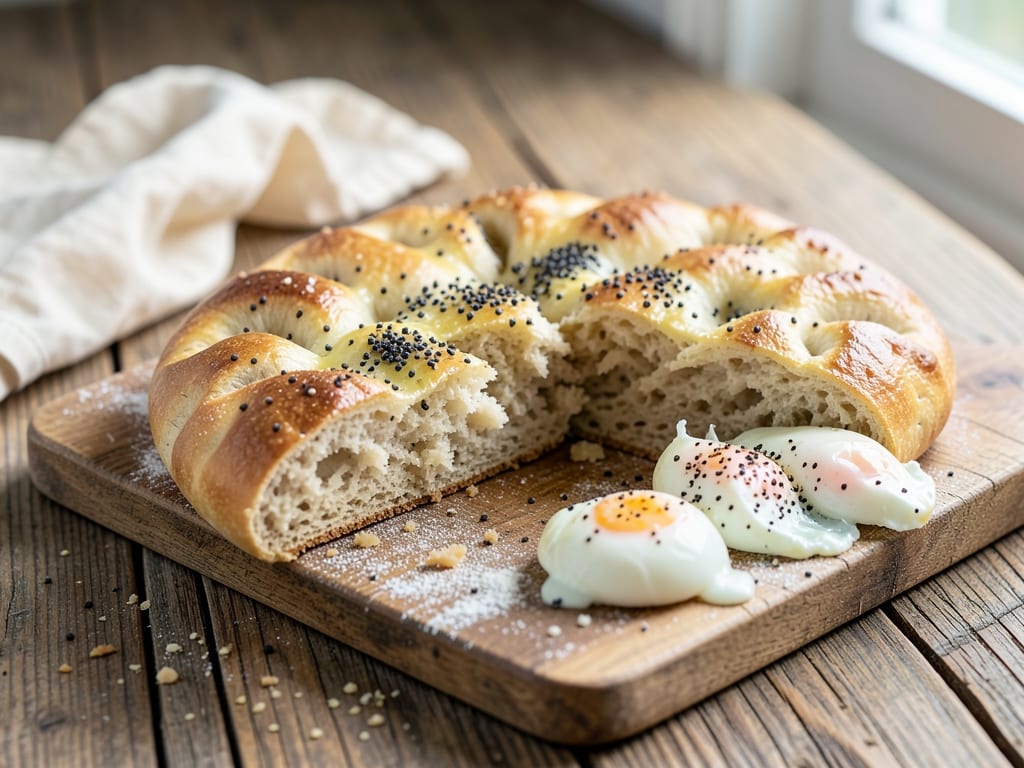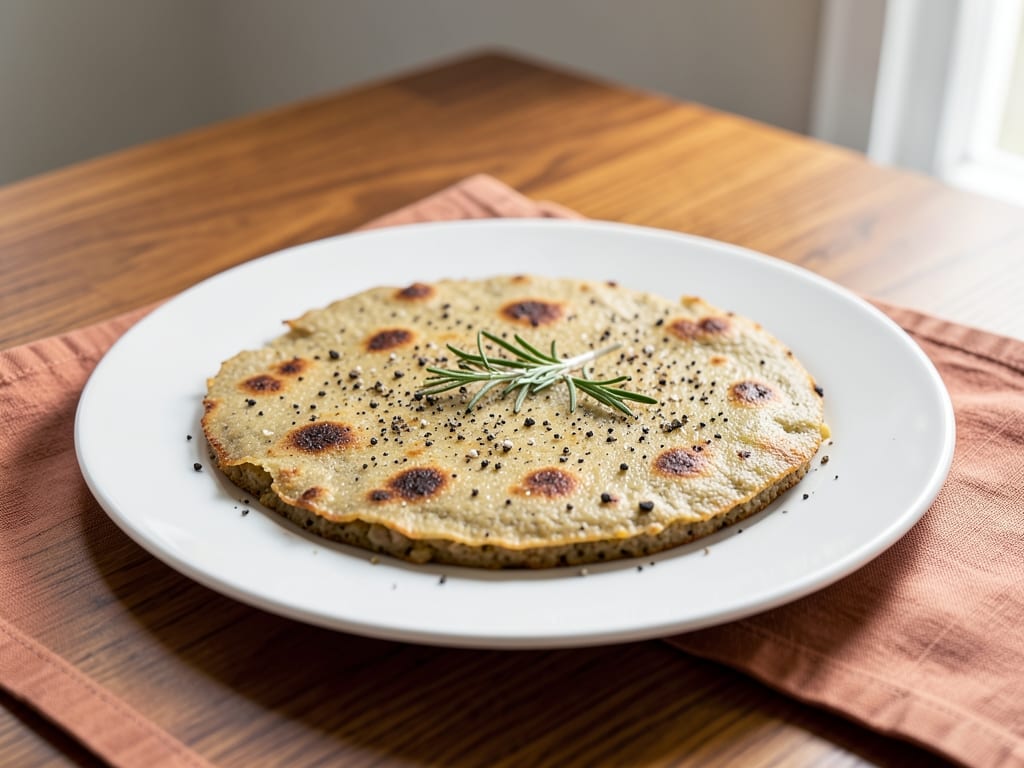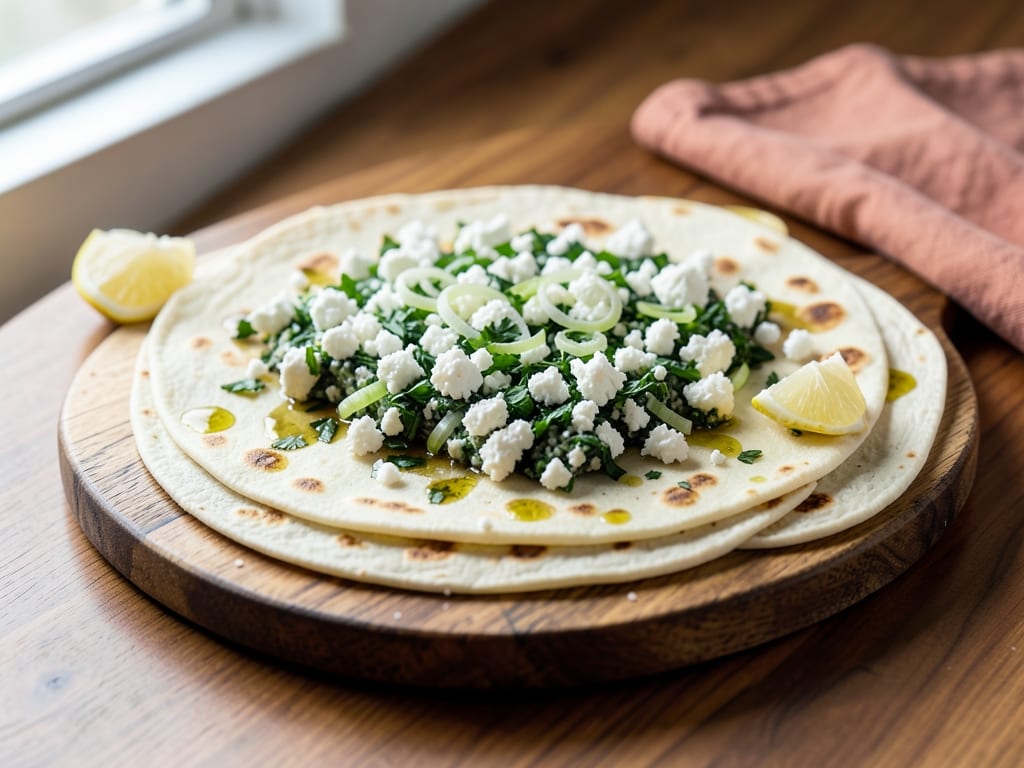
Turkish Yogurt Flatbread Dough for Gözleme (with Feta and Parsley Filling)
A soft, no-yeast yogurt dough that rolls paper-thin without fighting back, then gets stuffed with a salty feta-parsley filling and griddled until blistered and golden. This makes eight crisp-edged, tender gözleme.
- Prep
- 35 min
- Cook
- 40 min
- Wait
- 40 min
- Total
- 1 hr 55 min
- Makes
- 8 filled gözleme (half-moons, about 9 inches / 23 cm wide)
Steps
Before you start
- Take the yogurt out of the fridge 30 minutes ahead so it is at room temperature. Cold yogurt makes the dough stiff.
- Plan on about 40 minutes of total resting time. The dough rests 30 minutes, then 10 minutes more after you divide it. Resting is what lets you roll it thin without tearing.
- You need a long, thin rolling pin (a dowel-style or Turkish oklava works best) and a clean, lightly floured work surface about 24 inches (60 cm) wide.
- Cook the gözleme one at a time. Keep finished ones warm on a plate under a clean towel.
Mix the dough
- In a large bowl, whisk the 500 g flour and 1½ tsp salt together.
- Add the yogurt, 200 ml lukewarm water, and 2 tbsp olive oil.
- Stir with a wooden spoon, then your hand, until no dry flour remains and the dough forms a shaggy, slightly sticky mass.
+ Show details− Hide details
Ready when: No dry flour is left and the dough clumps together in one shaggy mass.
Tip: If the dough feels stiff and dry after 1 minute, add water 1 tsp at a time. Flours vary.
Knead until smooth
- Turn the dough onto a lightly floured surface.
- Knead for 6 to 8 minutes, pushing it away with the heel of your hand, folding it back, and turning it a quarter turn each time.
- Dust with only a pinch of flour if it sticks.
+ Show details− Hide details
Ready when: The dough is smooth, soft, and springs back slowly when you poke it with a finger. It should feel like an earlobe and no longer stick to your hands.
Tip: Keep the dough soft. A slightly tacky dough rolls much thinner than a stiff one.
Rest the dough
- Shape the dough into a ball and place it in the bowl.
- Cover the bowl tightly with a plate or damp towel.
- Let it rest at room temperature for 30 minutes.
+ Show details− Hide details
Ready when: The dough is noticeably softer and puffier, and it stretches easily when you pull a small piece.
Mix the filling
- While the dough rests, combine the crumbled feta, chopped parsley, and sliced scallions in a bowl.
- Add several grinds of black pepper and toss with a fork.
- Taste a pinch.
- Feta is usually salty enough, so don't add salt.
- Cover and refrigerate until needed.
+ Show details− Hide details
Ready when: The filling is evenly speckled with green and the feta is in small crumbles, not clumps.
Tip: Pat wet feta dry with paper towels first. Excess brine makes the dough soggy and can leak out during cooking.
Divide and rest
- Cut the dough into 8 equal pieces of about 105 g each, using a scale if you have one.
- Roll each piece into a smooth ball between your palms.
- Place on a lightly floured surface, cover with a towel, and rest 10 minutes.
+ Show details− Hide details
Ready when: The balls are smooth with no cracks and feel soft when pressed.
Tip: Keep any dough you aren't rolling covered. Uncovered dough forms a dry skin that cracks.
Roll paper-thin
- Flatten one ball into a disc on a lightly floured surface.
- Roll it from the center outward, turning it a quarter turn after every few passes, until it forms a round about 11 inches (28 cm) wide and 1/16 inch (1.5 mm) thick.
- Dust lightly with flour only if it sticks.
- Roll the remaining dough balls when you're ready to cook them.
+ Show details− Hide details
Ready when: The dough is thin enough to see the shadow of your hand through it, and it doesn't tear when lifted.
Tip: If the dough keeps shrinking back, cover it and let it rest 5 more minutes. Don't force it.
Fill and fold
- Spread about ⅓ cup (about 40 g) filling over one half of the round, leaving a 1-inch (2.5 cm) border along the edge.
- Fold the empty half over the filling to form a half-moon.
- Press the edges firmly with your fingertips to seal.
- Press out any air pockets, then gently press the top so the filling spreads evenly.
+ Show details− Hide details
Ready when: The edges are sealed with no gaps and the filling is spread flat, not mounded.
Tip: Don't overfill. Too much filling splits the dough as it cooks.
Heat the pan
- Set a 12-inch (30 cm) cast-iron skillet or griddle over medium-high heat.
- Heat it dry for 3 to 4 minutes.
- Keep the pan dry, with no oil in it.
+ Show details− Hide details
Ready when: A sprinkle of flour in the pan browns in about 10 seconds.
Tip: If the pan smokes heavily, lower the heat slightly. The dough should blister and brown, not scorch.
Griddle each gözleme
- Place one filled gözleme in the hot pan.
- Cook for 2 to 3 minutes, until the underside has golden-brown spots and the dough has puffed in places.
- Flip and cook the second side for 2 to 3 minutes.
- Brush the top with a little olive oil, flip once more for 20 seconds, then brush the other side.
- Move to a plate under a towel.
- Repeat with the remaining gözleme, lowering the heat to medium if they brown too fast.
+ Show details− Hide details
Ready when: Both sides are covered in golden-brown blisters, the dough is cooked through and no longer pale or doughy, and the cheese inside is warm and soft.
Tip: Poke any big air bubble with a fork tip so the gözleme sits flat against the pan.
Cut and serve
- Cut each gözleme into 3 or 4 wedges with a sharp knife or pizza wheel.
- Serve at once while the edges are crisp, with lemon wedges for squeezing over the top.
+ Show details− Hide details
Tip: Gözleme is best within 10 minutes of cooking, when the dough is still crisp at the edges and soft inside.
Good to know
Tips
- Roll the dough thinner than feels natural. Gözleme is meant to be delicate, and thick dough turns doughy rather than crisp.
- Cook in a dry pan and brush with oil only after the dough has set. Oil in the pan fries the dough instead of blistering it.
- Wilted spinach, cooked spiced lamb, or mashed potato also work as fillings. Whatever you choose, keep it dry, cool, and spread thin.
- If the dough tears while rolling, press the tear together with a floured fingertip or patch it with a small scrap of dough.
Make ahead
"The kneaded dough can be refrigerated in an oiled, covered bowl for up to 24 hours. Let it sit at room temperature for 45 minutes before dividing and rolling. The filling keeps covered in the fridge for up to 2 days. You can also roll the dough rounds, stack them with parchment between each, wrap tightly, and refrigerate for up to 4 hours before filling."
Storage & reheating
"Room temperature: up to 2 hours, covered. Fridge: up to 3 days in an airtight container. Freezer: up to 2 months, with parchment between each piece in a freezer bag. Reheat from the fridge or frozen in a dry skillet over medium heat for 2 to 3 minutes per side until hot and crisp. Don't microwave, which makes them soft and chewy."
Substitutions
- plain whole-milk yogurt → Full-fat Greek yogurt thinned with 1 tbsp water, or buttermilk. Use the same weight. The dough is slightly richer with Greek yogurt, and you may need an extra teaspoon of water.
- all-purpose flour → Bread flour. Gives a chewier dough. Add 1 to 2 tbsp more water if it feels stiff, and rest the dough a full 10 minutes after dividing.
- feta cheese → Crumbled ricotta salata, or 5 oz (150 g) ricotta plus 4 oz (100 g) mozzarella. Season ricotta well with salt. Squeeze out any excess moisture first.
- olive oil → Melted unsalted butter. Gives a richer flavor and deeper browning. Brush it on after cooking.