
Sourdough Olive Oil Batard
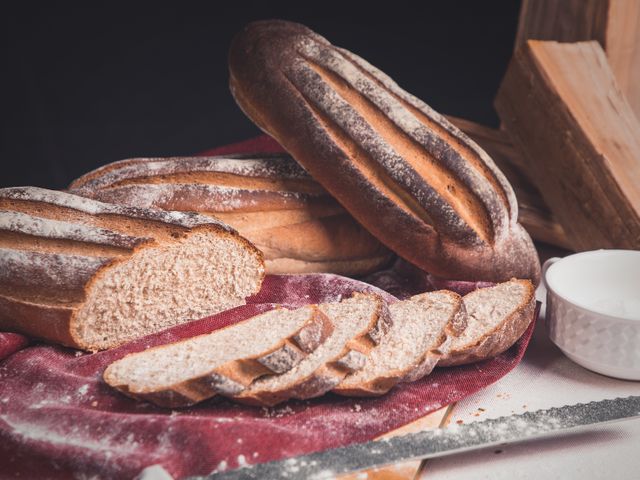
A traditional French batard—an elegant oval loaf—made with long fermentation for deep flavor and beautiful scoring. Extra virgin olive oil enriches the dough, adding subtle fruitiness and extending shelf life. This recipe uses a 24-hour cold fermentation for convenience and superior tang. The result is a rustic loaf with a crackling crust and open, irregular crumb.
- Prep
- 20 min
- Cook
- 32 min
- Wait
- 1 days
- Total
- 1.1 days
- Makes
- 1 batard loaf (approximately 14 oz / 400 g; about 8 slices)
Steps
Before you start
- Feed your sourdough starter 4–6 hours ahead and use it at peak activity (bubbly, risen, not yet collapsed)
- Have all ingredients at room temperature (70°F / 21°C)
- Clear oven rack for dutch oven and preheat 1 hour before baking
- Use a banneton or bowl lined with a well-floured kitchen towel
Mix dough
- In a large bowl, combine 150g active sourdough starter, 230ml lukewarm water, and 350g bread flour.
- Stir with a dough whisk or your fingers until all flour is hydrated and no dry streaks remain; the dough will be shaggy and sticky (roughly 65% hydration).
- Cover the bowl with a damp towel and let rest 30 minutes at room temperature (70°F / 21°C).
- This autolyse allows flour to fully absorb water and makes handling easier.
+ Show details− Hide details
Ready when: All flour is wet and dough is visibly shaggy
Tip: Do not add salt yet; it will inhibit yeast activity during rest
Incorporate oil and salt
- Sprinkle 8g fine sea salt and 15ml olive oil over the dough.
- Using wet fingertips, pinch and fold the salt and oil into the dough, working around the bowl 8–10 times.
- The dough will feel slicker and smoother as the oil is absorbed.
- Fold until salt and oil are fully incorporated and no visible granules remain.
+ Show details− Hide details
Ready when: Salt and oil are fully distributed throughout the dough
Tip: Wet fingers help the dough release from your hands and speed folding
Bulk fermentation with folds
- Cover the bowl loosely and leave at room temperature (70°F / 21°C).
- Over the next 3 hours, perform 4 sets of stretch-and-folds (at 30-minute intervals: 0:30, 1:00, 1:30, 2:00 from the start of bulk).
- For each fold, wet your hand, grip the dough from one side, stretch it up and fold it over the top of itself, rotate the bowl 90°, and repeat 4 times.
- By the 4th set, the dough should feel noticeably smoother and slightly domed.
- After the final fold set, cover and let the dough rest undisturbed for 1 hour.
+ Show details− Hide details
Ready when: Dough is cohesive, smooth on the surface, and has risen 30–40%
Tip: Folds build gluten strength without heavy kneading; the dough should feel airy and slightly jiggly
Transfer to cold storage
- At 4 hours from the start (1 hour after the final fold), gently turn the dough out onto a lightly floured work surface.
- It should be soft and puffy.
- Shape it very loosely into an oval ball by gently pulling the edges toward the center and rotating the dough as you work.
- Do not overwork.
- Place the dough seam-side up in a floured banneton (or a bowl lined with a floured kitchen towel).
- Cover tightly with plastic wrap or a plastic bag and refrigerate at 38–40°F (3–4°C) for at least 12 hours and up to 48 hours.
- A longer cold fermentation (24 hours) develops superior sour flavor and makes shaping easier.
+ Show details− Hide details
Ready when: Dough is chilled and firm to the touch
Tip: Do not skip this step; the cold ferment is crucial for flavor development and oven spring
Preheat oven and dutch ovenOven 475°F / 245°C
- About 1 hour before baking, move your dutch oven (with lid) to the middle oven rack and preheat to 475°F (245°C).
- The heavy pot will trap steam and create the crisp, blistered crust that defines a great sourdough batard.
- Allow the oven and pot to fully heat.
- This step is essential and cannot be rushed.
+ Show details− Hide details
Ready when: Oven thermometer confirms 475°F (245°C) and pot is very hot
Tip: A sluggish or cooler dutch oven will produce pale, thick crust instead of crackling crisp
Score the batard
- Carefully turn the cold dough out of the banneton onto parchment paper (seam-side down).
- Dust off excess flour with a soft brush.
- Using a sharp lame or razor blade held at a 30° angle, score a single decisive slash 6–7 inches (15–18 cm) long along the length of the loaf, starting about 1 inch (2.5 cm) from the top and angling slightly.
- Aim for a depth of about ¼ inch (6 mm).
- A confident, single cut is better than hesitant multiple cuts.
- The score directs the dough's expansion and opens the loaf dramatically.
+ Show details− Hide details
Ready when: One clean, angled score is visible along the loaf's length
Tip: A dull blade will drag and tear the dough; use a fresh lame or razor blade
Bake with steam (first 20 minutes)Oven 475°F / 245°C
- Carefully remove the screaming-hot dutch oven from the oven.
- Transfer the scored dough (still on parchment) into the pot, parchment and all.
- The parchment protects the bottom and makes removal easier.
- Clap the lid on immediately.
- This traps steam, which keeps the crust soft and extensible, allowing the loaf to expand fully.
- Bake covered at 475°F (245°C) for 20 minutes without opening the oven door.
+ Show details− Hide details
Ready when: Oven thermometer remains at 475°F; no peeking
Tip: Opening the lid before 20 minutes releases steam and reduces oven spring
Finish baking uncoveredOven 450°F / 230°C
- Carefully remove the dutch oven lid (steam will billow out—stand back).
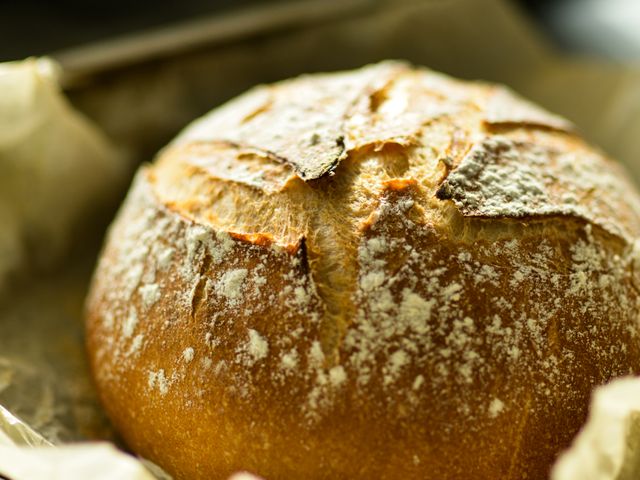
- Reduce oven temperature to 450°F (232°C) and continue baking uncovered for 12–14 minutes, until the loaf is deep golden-brown all over, with a shiny, papery crust that crackles slightly when tapped.
- The batard should sound hollow when you tap the bottom.
- If using an instant-read thermometer, the internal crumb temperature should reach 205–210°F (96–99°C).
+ Show details− Hide details
Ready when: Crust is deep mahogany to dark golden, hollow-sounding, internal temp 205–210°F (96–99°C)
Tip: Start checking at 12 minutes; overbaking dries the crumb, but underbaking leaves a gummy center
Cool completely
- Transfer the batard to a wire rack using tongs or a bench scraper (the parchment will pull away easily).
- Let the loaf cool at room temperature for at least 1 hour before slicing—ideally 2 hours.
- During cooling, the interior finishes setting and the flavor stabilizes.
- Do not slice too early or the crumb will be gummy.
+ Show details− Hide details
Ready when: Loaf is no longer steaming and feels firm when gently squeezed at the sides
Tip: Slice with a serrated bread knife using a gentle sawing motion to avoid compressing the crumb
Slice and serve
- Using a serrated bread knife, slice the cooled batard with light, sawing strokes—do not press down hard.
- The bread should yield cleanly with visible irregular air holes in the crumb.
- Serve warm or at room temperature.
- A thin slice of this loaf makes excellent toast, and leftover slices are perfect for soups or sandwiches.
+ Show details− Hide details
Ready when: Slices are clean and crumb is open, moist, and not gummy
Tip: Store uneaten slices in a paper bag at room temperature for best crust retention
Good to know
Tips
- For deeper sour flavor, extend bulk fermentation to 5–6 hours at room temperature before the cold rest, or cold-ferment for the full 48 hours
- Use a banneton that supports the dough's shape; a 7–8 inch oblong banneton will shape your batard beautifully
- Feed your starter at least 4–6 hours before mixing; an overfed or partially collapsed starter will not have enough oomph to leaven the dough
- The batard's elegant oval shape requires gentle handling—never press or squeeze the cold dough during shaping, or you will deflate it
Make ahead
Prepare the dough through the cold ferment up to 48 hours ahead. The dough can be baked directly from the refrigerator—increase final covered bake time by 2–3 minutes if baking from fully cold. Alternatively, remove from the fridge 1 hour before baking to allow slight room-temperature proof before scoring (optional, but yields even better oven spring).
Storage & reheating
Room temperature (70°F / 21°C) in a paper bag: 2–3 days (crust softens over time). For longer storage, wrap cooled loaf in plastic and refrigerate up to 5 days, or freeze whole or sliced up to 3 months. To refresh a day-old loaf, wrap in foil and warm at 350°F (175°C) for 10 minutes. Sliced frozen bread toasts directly from the freezer.
Substitutions
- bread flour → all-purpose flour (protein ~11–12%). Batard will have slightly less extensibility and a tighter crumb; reduce water to 215ml to compensate for lower gluten development
- extra virgin olive oil → neutral oil (sunflower, canola, or grapeseed). Loaf will have a subtler flavor, but crumb texture and shelf life remain excellent
- filtered or tap water, lukewarm → filtered water with 1% salt (by weight) added separately if preferred. This method yields the same result; simply dissolve salt in water before mixing
More sourdough
See all →


Find more like this
- Meal
- Breakfast
- Method
- Oven
- Quick & Easy
- 5 Ingredients or Less